

U.S. Senate Briefing on Iran: Bipartisan Calls for a Democratic Republic Amidst Regional Crisis
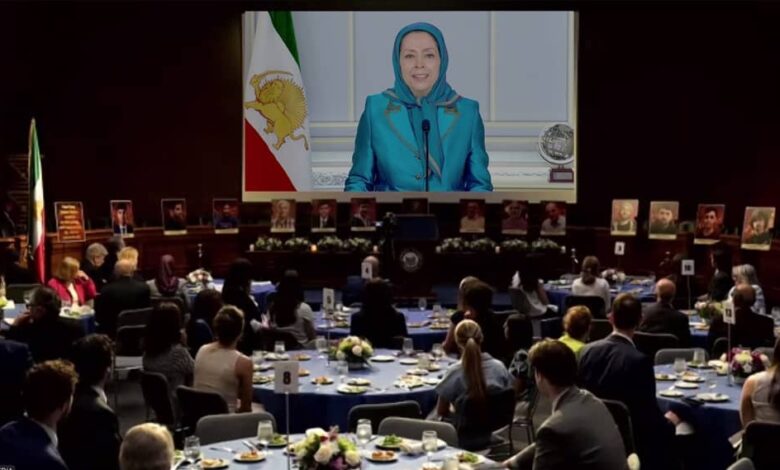
NCRI President-elect Mrs. Maryam Rajavi addresses a U.S. Senate briefing in Washington, D.C., via live broadcast on April 16, 2026
Written by
Shamsi Saadati
WASHINGTON, D.C. — On April 16, 2026, a bipartisan coalition of U.S. Senators and former high-ranking diplomats convened for a high-stakes briefing titled “Iran: Towards Peace and Freedom.” Against a backdrop of portraits of recently executed members of the People’s Mojahedin Organization of Iran (PMOI/MEK) as well as other protesters, the speakers reached a rare consensus: neither foreign war nor continued appeasement can solve the Iranian crisis. Instead, they called for the recognition of the Iranian people’s right to overthrow the current theocracy and established the National Council of Resistance of Iran (NCRI) as the viable democratic alternative to both the current regime and the former monarchy.
In a keynote address, Mrs. Maryam Rajavi, President-elect of the NCRI, asserted that “the solution to the crisis in Iran lies in its people, in their courage, and in their organized resistance.” She argued that after 47 years of failed policies—including appeasement, negotiations, and war—the international community must recognize that the regime “will neither revise its policy of repression nor abandon its efforts to obtain a nuclear weapon.”
Mrs. Rajavi emphasized that the most important missing element in Western policy has been a “failure to recognize the role of the Iranian people and their organized resistance in bringing about change.” She urged global lawmakers to focus their support on the “Resistance Units that stand on the front lines of the struggle for freedom” inside the country.
Crucially, Mrs. Rajavi defined the political identity of the movement by rejecting all forms of dictatorship, stating: “I must emphasize that the people of Iran do not want to return to the dictatorship of the Shah.” She challenged the regime’s claims of popular support, suggesting that if they truly had followers, they should “accept a free election under United Nations supervision and based on the principle of popular sovereignty, not clerical rule.”
As a roadmap for a post-mullah Iran, Mrs. Rajavi presented the “Ten-Point Plan” as a plan for stability and peace. This vision outlines a future defined by “free elections, gender equality with participation of women in political leadership, the separation of religion and state, recognition of the rights of oppressed ethnic groups, a non-nuclear policy, and peaceful coexistence.” She concluded by stating that the NCRI offers a credible framework for a peaceful transition, aiming to hold free elections within six months of the regime’s fall to “hand over the power to the elected representatives of the people.”
This is a critical moment, not only in Iran’s history, but also in the history of the Middle East and the world.
I call on all of you to support the Iranian people and Resistance, and their effort to bring about regime change.#FreeIran10PointPlanhttps://t.co/Ep3Bn6niI7 pic.twitter.com/0KYvVxpEOT— Maryam Rajavi (@Maryam_Rajavi) April 16, 2026
Marc Ginsberg, former U.S. Ambassador to Marocco, opened the briefing by affirming his “unyielding commitment for decades to a free democratic Iran,” a passion driven by the personal losses his family has endured due to Iranian state-sponsored terror. Serving as the moderator, he was unequivocal about the political evolution of the Iranian people, stating firmly that they “are not interested in a monarchy” and have no desire for a “pretender to the throne who has sat in Los Angeles sunning himself” while the domestic resistance and diaspora have sacrificed everything.
Amb. Ginsberg highlighted the strength of the “internal compatriots of the MEK” and the broader domestic movement, describing Maryam Rajavi as the “future Iron Lady of Iran.” He noted that the principles found in her “Ten-Point Plan“—including the separation of religion and state and gender equality—are so aligned with universal democratic ideals as a modern Declaration of Independence.
In terms of U.S. policy, Amb. Ginsberg called for a “new Iran Freedom Act” to replace the failed approach of seeking a “grand bargain” with the mullahs. He urged the administration to grant formal “recognition of a provisional government” and provide the necessary “communications and intelligence support” to those fighting on the ground. He concluded by honoring the martyrs whose portraits were displayed, asserting that the regime’s brutality only proves it “fears its own people more than it fears an external enemy.”
Senator Thom Tillis, co-chair of the bipartisan Senate Human Rights Caucus, delivered an urgent address centered on the necessity of a long-term, legally binding U.S. commitment to Iranian liberty. Standing before the portraits of activists, Tillis expressed his long-standing hope, stating, “someday I hope we’re doing this in Tehran.” He argued that the current geopolitical climate offers a unique opportunity to force “real meaningful and lasting change,” moving beyond mere containment of the regime.
Senator Tillis emphasized that while the international community must address the “threat of nuclear weapons that the mullahs represent,” it is equally critical to ensure Iran is placed on a definitive “path to freedom.” He urged the Iranian people to look toward the “family of democratic nations”—including the U.S., which he noted has a 250-year history of proving that democracy and free speech work.
Senator Tillis called for a shift in strategy where “whatever agreement comes out of these discussions… be an agreement that’s ratified by Congress so that it transcends administrations.” By codifying support for a democratic Iran, Senator Tillis said he believes the U.S. can finally provide the stable framework needed to replace the current “theo-fascist” rule with a system based on popular sovereignty.
Thank you to all who attended our U.S. Senate Briefing today.
Iran’s future should NOT be decided by recycled claims of destiny or nostalgia.
The future of Iran should be decided by the people and the organized resistance! pic.twitter.com/r23b8I6dFA
— OIAC: Organization of Iranian American Communities (@OrgIAC) April 16, 2026
Senator Cory Booker delivered a poignant address, acknowledging the profound sacrifice of those who have given their “last full measure” for a cause that has been dear to his own family for generations. Senator Booker rejected the notion that the desire for self-determination is a Western export, asserting instead that the struggle for a democratic Iran is a global moral imperative. “All people deserve liberty, all people deserve justice,” he stated, emphasizing that these are universal human rights, not merely American ideals.
Throughout his remarks, Senator Booker stressed that solidarity with the Iranian people must be matched by serious political engagement in Washington. He praised what he called the “quiet patriotism” of those fighting for freedom, both in the United States and in Iran, concluding with a firm declaration of solidarity: “The people of Iran will be free.” His remarks centered on the idea that no amount of repression can ultimately extinguish the inherent human drive for freedom.
Senator @CoryBooker spoke at our U.S. Senate Briefing.
Senator Booker is right. This isn’t a partisan issue…. It’s a right vs. wrong issue.
The Iranian people have been fighting this tyrannical regime for decades, and it’s time we put our full support behind them!#FreeIran… pic.twitter.com/0hObPYJ633
— OIAC: Organization of Iranian American Communities (@OrgIAC) April 16, 2026
Former Senator Roy Blunt, a veteran supporter of the Iranian Resistance throughout his career in both the House and Senate, emphasized the strategic consistency and preparedness of the movement. He noted that the “Ten-Point Plan” has served as a stable roadmap for “two decades,” providing a transparent and principled vision for a democratic future. Senator Blunt argued that this long-standing commitment proves the NCRI is a mature governing body ready to lead a transition, rather than a reactionary force.
He delivered a sharp critique of international diplomacy, stating firmly, “there should be no guarantees in any agreement with the regime that we in any way will stand by and affirm the regime.” For Blunt, the immediate priority of any global policy must be to “stop the executions now” and halt the state’s violence against protesters.
Praising the “consistent effort” of the Resistance, he highlighted the NCRI’s proposed structure for an “interim government” designed to ensure stability while moving rapidly toward “democratic free and fair elections.” Senator Blunt concluded by urging the U.S. to recognize the momentum gained by those “attacking the regime internally,” asserting that the international community must support the organized forces capable of delivering a republic based on the will of the people.
Senator @RoyBlunt spoke at our U.S. Senate Briefing.
Senator Blunt honored those who have been mercilessly executed by this regime, while also pointing attention to @Maryam_Rajavi’s 10 point plan, which lays the transition framework that allows Iran to hold a free and democratic… pic.twitter.com/bpnTr3IO1O
— OIAC: Organization of Iranian American Communities (@OrgIAC) April 16, 2026
Carla Sands, former U.S. Ambassador to Denmark, delivered a forceful argument that the Iranian crisis must be resolved from within, stating, “The Iranian crisis cannot be solved from outside. It must be resolved from within. This is not an abstract conclusion, it’s a strategic fact.” She dismissed the traditional options of appeasement and war, noting that while military force may weaken the regime, it cannot build democratic institutions or produce legitimacy. Amb. Sands asserted that the regime is at its weakest point since 1979, but has become more repressive because “it fears its own population more than any foreign bombs.”
A central theme of her remarks was the leadership of Iranian women, whom she described as the “core” force shaping and sustaining the organized resistance. Amb. Sands was unequivocal in rejecting a return to the monarchy, declaring that “Iran’s future will not be shaped by relics of the past.” Instead, she urged the United States to recognize the National Council of Resistance of Iran (NCRI) and its provisional government. She specifically lauded Mrs. Rajavi’s “Jeffersonian 10-point platform” as the only viable path to a secular, democratic, and non-nuclear republic. Amb. Sands concluded by calling for an end to the “decades of misinformation and marginalization” of the movement, insisting that the time for choosing sides is now.
I’m proud to stand alongside Ambassador @SamuelBrownback with the patriotic resistance of Iran and mourn the loss of young Iranians like champion wrestler Saleh Mohammadi. @iran_policy @NCRIUS pic.twitter.com/TWkxeKsgtj
— Carla Sands (@CarlaHSands) April 16, 2026
Ambassador Sam Brownback, former Governor and Senator from Kansas, delivered a high-energy address, framing the current struggle within a historic context of five decades of resistance. Utilizing a football metaphor to describe the proximity of success, he asserted, “We are in the red zone now… We are close to winning. We can win this. This is the time.” He urged the international community to push harder, stating that the regime is an “extremely, extremely dangerous situation” that must be removed rather than managed.
Amb. Brownback strongly endorsed the NCRI, describing it as a movement willing to keep fighting when others retreat. He credited the organization with maintaining pressure on the Iranian regime for 50 years and said that, at this stage, successful opposition depends not on appearances or reputation, but on endurance and resolve.
Former Senator and longtime supporter @SamuelBrownback spoke at our Senate Briefing.
Amb. Brownback outlined ways that we can support the Iranian people in overthrowing this regime once and for all.#Iran #FreeIran #IranWar pic.twitter.com/HXAuy94GKP
— OIAC: Organization of Iranian American Communities (@OrgIAC) April 16, 2026
Highlighting the unique role of the MEK as the force with “boots on the ground,” Amb. Brownback concluded by urging the U.S. to “seize this moment that has been pushed for and sought after and desired for 50 years.” He warned that failing to act now would lead to a far worse global outcome.