
Reza Pahlavi Glorifies the Legacy of Repression, Corruption, and Despotism
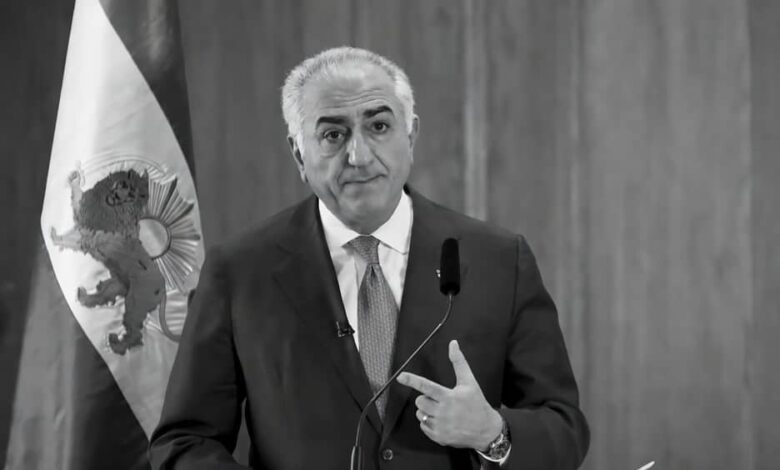
Reza Pahlavi, the son of Iran’s ousted monarchial dictator, speaking at the Swedish Parliament (Riksdag) in Stockholm, Sweden. April 13, 2026
Written by
Farid Mahoutchi
A claim to democracy becomes especially hollow when the person making it not only refuses to condemn the crimes of a dictatorship but openly takes pride in them. For years, Reza Pahlavi, the son of former dictator, has tried to present himself as a democrat, and a modern political figure. But his remarks in Sweden on April 12 and 13, 2026 stripped away that carefully cultivated image. He did not merely evade accountability for the record of his father and grandfather. He declared that he was proud of their legacy and supported their actions. In doing so, he made unmistakably clear that behind his democratic rhetoric lies the same old admiration for hereditary power, political repression, and rule from above.
At his April 13, 2026, press conference in Stockholm, Reza Pahlavi was asked whether his father had ever done anything he disagreed with. Rather than confront the substance of the question, he dismissed it as an obsession with events that happened decades ago. He said he was proud of his family name, proud of his background and heritage, and proud of the legacy he represents. One day earlier, in an interview on the Swedish state television program Agenda, he was even more explicit: “Regarding my family background, I am proud of my heritage and I support their actions.”
These were not slips of the tongue or merely emotional remarks in defense of family. They were clear political statements. Anyone who claims to believe in democracy, while being tied by blood to a legacy of dictatorship, has a basic moral obligation to draw a clear line between himself and that record. Democracy without historical accountability, without condemning torture, repression, corruption, and the destruction of political freedom, is nothing more than a branding exercise.
Who Is “Reza the Bully”, and Why Does Reza Pahlavi Seek Credit from Him?https://t.co/Mo0xpuK0LF
— NCRI-FAC (@iran_policy) April 28, 2023
To understand the meaning of his defense, one must look directly at the legacy he praises.
The Pahlavi monarchy was not born out of popular will or democratic development. It emerged from the 1921 coup, carried out in a context of decisive British influence. Reza Khan, later Reza Shah, was not the product of constitutional rule or public consent. He rose through the Cossack Brigade, a force deeply implicated in the suppression of Iran’s constitutional movement and in crushing the aspirations of freedom-seeking Iranians. Backed by British power, especially General Edmund Ironside, Reza Khan marched on Tehran, seized control, became prime minister, and in 1925 forced parliament to depose the Qajars and crown him Shah. From the beginning, then, Pahlavi rule was not the continuation of Iran’s democratic aspirations, but the destruction of one of the country’s earliest modern experiments in constitutional government.
Reza Shah was not simply an authoritarian ruler. He embodied the violent concentration of power, plunder, and the systematic elimination of independent voices. He forcibly seized tens of thousands of properties and turned himself into one of the wealthiest corrupt rulers of his era. Journalists, poets, intellectuals, and political dissidents were imprisoned, silenced, or murdered. What is sometimes called “modernization” under Reza Shah was, in practice, modernization at bayonet-point: compulsory unveiling, coercive social engineering, and the destruction of political pluralism. He did not modernize Iran by expanding freedom; he imposed state control while crushing independent thinkers, democratic forces, and economic autonomy.
His dependence on foreign power was no less central to his rule. Reza Shah rose with British backing, and when his closeness to Nazi Germany became inconvenient during the Second World War, the same foreign powers forced him to abdicate. His downfall exposed the truth about his legitimacy: it rested not on the people of Iran, but on the favor of outside powers.
Ambassador @LBJunior slams Reza Pahlavi and Iranian monarchists for treacherous strategies and their rooting for engagement with the #IRGCterrorists on "The Untold Story" podcast.#FreeIran2024 pic.twitter.com/HOe3ZTaARM
— NCRI-FAC (@iran_policy) June 22, 2024
The record of Mohammad Reza Pahlavi was, if anything, even darker. He ascended the throne in 1941 after the Allied occupation of Iran, and in 1953 consolidated his rule after the coup against the democratically elected Prime Minister Dr. Mohammad Mossadeq. That coup, backed by foreign powers and supported by reactionary domestic forces, destroyed a democratic opening and entrenched royal dictatorship. What followed was not democratic development, but the consolidation of a police state.
The Shah’s intelligence apparatus, SAVAK, became one of the central instruments of terror and political domination. According to the Amnesty International reports cited in the material above, arbitrary arrest, prolonged detention without meaningful legal safeguards, incommunicado imprisonment, systematic torture, forced confessions, executions, and deaths under torture were all defining features of the Shah’s system. The torture methods documented in these reports—whippings, electric shocks, the extraction of nails and teeth, burns, sexual abuse, and rape—were not the excesses of a few rogue agents. They reflected the underlying logic of the regime itself: rule through fear. When Amnesty concluded that torture “invariably” occurred between arrest and trial, especially in political cases, this was not evidence of isolated abuse. It was evidence of the nature of the system.
Mohammad Reza Shah was also open in his contempt for democracy. He mocked the very language of freedom and democratic rule. In 1975 he imposed the one-party Rastakhiz system and made loyalty to the regime a condition of political life. His message was blunt: anyone unwilling to join should either go to prison or leave the country. That was not a policy error. It was a declaration of war on pluralism, opposition, and the right of citizens to organize independently of the state.
#Iran News: State-Run Newspaper Says Reza Pahlavi and Monarchists Have Served Clerical Regimehttps://t.co/iey2VpMKXU
— NCRI-FAC (@iran_policy) April 8, 2025
At the same time, the monarchy was marked by entrenched corruption and extreme social inequality. While U.S. media reported on the enormous hidden wealth of the Pahlavi Foundation and the vast assets accumulated by the royal family, much of Iran’s population remained poor, undereducated, and excluded from basic opportunities. This contradiction—lavish elite wealth alongside widespread deprivation—helped generate the social anger that exploded in the late 1970s.
Even the image of the Shah as a progressive modernizer on women’s rights collapses under scrutiny. The statements attributed to him in interviews with Barbara Walters and Oriana Fallaci reveal deeply reactionary and misogynistic views. He questioned women’s equality with men, reduced their worth to beauty and femininity, and dismissed women’s historical and intellectual achievements. That record makes it impossible to honestly present the Pahlavi monarchy as a genuine vehicle of women’s liberation without grotesquely distorting reality.
Seen in that light, Reza Pahlavi’s recent remarks are politically decisive. The issue is no longer that he has long avoided direct moral judgment on his father’s and grandfather’s crimes. The issue is that he has now made his position explicit. He did not say that, despite some reforms, their reigns were stained by dictatorship, torture, corruption, and the crushing of democratic forces. He did not say that one-party rule, political murder, and systematic repression are indefensible. He did not say that land theft, secret police terror, and the silencing of dissidents were disgraceful crimes. On the contrary, he said he was proud of that heritage and supported their actions.
In an assessment, Col. Wesley Martin, former Senior Antiterrorism Officer for all Coalition Force – Iraq, portrays Reza Pahlavi’s Iran Prosperity Project (IPP) as an authoritarian scheme wrapped in the language of #democratic change.https://t.co/7YeC1vSGCq
— NCRI-FAC (@iran_policy) March 22, 2026
That is where his claim to democracy collapses.
Democracy is not merely the language one uses while out of power. It is not enough to speak of elections, rights, and freedom in the abstract. Democracy means accepting that no family name, no dynasty, and no inherited political legacy stands above the rights of the people. It means condemning torture without qualification. It means rejecting one-party rule, defending the rights of opponents, and recognizing that economic development without freedom is simply another form of despotism. A man who glorifies a dynasty with such a record is telling the public that his objection is not to authoritarianism itself, but only to the authoritarianism of his rivals.
That is exactly what the interviews of April 12 and 13, 2026 revealed. Reza Pahlavi is not the bearer of a democratic break with the past. He is the defender of the political rehabilitation of that past. He seeks to strip the monarchy’s history of its prisons, torture chambers, corruption, foreign dependence, and repression, and repackage it as nostalgia, order, and “progress.” But history cannot be cleansed by public relations. The legacy he praises is not a legacy of freedom. It is a legacy of domination.
For that reason, the problem is not simply that Reza Pahlavi is not a democrat. The deeper problem is that his own words have now exposed how hollow his democratic claims always were. A man who takes pride in hereditary despotism offers no credible guarantee of liberty. If anything, he represents the danger of restoring the same logic of rule that devastated Iran before: power without accountability, government without historical memory, and politics grounded not in the rights of citizens, but in the prestige of a family name.