
Unmasking the Role of Ex-MEK Members in Tehran’s “Demonization Machine”
Written by
Mohammad Sadat Khansari
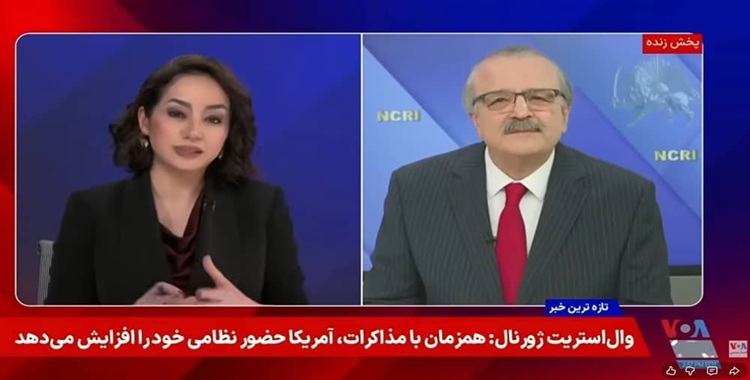
In an interview aired on April 11, 2026, on Voice of America’s Persian-language program Omgheh Meydan, Fahimeh Khezrheidari interviewed Mohammad Mohaddessin, Chairman of the Foreign Affairs Committee of the National Council of Resistance of Iran (NCRI). The televised exchange highlighted a key front in the conflict between the Iranian regime and its organized opposition. During the interview, Mohaddessin was asked about allegations of mistreatment raised by former members, a narrative often used to challenge the movement’s internal legitimacy.
In response, Mr. Mohaddessin rejected the allegations and said they form part of a broader campaign of demonization and disinformation orchestrated by the Iranian regime, stating:
“This narrative you are referring to is a very familiar one. The MEK is, in fact, the exact opposite of what others try to portray, and at the core of this propaganda is the regime itself. The regime produces hundreds of books, hundreds of films, and tens of thousands of articles, both in domestic media and in foreign outlets where it has influence, in order to present a frightening image of the MEK through what can only be described as a demonization machine. The reason is clear: it wants to prevent young people from joining the MEK, precisely because it is terrified of that possibility. This is a well-known practice of the regime.
“But as far as the MEK is concerned, the reality is completely the opposite of what the regime tries to promote, or what others, under the regime’s influence or for other reasons, may imagine. Joining the MEK is difficult, while leaving it is very easy. Anyone who wants to join must make a serious decision. They must be willing to pay a price, give up their ordinary life, accept the possibility of martyrdom, and understand that they could be assassinated at any moment or killed in confrontation with the regime. So yes, entering the MEK is difficult. But if anyone wishes to leave, on any day, the doors of the organization are open.”
One of the main goals of the Iranian regime's four-decade demonization campaign against the #MEK has been to spread the narrative that the MEK is a fringe group, a cult with no popular base inside Iran.#IranRevolution pic.twitter.com/TrV6YhGBBQ
— NCRI-FAC (@iran_policy) February 9, 2023
In fact, many people have left the MEK and are now living their lives. They continue to support us, work, and even contribute financially to us. Those whom you are referring to, the people making these accusations, are only a small number of individuals. They are well known, and the facts about them are also very clear. Let me mention two documents here for you. The security services of the Netherlands and Germany, two countries where many such individuals—those who attack the MEK under the title of “former members”—are active, have both written reports on this matter.
Let me read one sentence from the annual report of the Dutch security service: the Dutch security service has found that the Iranian government is continuously active in its campaign against the MEK, and it has been observed that the Ministry of Intelligence directs a European network that is also active in the Netherlands. Members of this network are former members of the MEK who have been recruited by the Ministry of Intelligence.
All of these claims and issues that have been raised so frequently are products of the Ministry of Intelligence. Pay attention to one more point: recently, they have set up a court in Tehran for 104 members of the MEK, including myself, ranging from our leadership to ordinary members. For the past two years, this court has been convening every Tuesday in Tehran. In this court, some of these same individuals—some of those who present themselves as former members of the MEK and recount those strange and dramatic stories—are testifying against us. These are not healthy individuals.
Watch and judge how an #Iranian state official reveals his fear of the MEK #ResistanceUnits in the midst of #IranRevoIution pic.twitter.com/ludxvDwmSl
— NCRI-FAC (@iran_policy) January 17, 2023
Under agencies’ radar
This defense is anchored in more than just political rhetoric; it finds a persistent echo in the classified files of European security services. For years, the intelligence agencies of the Netherlands (AIVD) and Germany (BfV) have documented a specific pattern of behavior by the Iranian state. Their reports describe a network of “former members” recruited by the MOIS to serve as the vanguard of a European-based disinformation campaign.
AIVD 2012 Annual Report (page 37):
The AIVD has observed that the Iranian government remains “undiminished in its struggle against the opposition movement Mujahedin-e-Khalq (MEK).” Investigations have shown that the Iranian intelligence service directs a European network that is also active in the Netherlands. This network “consists of former MEK members who have been recruited by the Iranian intelligence service.” They have been “given the task of negatively influencing public opinion about the MEK by means of lobbying, publications and anti-MEK meetings.” Additionally, they “collect information for the Iranian intelligence service about the MEK and its (suspected) members.”
The Federal Office for the Protection of the Constitution has also consistently identified the PMOI and NCRI as the main targets of Iranian espionage. Their reports state that the MOIS “recruits former members” to act as tools for propaganda and to influence public opinion in the West.
The objective is simple: to paint the resistance as a “cult” so toxic that Western governments, MPs and media will find it politically impossible to treat them as a viable democratic alternative.
Iran Revives a 104-Defendant Show Trial as January Uprising Still Haunts the Regime https://t.co/6kBwagPeb4
— M. S. Khansari (@khansari_m) February 9, 2026
From elimination to dehumanization
To understand why Tehran invests so heavily in this “former member” project, one must look back to the early 1990s. After the 1988 massacre of political prisoners failed to break the back of the resistance, and after a string of overseas assassinations led to diplomatic isolation, the clerical regime reached a strategic epiphany. They realized that physical elimination often created martyrs and social capital for the Resistance. Under the guidance of figures like former Intelligence Minister Ali Fallahian, the strategy shifted toward “soft war.”
The mechanics of this shift are as effective as they are cynical. When members leave the Resistance, the vast majority transition into private life, often continuing to support the movement financially or through advocacy. However, a small, targeted group becomes the focus of MOIS “reclamation.” Through a combination of threats against family members remaining in Iran, the freezing of property, and the promise of material incentives or “embassy facilities” in Europe, the regime secures testimonies that are then shopped to international media and human rights groups.
Iran Revives a 104-Defendant Show Trial as January Uprising Still Haunts the Regime https://t.co/6kBwagPeb4
— M. S. Khansari (@khansari_m) February 9, 2026
Behind the legal battles
The danger of taking these testimonies at face value was perhaps best illustrated by the landmark legal battles in France following the 2003 raid on the NCRI’s headquarters in Auvers-sur-Oise. At the time, French authorities relied on “tens of thousands” of documents and the word of several “ex-members” to justify a massive anti-terror operation. Yet, after a decade of forensic legal scrutiny, the case collapsed. French courts found the testimonies to be inconsistent and politically motivated, ultimately clearing the NCRI of all charges and forcing the government to pay compensation.
Today, this shadow war has moved back into the courtroom, but this time in Tehran. The regime is currently conducting a high-profile trial in absentia of 104 resistance leaders, including Mohaddessin himself. The primary witnesses for the prosecution? The same “former members” who appear on Western television screens. By using these individuals to provide a veneer of “first-hand” evidence, the regime seeks to build a legal foundation for future extradition requests and to justify its ongoing domestic crackdown.
Mike Pompeo: "The MEK has been the target of terror abroad and the subject of massive demonization campaigns by the regime.
"But now, I think we all know the truth. You all are freedom fighters of the highest order."#NCRIAlternative #FreeIran2025 pic.twitter.com/RtXE0zX1Wn— NCRI-FAC (@iran_policy) January 9, 2025
The Industrial Scale of Character Assassination
The sheer volume of the Iranian regime’s anti-opposition propaganda reveals a state-level obsession that goes far beyond the “personal grievance” narrative. Since the 1990s, the Ministry of Intelligence (MOIS) and the Islamic Revolutionary Guard Corps (IRGC) have financed an industrial-scale “demonization machine.” Conservative estimates and internal leaks suggest that the regime has produced over 700 books, 500 documentaries, and dozens of high-budget cinematic films and television series specifically targeting the PMOI.
This is supplemented by tens of thousands of articles and coordinated social media campaigns generated by “cyber-armies.” Notable examples include big-budget productions like The Enigma of the Shah and Midday Adventures (Majera-ye Nimrouz), which utilize sophisticated cinematic techniques to rewrite history. This massive expenditure of state resources is not merely for domestic consumption; it is a strategic investment designed to saturate the global information space, ensuring that any objective search for information on the Iranian Resistance is met with a wall of state-curated “disinformation.”
Debunking propaganda against People’s Mojahedin Organization of Iran (PMOI/MEK)
Follow the Money
For political observers, the challenge lies in distinguishing between genuine dissent and state-sponsored deception. In the world of Iranian geopolitics, the “former member” is often less a person and more a weapon—a tool designed to ensure that the only alternative to the current theocracy is a landscape of confusion and doubt.
To decode this phenomenon, one must apply the psychological and economic axiom that time and energy are currency. In any political struggle, it is logical for a citizen to spend resources fighting a ruling establishment that affects their life. However, when an individual or entity dedicates an extraordinary amount of time, money, and energy—often for years on end—to attack not the regime in power, but rather the only organized entity opposing it, the “Golden Rule” of intelligence must be applied.
Instead of focusing on the name of the author, the face of the film producer, or the “former member” speaking at a podium, the analytical lens must shift toward the logistical infrastructure supporting them. One must follow the trail to the publisher, the funder, and the sponsor. The true source of the narrative is rarely the speaker; it is the silent hand issuing the visas, arranging the high-stakes interviews, and facilitating the expensive international conferences. When the resources of a private “critic” match the logistical capabilities of a state intelligence service, the “dissent” is no longer a personal opinion—it is a paid operation.