
British Parliamentarians and Activists Urge Recognition of NCRI Provisional Government
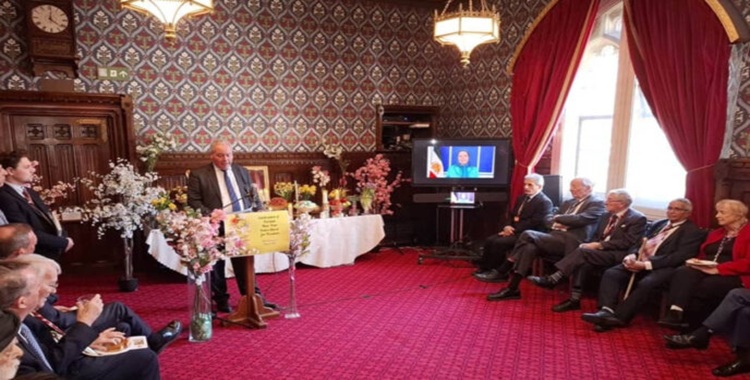
MP Bob Blackman addresses a meeting at the U.K. Parliament on March 26, 2026
Written by
Shamsi Saadati
On March 26, 2026, British lawmakers, legal experts, and human rights advocates gathered at Westminster to mark the Persian New Year, calling for a fundamental shift in United Kingdom policy toward the Iranian regime. Speakers at the event emphasized support for a democratic transition led by the Iranian people and their organized resistance, specifically referencing the National Council of Resistance of Iran (NCRI). The assembly largely advocated for the proscription of the Islamic Revolutionary Guard Corps (IRGC) as a terrorist entity and expressed support for Maryam Rajavi’s Ten-Point Plan for a future secular republic. Participants consistently rejected both the current theocratic dictatorship and any restoration of the monarchy, framing the movement as a struggle for sovereignty and human rights.
Conference at the UK Parliament in support of the NCRI’s Provisional Government-
I sincerely hope that, at this critical juncture, you will consider implementing extraordinary measures in support of the Iranian people’s struggle. I respectfully urge that the United Kingdom:… pic.twitter.com/p87SY9qP3X— Maryam Rajavi (@Maryam_Rajavi) March 26, 2026
Dr. Liam Fox MP stated that the “moral right to determine who governs Iran” belongs exclusively to the Iranian people. He criticized consecutive British governments for failing to proscribe the IRGC, describing the decision as “unconscionable.” Dr. Fox argued that the current regime is “kept in office by terror and brutality” and lacks any popular support, noting that “this is a revolution to young people in Iran of their grandparents or even great-grandparents.” He asserted that a successful transition requires the forces of opposition to be “united around the sound principles that have been set out in the Ten-Point Plan.” He concluded that while the night for the Iranian people is not yet over, the “first cracks of dawn are coming,” and urged the UK to deal with “sleepers, agents, and apologists” within its own borders.
Lord Bruce of Bennachie praised the “grit, determination and total tenacity” of the Iranian resistance, comparing their persistence to the historical movements that ended Soviet rule in Poland and apartheid in South Africa. He emphasized that the struggle for a free Iran remains a global priority, noting that “your fight is our fight… if you win, we win.” Regarding security, he questioned how the United Kingdom could maintain diplomatic engagement with a regime that is “advertising on social media for British citizens to become agents of Tehran here and perpetrate acts of terrorism within the United Kingdom.” He concluded by calling for a firm policy that prioritizes the “door for democracy and freedom in Iran” above all other diplomatic considerations.
With Liam Fox and others supporting the people of Iran on the festival of Nowruz. pic.twitter.com/d9ecWZWvzQ
— Robert Ward (@moguloilman) March 26, 2026
Lord Dholakia noted that “over 5,000 different parliamentarians in different parts of the world support the cause of NCRI.” He explicitly dismissed the possibility of a monarchical restoration, stating, “No longer have we got to be impressed with the pronouncement that is made by Pahlavi regime in terms of control of power in Iran. They were responsible for this type of suppression that they suffered in earlier days and we no longer can allow that sort of situation to go again.” He emphasized that the “Ten-Point Plan Mrs. Rajavi set out very clearly makes it very clear of the type of society we should have on Iranian soil.” He praised the movement’s international reach and expressed his hope to one day celebrate Nowruz in a free Tehran marked by “freedom, justice and liberty.”
Lord Hamilton of Epsom discussed the geopolitical and economic pressures facing the Iranian regime, noting that “cracks are appearing” in the current regime. He emphasized the importance of international leverage, suggesting that establishing a “stranglehold on all the oil coming out of Iran” would place the international community in a “much stronger position when it comes to negotiating with the regime.” While acknowledging the difficult path toward change and the reality that “a lot of blood is going to be shed” by those seeking reform, he remained “convinced that eventually” such “awful regimes do eventually fall.” He urged the Iranian people to “keep up your wonderful resistance” and shared his optimism for a “prosperous and democratic new year in Iran” where democracy will eventually take over.
Lord McInnes of Kilwinning called for the immediate seizure of IRGC assets in London, suggesting they be “returned to the people of Iran when it is able to establish itself as a secular democracy.” He argued that the UK must “strip them [the Iranian regime] of their power and influence by banning any access they have in this country.” Furthermore, he encouraged the NCRI to “push ahead with all necessary steps to form a broad-based transitional set of arrangements to pave the way for fully supported, free, and democratic elections.” He emphasized that the Resistance has nothing to fear from transparency, stating, “if you want to have a free secular democracy, there is nothing to be afraid of.” He concluded that the Ten-Point Plan is the “crystal clear” roadmap for human rights and open democracy.
🔵 Conference in the UK Parliament in support of the provisional government of the National Council of Resistance of Iran
I hope that respected lawmakers in both houses of the Parliament of the United Kingdom will take extraordinary initiatives at this critical moment to support… pic.twitter.com/CPInI6Z4EQ
— Academics In Exile Association (@iranianacademic) March 26, 2026
Lord Singh of Wimbledon emphasized the Iranian people’s “rejection of all forms of dictatorship,” stating, “They reject the oppression of the mullahs, and they reject any return to the rule of the Shah.” He congratulated Mrs. Maryam Rajavi and the NCRI for “announcing a provisional government, an important and responsible step towards ensuring a democratic transition.” He welcomed the movement’s emphasis on the “complete equality of women,” noting that this value is deeply reflected in the work of the National Council. He asserted that “change in Iran will not come from outside forces, not from any deals with remnants of past regimes,” but remains the “responsibility and the right of the Iranian people and their organized resistance.”
Lord Hacking offered a message of historical perspective, drawing parallels between the Iranian Resistance and the “dark days” of the Second World War. He recalled the time when “the whole of Europe had become fascist” and the British government produced posters reading: “Stay calm, stay calm and carry on.” He delivered this as his primary message to the Iranian Resistance, encouraging them to maintain their resolve in the face of grim circumstances. He thanked the hosts for providing a platform for the Persian New Year and emphasized that “we are celebrating a new day,” signaling his belief that the current darkness in Iran will eventually give way to a democratic future.
Baroness Helena Kennedy KC spoke as a human rights lawyer, expressing her deep pain at seeing the “crushing of resolve” among Iranian activists. She noted her personal acquaintance with many “lawyers in Iran who have been imprisoned” and “women who were campaigning… for an Iran that would be democratic and in which people could live in equality.” While she voiced strong opposition to the “illegal” nature of recent military conflicts, stating she was “opposed to this damn war” due to the suffering of civilians, she reaffirmed her “solidarity with you” and her belief that “there is going to be that moment of transition.” She prayed that the transition would occur this year, allowing for the full “protection of human rights.”
With @sharrond62 and other supporting the people of Iran on the occasion of #Nowruz pic.twitter.com/sUAqiqFFIf
— Robert Ward (@moguloilman) March 26, 2026
Baroness Sharon Davies expressed her support for the Iranian people, wishing for a future defined by “freedom,” “democracy,” and a world where “women have a voice.” She criticized the regime for mismanaging the country’s “fantastic treasures under the floor,” stating that “all of that money is being used in the most destructive way possible which affects you but also affects the whole world.” She characterized the Iranian people as “incredible” and lamented that their history and achievements are “so not appreciated” under current conditions. She concluded by stating that a free and peaceful Iran “would bring peace to the world,” and expressed hope that the global community would soon be able to visit a liberated Iran.
Bob Blackman MP asserted that the “Shah and mullahs have been partners in the oppression of the Iranian people and must not be allowed to continue.” He stated that the Iranian people “firmly and unequivocally reject” the remnants of the former monarchy that seek to restore the previous regime through “TV propaganda and digital platforms.” Blackman highlighted the critical role of the “Resistance Units,” praising their bravery in leading “popular uprisings” and maintaining a “decades-long resistance against this brutal regime.” He further emphasized the organizational strength of the movement, referencing the “army of freedom” as the force capable of securing a democratic transition. He voiced support for the NCRI’s “provisional government for the transfer of sovereignty to the Iranian people,” grounded in the Ten-Point Plan, which he described as a vision for a “democratic, non-nuclear Republic in Iran, founded on gender equality, the rule of law, respect for ethnic nationalities and religious communities.” He concluded by urging the UK government to expel agents and “shut down the clerical regime’s embassy in London” to pave the way for a free Iran.
Jim Shannon MP emphasized his “full support for the quest for freedom” and his alignment with the “NCRI for the government in exile and for Madame Rajavi in particular for the Ten-Point Plan.” As the chair of the APPG for International Freedom of Religion or Belief, he highlighted the “persecution” and “violence” faced by religious minorities, including the Baha’i community. He expressed a desire for a day where “freedom to worship your God as you so wish to do” is guaranteed. He commended the “free voice of Iran” and assured the assembly that his colleagues in Parliament are committed to ensuring that democratic rights, including “the rights to jobs” and the “rights women and girls have,” are eventually realized in Iran.
Councilor Robert Ward addressed the presence of monarchist supporters, stating, “Anybody who thinks that returning the Shah… these people are nuts.” He recounted his personal experience in Iran prior to the revolution, remembering the “fear on the face” of citizens under the “regime of the Shah” and the “SAVAK.” He criticized the UK Foreign Office for failing to proscribe the IRGC, suggesting that “posh Oxford boys… thought that they were clever enough” to engage with such organizations. He called for the IRGC to be proscribed and for the Iranian embassy to be “reduced to a minimum rump so that we don’t have all these evil people… who mean us ill.” He expressed hope that by the end of 2026, the world would see a “free Iran.”
Councillor Matthew Goodwin, parliamentary assistant to Bob Blackman MP, shared that his visit to the NCRI conference in Paris provided an “eye-opening” perspective on the “terrorists that frankly run that despotic regime.” He voiced strong support for the current resistance over historical models of governance, contrasting the organized movement with those advocating for a return to the monarchy. He dismissed the viability of the Pahlavi regime, emphasizing that while some “shout for someone else to be in charge of Iran” or “want to go back to someone in the past,” the path to a democratic future requires a forward-looking approach. He concluded that “the only way to get that is Maryam Rajavi’s Ten-Point Plan,” which offers “freedom, fairness, and democracy,” and praised the “generations of wisdom and experience” found within the National Council of Resistance of Iran.
Azadeh Zabeti, co-president of the Committee of Anglo-Iranian Lawyers, called for the “recognition for the provisional government that was announced by Mrs. Maryam Rajavi” as an “absolutely paramount” step for the international community. She characterized the current system as a “theocratic regime, one that enforces misogyny and gender apartheid as state practice and law.” Zabeti dismissed the idea of a power vacuum, noting the strength of the “members and the supporters of the MEK” who are active on the ground. She urged the UK to “expel its terrorist diplomats” and close the “apologists and the agents and the charities” that do the regime’s bidding on British soil. She concluded with a call for the “overthrow of this barbaric and this savage regime.”
Leila Jazayeri, president of the Iranian Women’s Association, called for an end to the “appeasement policy” and requested “recognition of the Iranian people’s right to stand up to IRGC.” She argued that “years of appeasement did not create a moderate regime” and that change must be achieved “by Iranian people themselves and their organized resistance movement,” rather than foreign intervention. She stated that “the provisional government of the National Council of Resistance of Iran… need the recognition of this provisional government,” asserting that “everything is ready, they can take care of the regime.” She emphasized that the Resistance “only want recognition of the Iranian people’s right to stand up to IRGC… they don’t want money, they don’t want boots on the ground.”
Roza Zabeti, representing the Iranian youth community, described Nowruz as a “timeless hope for renewal and change” for those working for “dignity, justice, and human rights.” She expressed a vision for a future “where every person can live with freedom, equality, and respect, where voices are heard and where the rights of all people are protected.” She noted the personal sacrifice involved in the struggle, mentioning that she was “not able to call my family this year and get back home and contact them.”