
In Geneva Conference, NCRI Proposes Democratic Roadmap to End “Hereditary Religious Autocracy” in Iran
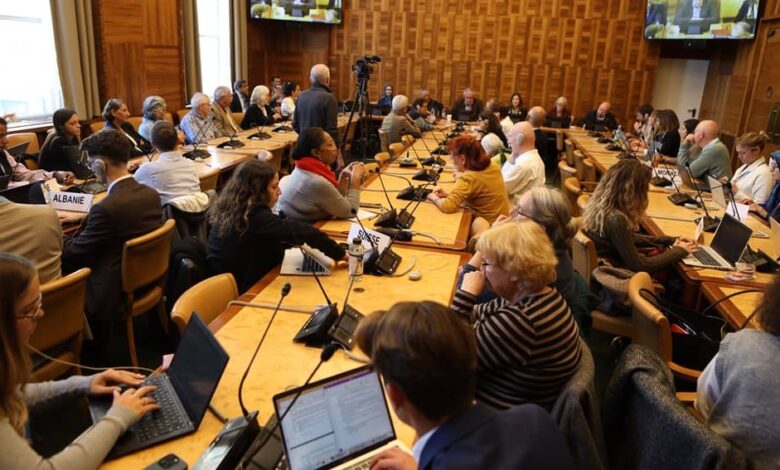
إFile photo: Conference in Geneva highlights human rights abuses and executions in Iran— September 30, 2025
Written by
Shamsi Saadati
On March 12, 2026, at the United Nations’ European Headquarters in Geneva, international human rights advocates and representatives of the Iranian Resistance convened to address the dire escalation of repression under Mojtaba Khamenei’s newly established hereditary rule. The conference underscored the strength of the Resistance Units and the National Council of Resistance of Iran’s (NCRI) Ten-Point Plan as the only legitimate path toward a secular republic, while forcefully rejecting the “fake opposition” seeking a return to monarchical dictatorship.
Mrs. Maryam Rajavi, President-elect of the NCRI, delivered a keynote address defining the current struggle as a “war between the people of Iran and their resistance on one side, and religious fascism on the other.” She warned that the succession of the younger Khamenei proves that “a viper cannot give birth to a dove,” noting that the Revolutionary Guards have officially authorized firing upon any protester. Mrs. Rajavi presented the Ten-Point Plan as the definitive alternative, emphasizing it is “a plan for the future of a free Iran, based on democracy and human rights,” which includes the separation of religion and state and the “autonomy of ethnic nationalities.” She challenged the international community’s history of silence, asserting, “By staying silent about the repression of freedoms in Iran, they gave the most significant concession to the regime. They allowed it to escape punishment for its crimes.” Underlining the NCRI’s long-standing legitimacy, Mrs. Rajavi stated that this alternative was “established 44 years ago based on the principle of No to Shah, No to the mullahs.”
Mrs. Rajavi concluded her remarks: “In this war, political prisoners are in the greatest danger. The clerical regime must be compelled to release them. The crimes of this regime should also be referred to the United Nations Security Council. The leaders of the regime must face justice through international mechanisms or by member states under the principle of universal jurisdiction.”
The main war is the war between the people of Iran and their resistance on one side, and religious fascism on the other. This struggle has continued for 44 years, since June 20, 1981.
The solution to this confrontation is the overthrow of this regime by the people and by an… pic.twitter.com/evcQWUYlL6— Maryam Rajavi (@Maryam_Rajavi) March 12, 2026
Struan Stevenson, former Member of the European Parliament and Co-chair of the In Search of Justice (ISJ) committee, condemned the regime’s shift into an “hereditary religious autocracy.” He noted that the younger Khamenei is synonymous with “the violent suppression of popular uprisings” and that the regime is now “weaker than it has been in decades.” Mr. Stevenson was particularly critical of the “fake opposition” surrounding the Shah’s son, Reza Pahlavi. Former MEP Stevenson remarked that Pahlavi’s reliance on IRGC commanders to maintain order is “like Winston Churchill saying ‘I will need the Gestapo to maintain peace after we get rid of Hitler.’” He insisted that the Iranian people will not trade one tyrant for another, stating, “After decades of sacrifice… the Iranian people will not accept another tyrant, whether cloaked in religious authority or dynastic privilege. Their message is clear: neither the Shah nor the Mullahs.” Mr. Stevenson concluded that the world must recognize the “right to resist tyranny” spearheaded by the courageous women and Resistance Units within Iran.
Fariba Mohammadi, representative of the Komala Party of Iranian Kurdistan, highlighted the disproportionate violence against ethnic minorities, noting that Kurdistan has said “no” to the regime since 1979. “Staying with the Islamic Republic means the survival of terrorism, the suppression of women, and the spread of misery,” Mrs. Mohammadi declared. She argued that the diverse fabric of Iranian society requires a “shared leadership” that allows “oppressed nations to reach their political sovereignty.” Fariba Mohammadi emphasized that the unity of the opposition, under the framework of a democratic republic, is the only way to ensure that “all ethnic and religious minorities… can feel that they also have equal rights.” She called for an alliance of all forces that seek the total destruction of the clerical apparatus in favor of a pluralistic future.
Erika Deuber Ziegler, a historian and former member of the Grand Council of Geneva, spoke as a “European voice” who witnessed the 1979 revolution’s betrayal. She dismissed the foreign-promoted narrative of a Pahlavi restoration as “totally impossible,” citing the “extraordinary cruelty” of both the past and present regimes. Madame Ziegler argued that the organized resistance is uniquely positioned to lead, stating, “I know the actors of the Iranian resistance… they are admirable, I should have said they are admirable because there is a majority of women among the leaders.” Mrs. Ziegler urged Western governments to stop accrediting the thesis of regime reform, asserting that the NCRI is “alone in the capacity today to offer an alternative to the chaotic situation.” She concluded by insisting that the motto “Ni Shah, ni molla” (Neither Shah nor Mullah) must be defended “at all costs” within European public opinion and consciousness.
Behzad Naziri, a member of the NCRI and former political prisoner, focused on the immediate danger facing organized activists. He noted that eighteen prisoners are currently under death sentences specifically for their “membership in the People’s Mojahedin Organization.” Mr. Naziri argued that the regime’s propaganda regarding the monarchy is a “cosmetic change” designed to replace the clerical secret police with a revival of the SAVAK. “The Iranian people did not give so much of a price for four decades to then give place to another form of monarchical dictatorship,” Mr. Naziri asserted. He described the Resistance Units as the functional engine of the uprising, noting that the international community must move beyond observation. Mr. Naziri stated, “The moment has come for the community of nations to recognize today the right to resistance of these Iranians who were massacred by thousands in January last.” He emphasized that the NCRI’s strength lies in its ability to maintain an organized, principled opposition that refuses to compromise with any form of dictatorship.
Iran: #HumanRights Conference at the UN’s European HQ in #Geneva
The leaders of the Iranian regime must face justice through international mechanisms
In the name of peace and freedom, I call on human rights defenders to support the solution of the Iranian people and resistance,… pic.twitter.com/kIwBhVzFGO— Maryam Rajavi (@Maryam_Rajavi) March 12, 2026
During the Q&A session, a question was raised regarding the moral high ground of Western powers following military strikes that damaged civilian infrastructure. Former MEP Stevenson responded by citing Mrs. Rajavi’s appeal to “avoid any action that puts the lives of innocent civilians in danger.” However, Mr. Stevenson clarified that the ultimate responsibility for the tragedy lies with the “tyrannical regime” that has executed over 100,000 people. He reiterated his rejection of Reza Pahlavi, describing him as a man who “pops up and says ‘I am the answer’” after living in luxury for 47 years while the Resistance fought on the ground. Mr. Stevenson concluded that the only acceptable solution is the complete removal of the regime by the people and their organized resistance.