
Mourning Turns to Uprising as Abdanan, Sharif University, and Cities Across Iran Explode in Defiance
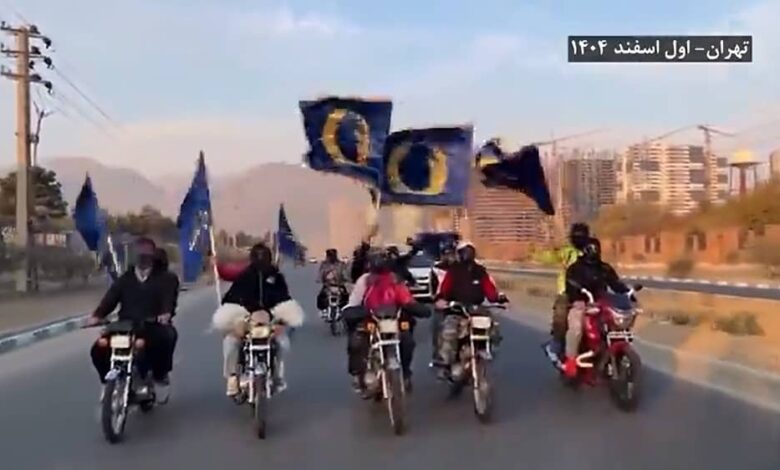
In Tehran, members of the PMOI-led Resistance Units were carrying the flag of the National Liberation Army of Iran— February 20, 2026
Written by
Mansoureh Galestan
Today, February 21, 2026, the streets across Iran have ignited once again as the traditional forty-day mourning period for those killed in the January uprising has transitioned from private grief into a massive, nationwide display of political defiance. Reports from the city of Abdanan in Ilam Province indicate a significant escalation following the arbitrary arrest of Yaghoub Mohammadi, a prominent teacher and union activist. Citizens who initially gathered in front of the regime’s intelligence headquarters quickly expanded their reach into the city center, transforming a local grievance into a wider rebellion against the state.
The air in Abdanan today was thick with the echoes of “Death to Khamenei” and “Death to the dictator” as residents blocked roads to protest the lawless abduction of their educators. Witnesses describe a scene where the fear of the security apparatus has been replaced by a collective fury, with protesters explicitly stating that such suppressive measures will no longer result in the silence of the community but will instead “fuel the fire of public anger and expand the scope of the protests.” This localized explosion of dissent is a microcosm of a much larger psychological shift occurring across the Iranian landscape.
While the provinces erupted, the intellectual heart of the capital also saw a return to open conflict at Sharif University of Technology. Students organized a massive rally to condemn the ongoing state violence, leading to direct physical confrontations with Basij paramilitary forces who attempted to breach the campus. The slogans shouted within the university gates were among the most radical to date, with students chanting, “Until the mullah is shrouded, this homeland won’t be a homeland,” and “We’ll fight, we’ll die, we’ll take Iran back.”
🚨 Breaking: People in Abdanan have taken to the streets, chanting anti-regime slogans in a new wave of public protest. Developments are ongoing.#Iran #IranProtests2026 #آبدانان pic.twitter.com/P5uqW46GZk
— SIMAY AZADI TV (@en_simayazadi) February 21, 2026
A Resurgence of Defiance
The “Chehelom” or 40th-day memorial ceremonies have effectively become the primary engine of this new phase of the revolution, as families of the deceased refuse to remain silent. In Gorgan, the mother of Nehayat Rahimi Dashti, a young woman shot in the throat during the January protests, stood before a massive crowd to deliver a searing indictment of the ruling elite. She reclaimed religious iconography from the state, declaring to the security forces, “My child wasn’t a passerby, she was a fighter! She went for her country!”
Her speech reached a crescendo when she compared the current leadership to historical oppressors, stating, “Today’s Yazid is the one who kills thousands of people in this land.” By announcing that her family would henceforth mark the anniversary of her daughter’s death on the 18th and 19th of Dey as their personal “Tasua and Ashura,” she signaled a profound cultural break from the state-sanctioned religious narrative. The crowd responded with a thunderous roar of “Cry, cry out against all this injustice,” underscoring a mood that has shifted from mourning to an active demand for retribution.
Similar scenes played out in the southern regions of Fars Province, specifically in the towns of Qir and Nurabad Mamasani. Thousands gathered at the gravesites of Mehdi Ahmadi and Abolfazl Heidari Moslou, where the atmosphere was described as resembling a massive public protest rather than a funeral. Mourners carried banners and chanted, “This withered flower is a gift to the homeland,” and “An Iranian dies but will not accept humiliation,” while explicitly targeting the military wings of the regime with slogans like “Death to the IRGC.”
PMOI Resistance Units in Zahedan reject all dictatorships following Iran’s January uprising https://t.co/CV6oCBq7aS
— People's Mojahedin Organization of Iran (PMOI/MEK) (@Mojahedineng) February 21, 2026
The New Martyrs of Ashura
The sheer scale of these gatherings has begun to overwhelm the state’s capacity for containment, with some local residents in Hamayunshahr noting that the crowds were so dense that movement through the streets became nearly impossible. These observers remarked that such turnouts are usually only seen during major religious holidays, but the focus has now shifted entirely toward the “martyrs of the uprising.” Slogans such as “By the blood of our comrades, we stand until the end” and “Tanks and machine guns no longer have an effect” were reported as constant refrains throughout the day.
In Tehran’s Narmak district, the resistance took on a more symbolic but equally potent form within the education system. Students of a local teacher whose son, Sadra Soltani, was killed by security forces, prepared a memorial desk for their educator’s return, signaling that the younger generation is deeply integrated into the grievance of their elders. This horizontal solidarity between students, teachers, and grieving parents has created a social barrier that the regime’s traditional “divide and conquer” tactics are currently failing to penetrate.
Meanwhile, the economic desperation fueling these protests was highlighted in Ghuchan, where the mother of Yousef Bakhshi, a 27-year-old killed in January, addressed the public with a defiant pride. She told the gathered mourners, “I am not ashamed… my head is held high, the crown of humanity is on my head and my son’s head.” Her rejection of the state’s attempt to brand her son as a criminal or a rioter was met with the chant, “I will kill the one who killed my brother,” a phrase that has become a staple of the current unrest.
🚨 BREAKING EXCLUSIVE | Tehran — February 20, 2026
In a defiant act in Tehran, women members of the @Mojahedineng's @ResistanceUnits were seen parading through city streets, carrying the flag of the National Liberation Army of Iran alongside a banner reading:“We Can and We… pic.twitter.com/Www9YbjgUr
— SIMAY AZADI TV (@en_simayazadi) February 21, 2026
Academic Frontlines and Regional Echoes
The geographical diversity of today’s protests—spanning from the northern forests of Siahkal to the coastal regions of Bushehr and the eastern plains of Mashhad—demonstrates a unified national front. In the city of Zahedan, the PMOI-led Resistance Units conducted high-visibility operations, displaying banners that offered a clear political alternative to the current status quo. Their slogans, such as “Curse of the people and history on the bloodthirsty Sheikh and Shah,” explicitly rejected a return to the monarchy while demanding the total removal of the current clerical system.
The internal architecture of the clerical regime is reportedly “shattering from every side” as state-aligned media admits the total collapse of the “social defense layer”—the system’s once-reliable ability to absorb and neutralize public dissatisfaction. Sociologists writing for Jahan-e Sanat and Shargh warn that the regime’s attempt to suppress mourning has backfired, creating a “mechanism for converting grief into collective political energy” where every funeral becomes a catalyst for the resistance. This sociological “anomie” is fueled by a profound “collapse of the future horizon,” where the “pain of one family is a wound on the body of the whole society,” and even acts of joy like dancing are now viewed as a “statement of defiance against state-imposed violence.”
The economic underpinnings of this unrest are equally terminal, with outlets like Kayhan reporting a “precipitous decline” in the national currency that has sent point-to-point inflation to 60% and food prices skyrocketing to 90%. Government advisors are allegedly so desperate that they have cited the “Tiananmen Square experience” as an “unavoidable cost” for their failing economic “shock therapy,” even as the average worker’s monthly wage has plummeted from a 2018 high of $221 to a level of mere “survival.” The upcoming 1405 national budget is now described by experts not as a plan for growth, but as a “document of survival and adaptation” for a regime struggling to bridge the “unbridgeable gap” between diminishing resources and an uncontainable surge of public rage.