
Arrests and “Hit-And-Run” Battles Reported in Iran as Diaspora Rallies Build in Berlin
Written by
Mansoureh Galestan
As the nationwide uprising in Iran pushes through late January, the clerical regime has intensified its dual strategy of brutal suppression on the streets and a suffocating information blackout designed to conceal the scale of its crimes. Despite severe internet restrictions disrupting the flow of information, new reports confirm that the death toll continues to rise while rebellious youth effectively challenge the regime’s security apparatus in major cities.
On Thursday, January 29, the People’s Mojahedin Organization of Iran (PMOI/MEK) released the names of 450 additional martyrs of the ongoing uprising. This latest publication follows a rigorous verification process, bringing the total number of identified martyrs to 1,449. The demographics of the victims reveal the indiscriminate nature of the crackdown: the new list includes 51 women and 35 children and adolescents. Among the victims identified are a three-year-old child from Neyshabur named Bahar Hosseini and an infant, Ali-Mohammad Sadeghi, from Dehaq, Isfahan.
According to the PMOI, the verified toll now includes at least 176 women and over 100 minors under the age of 18. The highest number of verified deaths has been recorded in Tehran Province with 369 martyrs, followed by Isfahan with 187, and Gilan with 116.
Thank you. This is a necessary step in the fight against terrorism, crimes against humanity, and genocide that had been long delayed.
Now is the time for the European Union to recognize the regime change driven by the Iranian people and resistance and struggle of the youth… https://t.co/52ampbZHJ2— Maryam Rajavi (@Maryam_Rajavi) January 30, 2026
Tactics on the Ground: Fire, Barricades, and “Hit-and-Run” Battles
Due to the regime’s near-total internet shutdown, footage and reports from the streets are emerging with a delay of several days. However, field reports covering January 8 to January 10 depict a volatile landscape where rebellious youth are no longer just protesting, but actively engaging in tactical maneuvers to exhaust the regime’s suppression machinery.
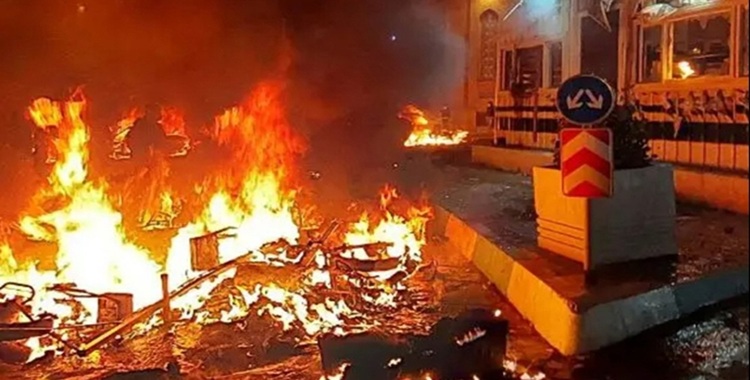
In the capital, Tehran, intense clashes were reported in the districts of Tehranpars, Sattarkhan, and Sadeghieh. Protesters utilized fire to erect barricades, effectively blocking the advance of security forces and seizing control of streets. On January 9, a Basij base—a primary center for organizing crackdowns—was set ablaze by rebellious youth in Tehran.
Similar scenes played out in Mashhad, where reports described “trench-by-trench” battles in the Vakilabad district. In a show of defiance against the regime’s financial institutions, the Sepah Bank was set on fire on January 10. In Arak, protesters systematically targeted the regime’s surveillance network, destroying identification cameras used to track dissidents. Meanwhile, in Zanjan, the motorbikes of the special riot units were torched, stripping the security forces of their mobility.
In a significant political development on the night of January 29, residents of Tehran’s Chitgar district took to rooftops and windows to chant slogans following news that the European Union had designated the Islamic Revolutionary Guard Corps (IRGC) as a terrorist organization. Chants of “Death to the terrorist IRGC” and “Death to the child-killing IRGC” echoed through the night, signaling public endorsement of the international isolation of Khamenei’s praetorian guard.
Naeem Abdollahi, 34, a PMOI Resistance Unit commander, was shot dead by the criminal IRGC on January 8 in Tehran’s southern Nazi Abad district. He held a Juris Doctor degree, was a political scientist, and served as an assistant professor at Tehran University.
Born in Kermanshah… pic.twitter.com/BST5mcjfqw
— People's Mojahedin Organization of Iran (PMOI/MEK) (@Mojahedineng) January 30, 2026
Profiles in Courage
Behind the statistics of the 1,449 martyrs are stories of individual bravery and intellect extinguished by state violence. Among the newly identified martyrs is Naeem Abdollahi, a 34-year-old PMOI Resistance Unit commander and an assistant professor of political science at the University of Tehran.
Abdollahi, who held a Juris Doctor degree, was shot dead by IRGC forces in Tehran’s Nazi Abad district on January 8. A veteran of the 2018, 2019, and 2022 protests, he had previously been imprisoned in Evin Prison and expelled from his university post for his activism. In a final message pledging his commitment to the cause of freedom, Abdollahi wrote: “How sweet is death when it is wedded to the ideal of Freedom… I, as a humble soldier, swear to remain faithful to this path.”
In a separate incident highlighting the brutality against Iran’s youth, 18-year-old Mohammad Bahrami was killed in Azadshahr, Golestan province, on January 6. According to reports, regime agents stabbed him with knives and machetes before shooting him, a grim testament to the savagery deployed to quell the uprising.
PMOI supporter Mohammad Bahrami, 18, was brutally killed in Azadshahr, Golestan, on January 6, during the nationwide uprising of the Iranian people.
In a heinous act, the regime's agents first stabbed and slashed him with knives and machetes before shooting him.Rest in peace.… pic.twitter.com/DAumqv3mZs
— People's Mojahedin Organization of Iran (PMOI/MEK) (@Mojahedineng) January 30, 2026
Regime Official Confirms Political Purge Disguised as Amnesty
While the violence continues, regime officials are attempting to project a facade of leniency that crumbles under scrutiny. Hossein Simayi Saraf, the regime’s Minister of Science, recently addressed the detention of university students. While claiming that some students would be released following coordination with the judiciary and the Supreme National Security Council, he explicitly carved out a massive exception for those who were in connection with the PMOI.
This admission effectively confirms that the regime is utilizing vague accusations of “being armed” or having “connections” to the organized opposition as a pretext to keep the most active and politically conscious students behind bars indefinitely. It underscores that any announced “amnesty” is merely a propaganda tool, while the crackdown on those seeking fundamental regime change continues unabated.
Global Solidarity: Athletes Call for Boycotts
As the internal struggle intensifies, support from the Iranian diaspora and international community is coalescing. A group of 60 national and world-class athletes issued a joint statement condemning the crackdown and supporting the democratic aspirations of the Iranian people.
The signatories declared their alignment with the NCRI’s 10-Point Plan for a future Iran—a plan advocating for a secular, democratic republic. The athletes called on international bodies, including the International Olympic Committee, to expel the regime’s representatives and for world governments to designate the IRGC as a terrorist entity. “A regime that suppresses, imprisons, or executes its sports heroes for speaking the truth… is not worthy of presence in the global sports community,” the statement read.
Furthermore, these athletes and activists have called on freedom-loving Iranians to gather in Berlin on February 7 to commemorate the anniversary of the 1979 anti-monarchic revolution and to amplify the voice of the current uprising.