
Iran Uprising Day 25: Clashes Continue in Cities, Regime Declares Open War on People
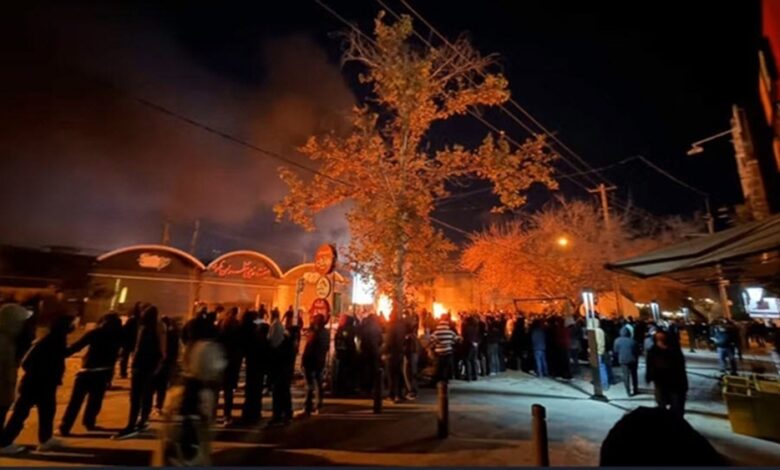
Iran Protests – January 2026
Written by
Mansoureh Galestan
January 21, 2026 – As the nationwide uprising in Iran reaches its 25th consecutive day, the clerical regime has intensified its crackdown, deploying military convoys to crush protests while maintaining a total internet blackout. Despite the suppression, the People’s Mojahedin Organization of Iran (PMOI/MEK) has verified and released the names of 103 additional martyrs.
Field Reports: Lethal Force and Defiant Resistance
Reports smuggled out of the country reveal a landscape of urban warfare. In Shahin Shahr, Isfahan province, local sources report a staggering toll, with 186 people killed and 400 wounded during the uprising. In the city of Mobarakeh, Isfahan, government buildings, including the City Council, Municipality, and multiple banks (Agriculture, Tejarat, and National), were set ablaze on January 8 and 9. Reports indicate that on January 8 alone, five protesters were killed, followed by 28 more the next day. Snipers stationed on the roof of the governor’s office targeted civilians with Kalashnikov rifles.
January 8—Isfahan, central Iran
Newly obtained videos from mass protests on January 8. The people showed immense courage, fighting back against the regime's repressive forces while chanting slogans such as "Down with the dictator" and "Khamenei will be overthrown"#IranProtests pic.twitter.com/b8grGEUkhB— People's Mojahedin Organization of Iran (PMOI/MEK) (@Mojahedineng) January 21, 2026
In the capital, Tehran, specifically in District 5 (Punak-Ashrafi Esfehani), residents report that gunshots can be heard at night. Women have taken leading roles in street confrontations, with eyewitnesses reporting them running toward bullets and pellets to hold the line. Due to the high risk of arrest at medical facilities, many wounded protesters are being treated in private homes. Security forces, including plainclothes agents, are infiltrating crowds to identify activists, forcing protesters to adopt disperse-and-regroup tactics.
In Kermanshah, a harrowing account highlights the brutality of the crackdown. A protester, initially wounded by birdshot, fell to the ground. When his father rushed to retrieve him, regime forces shot the father directly in the heart. Similar lethal tactics were reported in Mahshahr on January 15 and 16, where authorities attempted to label a slain female protester as a member of the Basij militia to cover up their crime, though her family resisted the narrative.
January 8—Karaj, northern Iran
Newly obtained videos show protesters resisting against the regime's repressive forces during the intense protests of January 8.#IranProtests pic.twitter.com/hEJJ0kPOEP— People's Mojahedin Organization of Iran (PMOI/MEK) (@Mojahedineng) January 21, 2026
Resistance tactics are evolving in response to the violence. In Bandar Abbas, a widespread strike has shuttered the bazaar, prompting the regime to block roads leading to government offices with heavy concrete barriers. In Quchan, despite a temporary reduction in security forces on the streets, youth have formed self-defense units, with one group organized by a man who witnessed the killing of two protesters.
The Human Cost
The NCRI’s latest statement on January 21 provides specifics on those who have paid the ultimate price. The list of 103 newly identified martyrs includes 12 women and several minors, reflecting the broad demographic participation in the uprising. Among the victims are 15-year-old Amirmohammad Arbab Pouri from Kermanshah and 16-year-old Amirsalar Bahmaninejad from Isfahan. The geographic spread of the martyrs—from Rasht in the north to Shiraz in the south—underscores the nationwide scope of the revolt.
Regime in Panic: “Quick and Decisive” Executions
Faced with unwavering protests, regime officials are demanding expedited judicial violence. Gholamhossein Mohseni Eje’i, head of the regime’s Judiciary, visited Bushehr on January 21, ordering judges to issue “quick and decisive” verdicts. He explicitly rejected charges of mere “disruption of public order,” insisting that detainees be charged with acting against national security—a distinct signal for harsh sentencing, including the death penalty. “There should be no leniency, no negligence, and no delay,” Eje’i stated.
However, fissures are appearing within the establishment. The state-run Ettela’at newspaper warned officials that labeling starving people as “rioters” is no longer effective, admitting that “concern for nightly bread is not a performance.” Similarly, regime insider cleric Mohammad-Ali Abtahi warned that the continued internet blackout creates a “new security crisis” and economic collapse.
International Condemnation
The international community is taking note of the regime’s militarized response. The U.S. State Department’s Persian account condemned the deployment of military convoys and machine guns in Lorestan, stating, “The Islamic Republic regime is not protecting the people of Iran, but has waged war against them.” NetBlocks confirmed that the national internet blackout has surpassed 300 hours, a tactic designed to hide atrocities. Meanwhile, Kaja Kallas, Vice-President of the European Commission, commended the struggle of the Iranian people and announced that new sanctions are being prepared in response to the repression.
Iranian women and men are fighting for a future of their own choosing.
For freedom, dignity, and a better life.The Iranian authorities’ brutal repression is unacceptable.
The EU already has sweeping sanctions on Iran in place.
We are working on new sanctions in response.My… pic.twitter.com/m2ZmDZLF3U
— Kaja Kallas (@kajakallas) January 20, 2026
The regime’s resort to military weaponry and mass arrests indicates a desperate attempt to regain control. Yet, as the uprising nears its fourth week, the unified resistance of the Iranian people suggests that neither concrete barriers nor internet blackouts can stem the tide of change.