
Iran’s Regime Faces Mounting International Pressure at IAEA Conference Over Nuclear Program
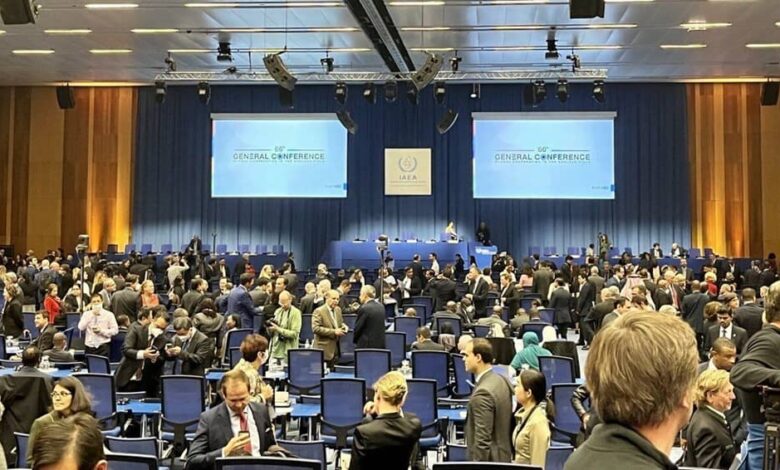
London – The 67th IAEA General Conference opened in Vienna
Written by
Shahriar Kia
The 69th General Conference of the International Atomic Energy Agency (IAEA) in Vienna has turned into a focal point of international pressure on Iran, with the United States, European governments, and the European Union demanding that Tehran immediately restore full cooperation with inspectors and halt its unprecedented enrichment activities.
European states set sharper tone
European delegations — including Belgium, Austria, France, Germany, Spain, and the United Kingdom — used the forum to declare that Iran must never be allowed to develop nuclear weapons. Belgium’s interior and security minister underscored that implementation of safeguards under the Nuclear Non-Proliferation Treaty (NPT) “can never be conditional” and insisted that Iran must not be permitted to cross the weapons threshold.
Austria voiced “deep regret” over Tehran’s failure to meet commitments under the 2015 Joint Comprehensive Plan of Action (JCPOA). It urged Iran to begin full cooperation with the IAEA on unresolved safeguards issues “without delay,” warning that the credibility of non-proliferation norms is at stake.
#Iran’s Regime Expels @iaeaorg Inspectors in Nuclear Extortion Bidhttps://t.co/UaRF9NHEA8
— NCRI-FAC (@iran_policy) July 5, 2025
France, echoing its E3 partners Germany and the UK, said Iran’s uranium enrichment above 60 percent and its stockpile — far beyond the JCPOA’s 3.67 percent limit — have reached “unprecedented levels” without any credible civilian justification. Paris reminded delegates that the E3 triggered the “snapback” mechanism on 28 August, notifying the UN Security Council of the regime’s non-compliance. A 30-day window under Resolution 2231 now runs until the end of September, after which UN sanctions suspended in 2015 could be reimposed.
Germany described Iran’s stockpiling of highly enriched uranium as “unprecedented for a state without nuclear weapons,” while Spain said the situation was “at a critical moment” and declared its support for snapback. The UK warned that IAEA oversight of Tehran’s nuclear program has been “driven close to zero,” describing Iran’s accumulation of enriched uranium as a “serious challenge” to the global non-proliferation regime.
#Iran News: Tehran Suspends Nuclear Oversight, Cuts Ties with @iaeaorg Monitors Amid Escalating Tensionshttps://t.co/scq1XpPpjO
— NCRI-FAC (@iran_policy) July 2, 2025
Washington demands dismantling of enrichment
US Energy Secretary Chris Wright reiterated Washington’s demand that the regime’s nuclear capabilities be rolled back completely. “Iran’s pathway to nuclear weapons — including enrichment and reprocessing — must be dismantled in full,” Wright told delegates on 15 September. He added that only by granting inspectors unrestricted access could Iran expect reintegration into the global economy.
The European Union’s delegation likewise urged Tehran to immediately resume full safeguards monitoring “without conditions,” citing the loss of “continuity of knowledge” about Iran’s nuclear material inventories since June.
The #IRGC Telegram post specifically lists the #Iranian regime’s nuclear capabilities, marking them with as follows:
✅Plutonium production capability
✅ Explosive mechanism construction capability
✅Explosion control chamber construction capability
✅Assembly and security… pic.twitter.com/HPSb76J50k— NCRI-FAC (@iran_policy) February 5, 2025
Tehran resists scrutiny
Iranian officials struck a defiant tone. Mohammad Eslami, head of the regime’s Atomic Energy Organization, addressed the conference by accusing IAEA Director General Rafael Grossi of “bias” and denouncing what he called the “silence” of the agency over Israeli and US attacks on Iranian facilities. He insisted Iran maintains “extensive cooperation” with the IAEA, but also warned against the return of UN sanctions, accusing Britain, France, and Germany of “bad faith.”
Despite Tehran’s protests, the IAEA Secretariat has confirmed that inspectors lack full access to key sites and that Iran continues to enrich uranium to 60 percent purity, with stockpiles of over 400 kilograms — material that could be further refined to weapons grade.
#Iran News: Regime FM Defiant After Blocking @iaeaorg, Warns Europe Against "Snapback" Sanctionshttps://t.co/rT3fiPTFwa
— NCRI-FAC (@iran_policy) June 28, 2025
A deadline looms
The confrontation now enters a decisive phase. If Tehran fails to comply with the IAEA and the conditions set out by the E3, the UN Security Council may see the restoration of international sanctions lifted under the JCPOA a decade ago.
Diplomats in Vienna stressed that Tehran has run out of excuses. With snapback sanctions looming at the end of September, Western officials warned that continued defiance will only accelerate Iran’s isolation and compound the regime’s crisis.