
Execution of Behrouz Ehsani and Mehdi Hassani Marks a Turning Point in Iran’s Struggle for Freedom
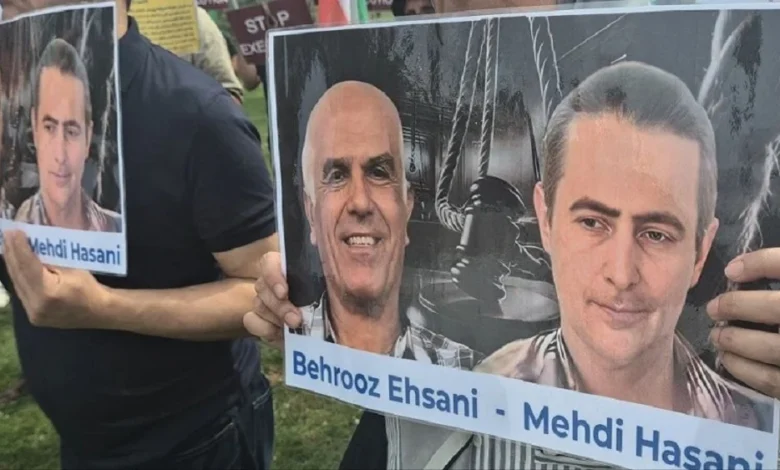
Supporters of the Iranian Resistance hold pictures of Behrouz Ehsani and Mehdi Hassani, two members of the People’s Mojahedin Organization of Iran, during a rally following their execution
Written by
Mohammad Sadat Khansari
Behrouz Ehsani and Mehdi Hassani two members of the People’s Mojahedin Organization of Iran
Three days after the execution of Behrouz Ehsani and Mehdi Hassani — two members of the People’s Mojahedin Organization of Iran (PMOI/MEK) — it has become increasingly evident that Iran’s internal conflict is not shaped by external powers, as the regime claims, but by the growing struggle between a brutal theocracy and an organized, democratic alternative. The executions, carried out in Ghezel Hesar Prison, have sparked widespread outrage and shined a spotlight on the regime’s desperate attempt to suppress an emboldened population and its resistance.
The True Battle: People vs. Tyranny
In the face of intensifying domestic repression, Iran’s regime finds itself increasingly challenged not by foreign powers but by its own people. This challenge is embodied most clearly in the organized resistance movement led by the PMOI, which calls for a secular, democratic alternative to the absolute rule of the Velayat-e Faqih (the Supreme Leader’s guardianship).
The regime’s judiciary, by singling out political prisoners affiliated with the PMOI, effectively acknowledges that the PMOI remains the most serious and sustained threat to its rule. Beyond executions and heavy prison sentences, the regime also devotes enormous resources to a relentless propaganda campaign aimed at discrediting the PMOI. Yet this propaganda increasingly falls flat, especially among Iran’s younger generation, who are no longer swayed by the state’s narrative.
World Reacts with Outrage After Execution of Iranian Political Prisoners #BehrouzEhsani and #MehdiHassanihttps://t.co/uoujFD942j
— NCRI-FAC (@iran_policy) July 27, 2025
The regime, and particularly Supreme Leader Ali Khamenei’s ideological apparatus, clearly understands the depth of this crisis. The legitimacy of the Iranian regime has moved beyond mere erosion and is now teetering on the brink of collapse. This is precisely why the regime’s machinery is focused on eliminating what it sees as its real adversary: not so-called reformists or token opposition groups, but a well-organized movement with roots in Iranian society.
The regime’s strategy — executions, defamation, disinformation, and psychological warfare — betrays its fear of a credible alternative. The more it tries to suppress the PMOI, the more it confirms its central role in Iran’s future.
Iran’s Youth Stage Fiery Attacks After Regime Executes Political Prisoners
A Generation That Demands Truth
What now matters most is the growing political consciousness among Iran’s youth. A new generation — one that did not witness the 1979 revolution or the Iran-Iraq war — has seen first-hand the regime’s brutality during nationwide protests over the past few years. These young Iranians are no longer interested in symbolic opposition or the hollow promises of internal reform. They seek genuine answers and meaningful change.
In this context, the executions of Ehsani and Hassani have not inspired fear but further fueled the desire to overthrow the regime. Rather than silencing dissent, the state’s violence has only widened the rift between rulers and ruled, reinforcing the image of a decaying system that survives solely through coercion.
#Exclusive
Another letter by the martyred PMOI supporter, Mehdi Hassani, from prison: I, Mehdi Hassani, a proud supporter of PMOI, am very happy to sacrifice my life for my people's freedom. #Iran pic.twitter.com/pKnqcRr351— SIMAY AZADI TV (@en_simayazadi) July 30, 2025
Voices of Defiance
The final letters and wills of Behrouz and Mehdi serve as testaments to the resilience of the Iranian Resistance. Their words reflect the gravity of the current moment — a turning point in the balance of power. They articulate the hope and determination of a people who refuse to be ruled by fear and demand a future free of tyranny.
Their sacrifice has added new momentum to a nationwide and global call for change. In martyrdom, they have become symbols of a broader awakening: a society no longer paralyzed by fear, but ready to claim its right to freedom and dignity.