

Sir Alan Meale: A Real Revolution Is Underway in Iran, and the World Must Stand with the Resistance
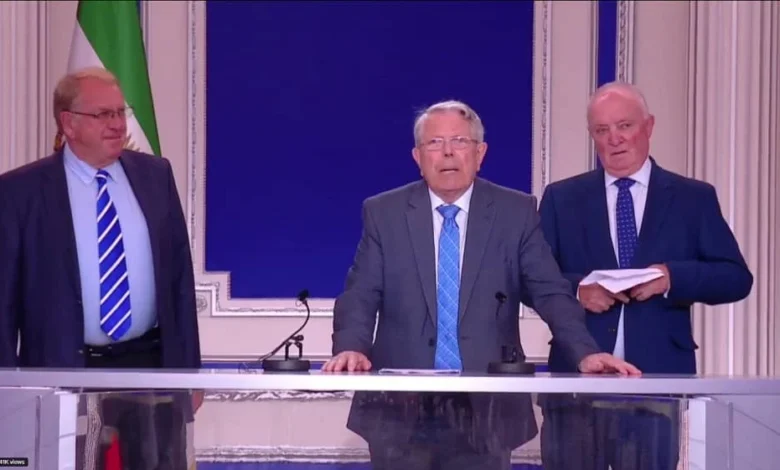
Former UK Minister Sir Alan Meale speaks at a conference held by the Iranian Resistance near Paris on May 17, 2025
Written by
Shamsi Saadati
On May 17, 2025, during a high-profile international conference aimed at advancing a new global strategy on Iran, former UK Minister and long-serving MP Sir Alan Meale delivered a powerful address. The Paris conference brought together parliamentarians and political leaders from across Europe and North America, focused on supporting democratic change in Iran and recognizing the National Council of Resistance of Iran (NCRI) as a legitimate alternative.
Sir Alan began by praising Mrs. Maryam Rajavi for her leadership in uniting the Iranian diaspora into a powerful global Resistance movement. He highlighted the Iranian women and youth leading the charge, calling their role the driving force behind the nation’s demand for change. Emphasizing Iran’s deepening unrest—marked by strikes across sectors—he asserted that these are unmistakable signs of a “real revolution.”
Drawing on decades of human rights work, he urged international labor organizations, including the UK Trades Union Congress and the ILO, to stand with Iranian workers. He called for global isolation of the regime, rejection of nuclear agreements, and immediate release of political prisoners.
Sir Alan concluded with an emphatic call: the Ten-Point Plan is not just a document—it is the roadmap to a free, democratic Iran, and the world must support it now.
The full transcript of the speech follows. Portions have been lightly edited for clarity.
Sir Alan Meale, former UK Minister:
"Appeasement has failed. What we want is the Ten-Point Plan and a UN system to examine Iran’s crimes."#FreeIran2025https://t.co/mlfL0BfLEo— SIMAY AZADI TV (@en_simayazadi) May 31, 2025
Thank you very much, it’s an honor to be once again invited to this gathering of people standing in solidarity with the people of Iran. It’s also about the resistance movement that’s there alive and thriving in trying to get freedom to that very important country.
But before I start on the brief address that I’m going to make I want to pay tribute to in two areas. First is to you, Madam Rajavi, for your management of the whole mechanism to try and achieve a free Iran.
You’ve gathered together, from the Iranian diaspora all over the world, an army of people who lead the Resistance and are organized for change and freedom in Iran.
I know I’ve been involved in human rights for a very very long time, and I don’t think there’s a day goes by when I’m not cornered by somebody from the Iranian Resistance asking me to sign something, to make contact, to be part of an organization.
I’m not the only one.
There are hundreds of parliamentarians getting that all the time, and I was for seventeen years a leading member of the Council of Europe and involved in the election of the judge of the Court of Human Rights. And it wasn’t just in Britain — it was in Strasbourg, Brussels, in every one of the 47 countries that are members of the Council of Europe.
And to say to you thank you for that management. And you’ve done it in a very, very different way than it’s been done before because you’re living proof that misogyny has no place in the future of our world.
At the lead are many courageous women, young girls, and children who are actually pushing the pace for change — in fact, demanding it — and that’s what’s so exciting about this revolution.
Sir Alan Meale: We must rally lawyers, judges, and voices for justice worldwide. Most of all, we must strengthen support for the #NCRIAlternative—without them, we wouldn’t be here. The future is with the Iranian people: free and democratic.
https://t.co/BEvNGP850H— NCRI-FAC (@iran_policy) May 31, 2025
Now can I just say I want to thank you for your very positive remarks. You made it clear — the truth is undeniable. Iran stands at a crossroads — a real crossroads — and as you mentioned in your speech, and the fine film showed, and the excellent address made by our colleague from Norway: the strikes by truck and lorry drivers are real.
And they’re now approaching the tenth day of action.
And they stand alongside the many teachers who are daily going on strike, the retirees who have gone on strike, the nurses who have gone on strike and many of them have been arrested, have been threatened, some have been jailed and it’s not good enough.
And my colleague who’s going to speak very shortly, sir David Crosby, is an ex leading official of the transport workers in The UK and I’m the ex an ex transport minister.
Upon our return to the UK tomorrow, we will contact the British Trades Union Congress — the head of the unions in Britain, representing twenty-four million members — and we’ll be urging them to express solidarity and offer help.
We will also demand they contact the ILO — the International Labour Organization in Geneva — and ask what they are doing, and push them to get involved at the forefront of change.
As you say, I’ve been involved in, human rights for a very, very long time and you get when you’re involved in things, you get to see and recognize certain things are occurring.
When Madam said that tremors and earthquakes are occurring in Iran for change — you can see it. The mullahs know what’s going on.
They recognize the strikes, the protests, the demonstrations from every layer of society — and it’s never happened like this before.
And what they do in such a when I’ve been involved in human rights in Southern America, South Africa, Eastern Europe, the Baltics, there’s certain things that come to the fore every time when people who are doing violations act.
They’re bothered about what people read, they’re bothered about what people say, they’re bothered about what people wear, they’re bothered about what people watch and they’re bothered about what people say on the media and television.
All that’s occurring. It all occurs when things are coming to a head, when things are coming to an end and the mullahs know that.
So there is a real revolution happening in Iran at this moment. And I believe I recognize most of the signs. And I’ll say this: in the near future, people will ask themselves, “Why did it take so long?”
It happens just like that. Mandela was released just like that. Killings in the Baltics — they stopped just like that.
And we’ll look back and say, “Why did it take so long?” And then we’ll move forward — because there is a future to be had.
Madam Rajavi delivered a truly excellent discourse — highlighting the demonstrations, the plight of the people inside and outside Iran, and the pressure the Resistance has faced — even from governments, including my own.
The U.S. said, “This is not the organization we want to work with.” And yet — we turned it around.
And we did it with the help of a document that Madam Rajavi chose to produce. It was a simple document — a Ten-Point Plan for economic recovery and freedom in Iran.
It stands today in every Parliament, we’ve seen the documents coming in again and again and again. People saying this is where it’s at. It’s not just a piece of publicity. It’s a real report, an agenda for change.
An agenda that says: we want a free Iran.
Sometimes, politicians put up hurdles. But now those hurdles are nearing their end — they’re being pushed aside. Appeasement has failed.
No more deals. What we want is the introduction of the Ten-Point Plan. And we want the UN to play a real part — along with the allies who now recognize the necessity of this plan.
We need them to accept it. We need to accept the UN Charter for change and recognize the threats posed to global security.
There should be no deals whatsoever on nuclear fusion or nuclear waste.
And I ask: why?
Iran is one of the richest countries in the world in terms of natural resources — gas, energy, oil. And yet, it is secretly stockpiling material to build a nuclear bomb through nuclear fusion.
Why?
The direction of science is changing. Soon, if you want energy, you won’t need oil and gas in the same way.
They will still be useful — for medicine, fertilizer, and many industries — but the way energy is produced is evolving.
So this nuclear program was never really about energy. It was about something else.
It was about nuclear weapons. That’s what it was always about.
Sir Alan Meale: When @Maryam_Rajavi said these movements are causing political earthquakes in #Iran, she was right. The mothers know. They see the strikes and protests across society. This has never happened before.#NCRIAlternative
https://t.co/BEvNGP7xb9— NCRI-FAC (@iran_policy) May 31, 2025
And while the rest of the world — working with the UN — tries to limit nuclear waste and power, this regime has tried to secretly go its own way, even blocking UN access.
There can be no deals on that.
Secondly, we must isolate the regime globally. That’s already happening — organized successfully by resistance movements. But we must go further.
We should insist immediately on the release of all detained prisoners, and we should urge the United Nations to set up a system to examine what has occurred in Iran — in the past, and now.
Now you may say, “That can’t be done.”
But I know how the overseas budgets of governments work. You don’t need to give lots of money. You need to provide judges.
And where better to find them than in the Iranian diaspora? There are already lawyers and judges out there.
We need to recruit them across Europe and the world, and give them an agenda for change.
And lastly — and most importantly — we must continue and expand our support for the NCRI.
Because without them, we would not be where we are today.
And if we want to win — and I believe we will — we won’t get there without them.
The future is the Iranian people — free and democratic. Let’s get on with it.