
What Did the 1979 Revolution Teach the World?
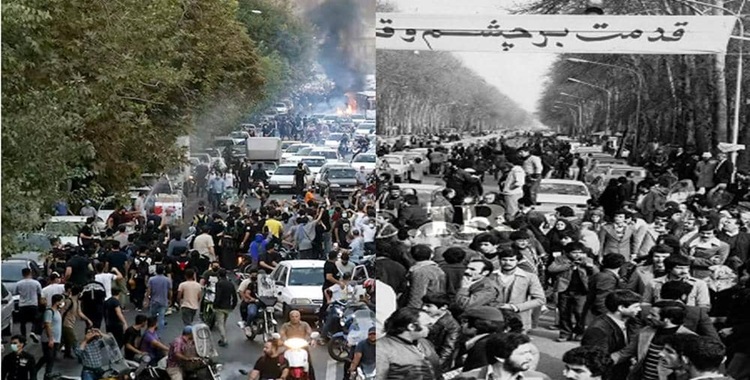
Iran’s 1979 revolution and 2022 protests side by side, capturing moments of mass demonstrations Four-minute read
Written by
Mehdi Oghbai
On February 11, Iran’s clerical regime once again turned the anniversary of the 1979 Revolution into a stage—part morale-boosting spectacle for its demoralized base, part defiant performance aimed at its growing roster of enemies. For a system that once boasted of dominating the entire Middle East, the smallness of the celebration was irony enough.
But the parade’s symbolism carried other messages, too—each revealing more than it intended. The familiar props were back: puppets, mock coffins, the ritual burning of other nations’ flags. Year after year, these theatrics are meant to reassure the regime’s enforcers and paid loyalists that the state can still sneer at the world.
More telling, though, was the regime’s media choreography. This year, even more conspicuously than last, state television sought out interviews with women without hijab and placed them prominently on screen. The aim was obvious: to broadcast to the outside world that even cultural dissenters have, in effect, made their peace with the religious dictatorship. Yet for a government that claims legitimacy through “spiritual capital”—ideological devotion—there is something deeply revealing in the way it must now seek credibility by showcasing disobedience. A state that insists compulsory veiling is nonnegotiable law, yet tries to validate itself by displaying “lawbreaking” as evidence of social support, is advertising the depletion of both its ideological force and its social base. It could hardly offer a clearer image of exhaustion.
If an #Iranian group or individual is truly opting for regime change, wouldn’t it be in their own interest to stop obstructing – even if not supporting – the most organized and serious force that has been struggling with the regime since the outset?https://t.co/B6fXrDk46D
— NCRI-FAC (@iran_policy) April 28, 2023
The Theft of a Revolution
For Iranians—especially middle-aged and older generations—February 11 marks something else as well: a bitter reminder of betrayal. It is the anniversary of a stolen mandate.
The era of the Pahlavi monarchy—born of coups, reinforced by foreign-backed intervention, shaken by the blood of Iranian revolutionaries, and finally ended by millions in the streets—contained a lesson that was plain to those who lived it. It was not an accident that the revolution’s central slogans were freedom and independence. Those two words were later hijacked, abused, and ultimately betrayed by the clerical establishment.
Contrary to the mullahs’ retrospective claims, Iranians did not rise up in 1979 to install a creed. They rose against SAVAK’s torture chambers, against injustice and discrimination, against a court and ruling families that stood above the majority as if by birthright. They rejected a militarized economy and demanded that the state invest in the foundations of a functioning society. More than anything, they wanted political freedom—free speech, free press, accountable government.
Revisiting the Legacy of Mohammad Mossadegh: A Blueprint for Democratic Governance in #Iran https://t.co/RyeT8s4ISt
— NCRI-FAC (@iran_policy) July 30, 2025
Yet the darker truth of Iran’s modern history is that, at the height of the Cold War, foreign powers misread the Iranian equation. They treated the country’s future as a problem to be managed, and chose what they considered the “less dangerous devil”: reactionary clerics. Through bargaining and back-channel calculations—amplified by major media attention granted to Ruhollah Khomeini, whose advantage over Iran’s genuine revolutionaries was not vision but opportunism—the fate of an entire people was pushed toward darkness.
Khomeini, in this view, was not the Shah’s negation so much as his inheritor. The Shah crushed political life—banning parties, enforcing absolute contraction, executing and torturing progressive forces and intellectuals within the country. In that vacuum, the only nationwide organization left intact—with deep social reach and free lines of communication—was the clerical network. When protests surged, it was uniquely positioned to exploit the brief opening. Widespread illiteracy and political ignorance, entrenched over decades, made it easier for many to trust men who routinely elevated superstition over knowledge and truth.
The Two Faces of Dictatorship: Theocracy and Monarchy
Iran is once again in upheaval—though it would be more accurate to say the country has remained in a state of uprising ever since the clerics seized power. What has changed is that the regime’s myth of stability, and the outside world’s convenient fiction that Iranians have grown tired of revolution, has been exposed.
Iran—just as in 1979—is too consequential for regional players and global powers to ignore. That is precisely why, since 2017, we have witnessed intensifying investments, pressure campaigns, and propaganda operations designed to shape Iran’s internal direction.
Selling a Dead Horse: Reza Pahlavi’s Bid to Market a Trashed Dictatorshiphttps://t.co/s6np8ebsVU
— NCRI-FAC (@iran_policy) April 26, 2023
The same powers that now market the son of Iran’s deposed dictator as a “solution”—and that manage expensive, relentless cyber and media campaigns to promote him—understand perfectly well what they are selling. They know he has no governing record, and not even the ability to keep a small circle unified. They also know that elevating such a figure may, in the short run, prolong the clerical regime’s survival; and if the regime falls, it could produce acute internal tensions—even the risk of civil conflict. But for those actors, a weakened Iran—perhaps even a fragmented one—is preferable. Who rules it is secondary.
And here Iran differs from 1979 in one crucial respect. After his overthrow, the Shah reportedly said his greatest mistake was failing to eliminate “terrorists”—by which he meant members of the People’s Mojahedin Organization of Iran (the MEK). His successors—first Khomeini, then Ali Khamenei—clearly tried to learn that lesson. Despite both external and “unseen” assistance, they failed.
Today Iran has an organized, longstanding resistance—one with more than six decades of history—which possesses the capacity to mobilize and unify diverse ethnicities, nationalities, and political tendencies. The National Council of Resistance of Iran, a coalition of independent organizations and figures, has demonstrated cohesion for nearly half a century under the harshest conditions. It is as a transitional authority with a limited six-month mandate—one intended to guarantee that a democratic, independent, and free Iran would serve not only Iranians but the wider world, offering stability and a workable model of coexistence in a turbulent region.
The lesson of 1979 is not obscure: Iran’s destiny must be left to Iranians. The consequences of foreign intervention rarely remain contained; they spill outward, harming the region and the world. But the world is not powerless to play a constructive role. Severing relations with the ruling dictatorship—and supporting the Iranian people’s struggle against it—is enough, at minimum, to avoid repeating the catastrophes of the past.
https://www.ncr-iran.org/en/news/iran-protests/what-did-the-1979-revolution-teach-the-world/