
“We Have Been Executed Thousands of Times”: The Defiant Manifesto of PMOI Martyrs
Written byDr. Masumeh Bolurchi
Three-minute read
Between March 30 and April 4, 2026, the Iranian regime executed six political prisoners and members of the People’s Mojahedin Organization of Iran (PMOI/MEK): Mohammad Taghavi, Akbar Daneshvarkar, Babak Alipour, Pouya Ghobadi, Vahid Bani Amerian, and Abolhassan Montazer. Hanged following sham trials and severe torture, these men left behind a profound legacy.
On March 3, 2025, anticipating their fate, the six heroes wrote a powerful manifesto from Evin Prison. They requested it be published on the websites and news network of the Iranian Resistance once their death sentences were confirmed by the Supreme Court. This letter is not a plea for mercy. It is a triumphant manifesto, framing their executions as the continuation of a century-long, unbreakable chain of Iranian patriots sacrificing their lives for freedom.
"I have sworn to overthrow the tyrant with my blood"
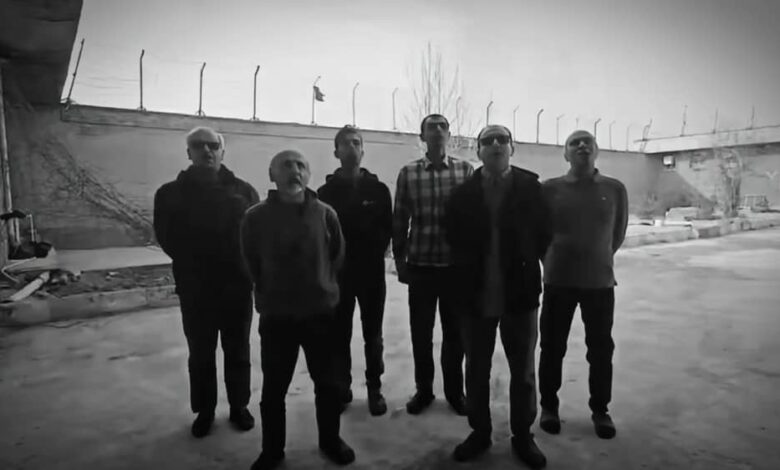
Six PMOI members after being sentenced to death by Iran's regime, singing songs of resistance and defiance against the mullahs' rule.
They were all executed this week:
Mohammad Taghavi (59)
Ali Akbar (Shahrokh) Daneshvarkar… pic.twitter.com/BnvzaRXYLr— People's Mojahedin Organization of Iran (PMOI/MEK) (@Mojahedineng) April 4, 2026
Tracing the century-long roots of resistance
The letter opens with a punchy and profound declaration: “We have previously been executed hundreds of thousands of times in Iran’s history!” The prisoners intertwine their souls with past martyrs, tracing their lineage to the 1906 Constitutional Revolution. They align themselves with the “Tabriz Mojahedin,” fighting alongside national hero Sattar Khan, and the forces that conquered Tehran to end absolute monarchy, leaving their torn bodies “under the rubble of cannons.”
They honor the Jangal Movement of the 1920s, writing of rushing to “Gurab Zarmikh” to swear allegiance to Mirza Kuchak Khan for an Iranian Republic, where fighters’ bodies froze in the Gaduk mountains.
Defying the Pahlavi dictatorships, they recall Kurdish leader Qazi Muhammad, executed by Reza Shah. They pay tribute to the 1953 democratic movement, shouting “Death or Mosaddegh” against the Shah’s tanks, and honoring Hossein Fatemi, Dr. Mohammad Mosaddegh’s executed foreign minister, whose blood “dripped from our bodies at Tehran University.”
Simay Azadi Exclusive | #Iran News Alert
PMOI member Vahid Baniamerian takes an oath as part of the MEK Resistance Units in 2018, vowing to fight the regime until the end—something he ultimately carried out.Baniamerian, 33, was executed on April 4, 2026, in Ghezel Hesar Prison… pic.twitter.com/Idrgr9wSuy
— SIMAY AZADI TV (@en_simayazadi) April 4, 2026
The birth of the Mojahedin and the stolen revolution
The prisoners detailed how their struggle evolved in the 1970s into the “Mojahedink” and “Fadaee” organizations. They honored PMOI founder Mohammad Hanifnejad, writing of their pact with “Hanif” and enduring the Shah’s secret police (SAVAK). They recalled the 1978 Jaleh Square massacre, noting how their spilled blood “broke the Shah’s throne.”
They then described the bitter aftermath of the 1979 revolution. After defeating the monarchy, they came face-to-face with a new “monster—named Khomeini.” They explained how Khomeini “stole our people’s revolution” and hovered like a vulture to establish the absolute dictatorship of the Velayat-e Faqih (absolute clerical rule).
Iran’s regime fails to silence Resistance Units with execution spree of PMOI members https://t.co/DRScP2LyT7
— People's Mojahedin Organization of Iran (PMOI/MEK) (@Mojahedineng) April 5, 2026
June 20, PMOI youth, and the 1988 mass graves
The letter highlighted June 20, 1981, when Khomeini’s guards fired upon peaceful protesters, sparking the organized resistance. They wrote of swearing an oath with Iranian Resistance Leader Massoud Rajavi to “stand with everything we have” against this vindictive enemy.
In a heartbreaking tribute, they recall the PMOI youth executed in Evin Prison who “shouted ‘Freedom’ instead of their names” before the firing squads.
They chillingly note that the regime turned all of Iran into “Khavaran,” the infamous site of unmarked mass graves from the 1988 massacre of 30,000 political prisoners—a legacy these six heroes knew they were joining.
Simay Azadi Exclusive | #Iran News Alert
PMOI member Abolhassan Montazer takes an oath in 2020 before returning to prison.
A former political prisoner under both the Shah and the current regime, Montazer had been jailed multiple times before his arrest in 2024 and subsequent… pic.twitter.com/uu4kXCaTfp— SIMAY AZADI TV (@en_simayazadi) April 4, 2026
A bridge to the modern uprisings: “We will not bargain”
Bridging history to the present, the prisoners linked their struggle to recent youth uprisings. They directly condemn the regime as the “cursed ones of the November Mothers” (referencing victims of the 2019 protests) and the “Murderers of Khodanour, Hadis, Koumar, and Aylar”—iconic martyrs of the 2022 nationwide uprising.
In ultimate defiance, they quoted Behrouz Ehsani, a fellow PMOI member executed in 2025: “We will not bargain with you over our lives!”
They concluded with a promise that even if executed a hundred thousand times more, they will stand firm for a “democratic republic” across all of Iran. Their unbreakable spirit is captured in their final poem:
We are the architects of your end
We step into your battlefield
We are the spring of that blooming morning
Upon the manuscript of history, we are your winter