
War Outside, Propaganda Inside: Tehran’s Desperate Bid to Reassure a Shaken Base
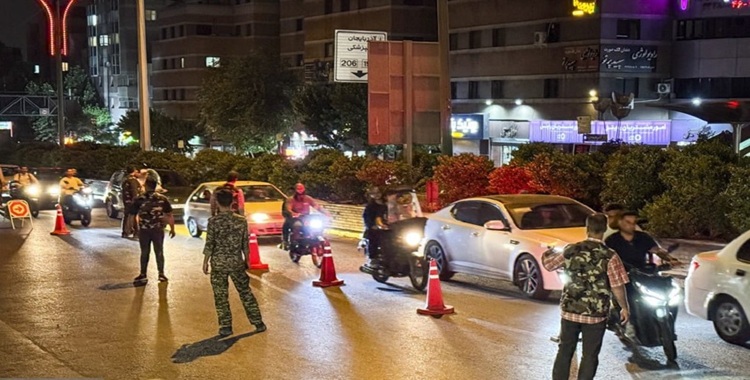
Basij forces set up checkpoints and mount repressive measures in wake of attacks by Israel
Written by
Shahriar Kia
This year, the clerical dictatorship’s Nowruz messaging did not sound like the voice of a confident state. It sounded like a regime trying to contain panic. Since the war began on February 28, Iran has endured sustained U.S.-Israeli attacks, the killing of senior leaders, and near-daily bombardment. But foreign strikes alone do not explain the tone of the regime’s propaganda. The deeper wound was opened earlier, in the nationwide uprising that peaked in January 2026 and shook the clerical state to its core. Reuters described it as the worst domestic unrest since the era of the 1979 revolution, while Amnesty called January 2026 the deadliest period of repression in decades of its research.
A Nowruz of Absence
For the first time in decades, the new year opened without Ali Khamenei’s image or presence, and under bombardment. The message attributed to Mojtaba Khamenei was meant to project continuity. Instead, it highlighted rupture. Mojtaba’s Nowruz message named the year one of a “resistance economy under national unity and national security” and denied Iranian responsibility for attacks in Turkey and Oman. But the very fact that the regime relied on a controlled written or mediated message rather than a visible, commanding appearance exposed how fragile the moment had become.
The real audience for this messaging was not the Iranian public at large. It was the regime’s own demoralized camp: the security services, Basij, judiciary, bureaucracy, and loyalist networks rattled by war, succession, and the memory of January’s revolt. In the message attributed to Mojtaba, he explicitly urges domestic media to avoid serious discussion of the regime’s weak points. A state that must order silence about failure is admitting that failure has become dangerous inside its own ranks.
Masoud Pezeshkian’s Nowruz message called for people to “wash away grudges and differences,” framed the new year as one of “consensus and solidarity,” and appealed even to Iranians abroad to set aside hostility. At the same time, he insisted that the killing of top leaders had failed to break the system and that the state had quickly restored order. His role was to soften the regime’s image with the language of reconciliation and calm while still reinforcing the same core claim: that the system remains stable, unified, and in control despite war and internal crisis.
An #IRGC commander called Karimi stated that 25 percent of the people arrested were members of the paramilitary Basij units, six percent were members of the IRGC and five percent were from relatives of #Iran-Iraq war veterans.https://t.co/O6D392urAs
— NCRI-FAC (@iran_policy) August 6, 2023
Manufactured Resolve
Because slogans alone cannot restore belief, the regime has turned to spectacle. In recent weeks, state media has showcased pro-regime rallies in several cities after Mojtaba Khamenei’s elevation, with supporters waving flags and carrying portraits of Ali and Mojtaba Khamenei. In Isfahan, one such rally reportedly unfolded even as explosions from nearby airstrikes could be heard. These were not displays of organic confidence. They were staged rituals of reassurance, aimed at proving to loyalists that the crowd still assembled and the chain of command still held.
The same desperation is visible in the regime’s increasingly synthetic media environment. The Wall Street Journal reported that Iranian state media has relied on AI-generated imagery and voice-overs to preserve the appearance of Mojtaba Khamenei’s public presence while he remains largely unseen. The Institute for Strategic Dialogue has likewise documented a surge of AI-generated and misleading visuals pushed by Iranian state-linked networks during the conflict to portray Iran as resilient and victorious.
Funeral pageantry has become another pillar of this campaign. Reuters reported on public mourning for war dead in Tehran, while AP noted that Eid prayers became a platform for mourning leaders killed in the conflict. The regime is trying to convert loss into ideological fuel, turning graves and rituals into proof that martyrdom still binds the system together. But a state that must constantly dramatize sacrifice is a state struggling to contain despair.
Ali Fadavi, #IRGC deputy chief: "Divine intervention and the presence of Basij, law enforcement, and security forces helped these riots to be defeated." 3/ pic.twitter.com/53chaHWLza
— NCRI-FAC (@iran_policy) July 15, 2023
Propaganda for Loyalists, Terror for Society
The final proof of the regime’s insecurity lies in the contrast between its morale campaign and its repression. If Tehran truly believed its own claims about unity and resilience, it would not need to execute young protesters in wartime. Yet on March 19, the regime executed three young men in Qom arrested during the January uprising, including 19-year-old wrestler Saleh Mohammadi. These were the first executions tied to the January protests, and rights groups said the convictions relied on torture-tainted confessions and grossly unfair trials. Amnesty said at least 30 people, including children, were at risk of the death penalty in cases linked to the uprising.
That is the real structure of the regime’s wartime politics. The rallies, the Nowruz message, the censorship orders, the AI-enhanced leadership imagery, and the funerals are aimed inward at a shaken ruling camp. The executions are aimed outward at society. One reassures the loyalists; the other terrorizes the people.
These facts show that the clerical dictatorship’s deepest fear is not foreign pressure but internal upheaval. The regime’s messaging is the emergency language of a system that knows its survival depends on keeping its military, security, and paramilitary foot soldiers loyal and ready to crush a restive society. Its messaging is therefore aimed above all at those forces whom it may consider shielded from air strikes, yet still vulnerable to fractures in state cohesion, declining morale, and the growing anger of the people they are ordered to suppress.