
UN Commissioner Condemns Iran’s Surge in Executions, Urges Immediate Moratorium
Volker Türk warns of systemic abuses and calls new espionage bill “dangerously broad”
Written by
Mansoureh Galestan
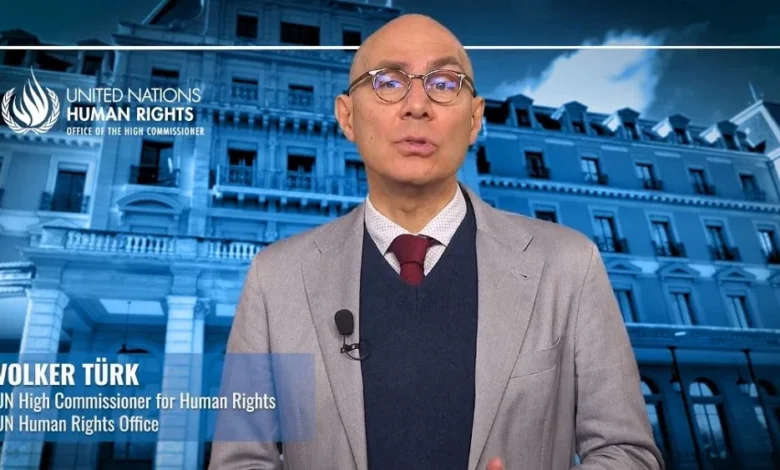
UN High Commissioner for Human Rights Volker Türk has issued a powerful rebuke of Iran regime’s alarming rise in executions, calling for an immediate moratorium and denouncing the Iranian regime’s expanding use of capital punishment, including through vague and politically motivated charges.
“Reports that there have been several hundred executions in Iran so far this year underscore how deeply disturbing the situation has become and the urgent need for an immediate moratorium in the country on the use of the death penalty,” Türk said in a statement from Geneva.
According to data gathered by the UN Human Rights Office, at least 612 people were executed in Iran in the first half of 2025—more than double the number in the same period of 2024, when 297 executions were reported. Among those executed, over 40 percent were convicted of drug-related offenses, while many others faced vague charges such as “enmity against God” and “corruption on earth.” These terms are “often used by the authorities to silence dissent,” Türk warned.
Iran’s execution spree met by nationwide resistance as ‘No to Executions’ campaign marks 75th week https://t.co/dMmzZEa2XL
— People's Mojahedin Organization of Iran (PMOI/MEK) (@Mojahedineng) July 1, 2025
The UN human rights chief also raised concerns about the lack of judicial transparency and fairness in many of these cases. “Information received by my Office also indicates that judicial proceedings in a number of cases, often held behind closed doors, have consistently failed to meet due process and fair trial guarantees,” he noted.
In a particularly disturbing development, Türk pointed to the fate of dozens currently awaiting execution: “It is alarming to see the reports that indicate there are at least 48 people currently on death row – 12 of whom are believed to be at imminent risk of execution.”
The statement highlighted the disproportionate impact of executions on ethnic and religious minorities and drew attention to new legislation that could worsen the crisis. The Iranian regime’s Guardian Council is reportedly finalizing a draft espionage bill that expands the definition of “collaboration with hostile States” to include acts such as online communication, collaboration with foreign media, and “ideological alignment”—all punishable by death.
Global Condemnation of the Execution of Behrouz Ehsani and Mehdi Hassani https://t.co/hsFdq4x0P7 pic.twitter.com/POszF8OpGn
— Iran Focus (@Iran_Focus) July 28, 2025
“This bill dangerously broadens the scope of capital punishment for espionage, and I call for it to be rescinded,” Türk said.
He concluded with a firm appeal to Iranian authorities: “The death penalty is incompatible with the right to life and irreconcilable with human dignity. Instead of accelerating executions, I urge Iran join the worldwide movement abolishing capital punishment, starting with a moratorium on all executions.”
Despite mounting international criticism, Iran’s regime remains the world’s top executioner per capita. The regime has intensified executions in the aftermath of its twelve-day war with Israel, using the death penalty as a tool of domestic repression and political control.