
UK MPs Press for IRGC Ban and UN “Snap-Back” Sanctions in Parliament Debate
UK MPs Press for IRGC Ban
Written by
Shahriar Kia
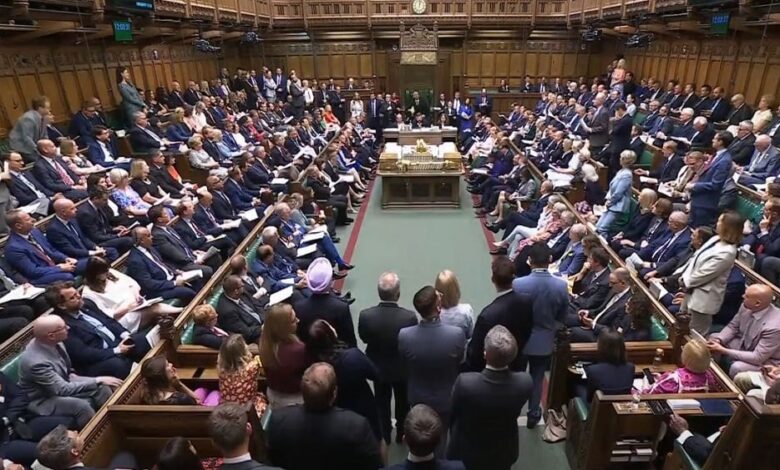
A debate in the UK House of Commons on 7 July delivered a point-by-point indictment of the clerical regime in Tehran. Ministers and back-bench MPs detailed how Iran’s regime fuels conflicts from Gaza to Ukraine, the way its security organs stalk dissidents and Jewish communities on British soil, the pressure building for tougher sanctions—including full proscription of the Islamic Revolutionary Guard Corps (IRGC)—and the narrowing window to stop its nuclear escalation by triggering the UN “snap-back” mechanism.
Tehran’s destabilizing regional role — from Gaza to Kyiv
Fact after fact dominated the opening exchanges. Parliamentary Under-Secretary Hamish Falconer recited the charge sheet: drones and ballistic missiles shipped by Iran’s regime to Russia for use against Ukraine; weapons, cash and training funneled to Hezbollah, Hamas and Yemen’s Houthis; and an undeclared presence of IRGC advisers across several fronts. Liberal Democrat Monica Harding warned that the regime is “utterly committed” to exporting conflict, underscoring cross-party alarm. MPs stressed that these external ventures are inseparable from Tehran’s domestic repression: each overseas battlefield diverts resources that could serve the Iranian people and buys the regime strategic depth against democratic forces at home.
Trans-national repression reaches British streets
A second theme was the regime’s reach into the United Kingdom. Falconer delivered an unambiguous commitment: the Government “will not tolerate any Iran-backed threats on UK soil.” Labour’s Gareth Snell added that exiled protesters from the 2022 uprising now face IRGC intimidation in Britain and allied countries. MPs asked what further protection and prosecutions will follow; ministers referred to the first National Security Act cases and pledged the “full force of the law.”
Sanctions, new legal tools and the IRGC proscription question
While the IRGC is already sanctioned “in its entirety” under UK regulations, many MPs argued that only outright proscription under terrorism law—or the forthcoming “state-threats proscription-like tool” recommended by reviewer Jonathan Hall KC—can close legal loopholes. Falconer highlighted a sanctions tally exceeding 450 regime-linked listings and acknowledged a gap when the perpetrator is a state body that acts like a terrorist group. Back-benchers pressed for decisive action before further plots materialize. They also called for secondary sanctions on the regime’s financial networks and for expelling diplomat-operatives from London—measures strongly supported by the Iranian diaspora and the NCRI.
U.S. Sanctions 22 Entities Tied to Iranian Regime’s Shadow Banking Network https://t.co/j05EFkRa2F pic.twitter.com/kFl2PZGa4l
— Iran Focus (@Iran_Focus) July 10, 2025
Nuclear escalation and the ticking “snap-back” clock
Attention was also given to the regime’s atomic program. Veteran security chair Sir Julian Lewis asked whether 60 percent enrichment has any civilian justification; Falconer conceded it “has no obvious civilian purpose.” MPs from both sides urged the Government to trigger the Joint Comprehensive Plan of Action (JCPOA) “snap-back” clause, which would automatically restore UN embargoes suspended since 2016. The Minister confirmed London is in talks with Paris, Berlin and Washington, calling snap-back “an important lever” if Tehran refuses to readmit IAEA inspectors expelled after the US–Israeli strikes on 22 June. With that deadline “fast approaching,” legislators warned that diplomacy cannot be “spun out indefinitely.”
https://twitter.com/iran_policy/status/1941577484929204409
An opening the world must seize
The debate revealed unity across party lines with MPs portraying the Iranian regime as a driver of war abroad and repression at home—and signaled impatience with incremental measures. For years, the NCRI has documented these twin threats; Westminster has now echoed that analysis. Policymakers have a narrow window to constrain the regime: proscribe the IRGC, activate UN snap-back sanctions, and redouble support for the Iranian people’s demand for democratic change and their right to defend themselves against the regime.