
UK MPs and Legal Experts Endorse NCRI’s Provisional Government and Ten-Point Plan for Future Iran
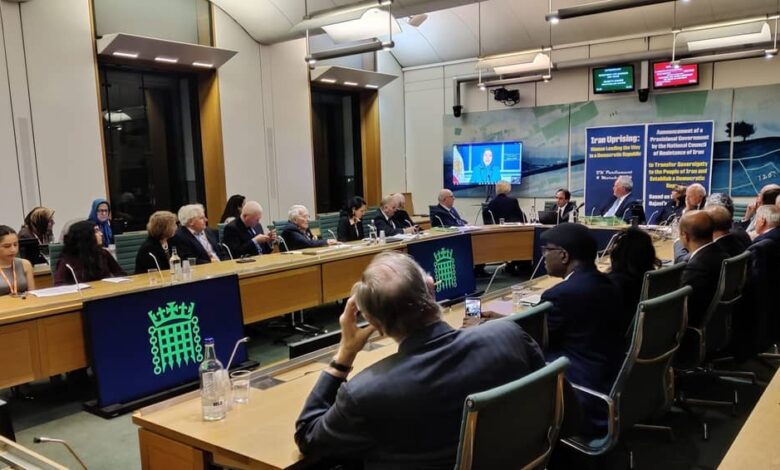
UK parliamentarians and legal experts listen to NCRI President-elect Mrs. Maryam Rajavi’s remarks during a conference on March 4, 2026
Written by
Shamsi Saadati
In a gathering marking International Women’s Day, a distinguished group of British lawmakers and international legal experts expressed their unwavering support for the National Council of Resistance of Iran (NCRI) and its President-elect, Mrs. Maryam Rajavi. The conference centered on the recent formation of a provisional transitional government, a strategic move aimed at transferring sovereignty to the Iranian people and establishing a democratic republic. The consensus among the speakers was a firm rejection of all forms of dictatorship—both the current theocratic regime and the former Pahlavi monarchy—affirming that the future of Iran belongs to its people and their organized resistance.
In her remarks, Mrs. Maryam Rajavi, President-elect of the National Council of Resistance of Iran (NCRI), delivered a keynote address outlining the transition to a democratic republic. She announced the formation of a provisional government intended to transfer sovereignty to the Iranian people. This transition is based on a Ten-Point Plan that guarantees a peaceful move toward popular sovereignty.
Mrs. Rajavi asserted that the death of Khamenei signifies the end of absolute religious dictatorship. She emphasized that the Iranian people reject all forms of dictatorship, specifically stating the struggle follows the principle of “neither Shah nor the mullahs”. She further called for the dissolution of the Revolutionary Guard Corps (IRGC) and all institutions involved in executions and torture.
Central to her remarks was the role of women, whom she identified as the “force deciding the future”. Mrs. Rajavi stated that “women’s leadership is the true measure of a democratic alternative” and noted that women have held key leadership positions within the resistance for four decades. She concluded by reaffirming that the provisional government is required to hold free elections within six months of its establishment.
Four days ago, the National Council of Resistance of Iran announced the formation of a provisional government to transfer sovereignty to the people and establish a democratic republic based on the Resistance’s Ten-Point Plan. This measure guarantees a peaceful transition of power… pic.twitter.com/GyK4SJHJ3j
— Maryam Rajavi (@Maryam_Rajavi) March 4, 2026
Mr. Bob Blackman MP, Member of Parliament for Harrow East, opened the session by characterizing the current era as an “extraordinary time in history for Iran.” MP Bob Blackman emphasized the urgency of replacing the current theocratic regime with a legitimate government, stating: “The NCRI announced the formation of a provisional government to transfer sovereignty to the people of Iran and to establish the democratic Republic that we all believe in based on Mrs. Maryam Rajavi’s Ten-Point Plan.” Mr. Blackman further asserted that the Ten-Point Plan demonstrates that the choice facing the nation is “not chaos versus theocracy, it is dictatorship versus democracy.”
“While some speak of a return of the Shah, they forget that his father was equally as brutal with SAVAK acting as his version of the IRGC,” the British MP said, adding, “We understand that the son of the late Ayatollah is the favorite to become the new Ayatollah. He owns several substantial properties in the UK. Those should all be sequestrated and taken away for the benefit of the Iranian people. Now we all want democratic change led by the Iranian people themselves, organized, principled, and grounded in a clear constitutional vision.”
The Baroness Sandip Verma, a member of the House of Lords and former government minister, addressed the gathering as a “true pioneer for women’s rights.” Baroness Verma praised the leadership roles women have assumed within the Iranian Resistance, noting that “women have shown they are not just powerless victims but the very force for change.” She urged the UK government to formally recognize the provisional government and take decisive action, stating: “The Iranian people are united in their determination to end the brutal and misogynist regime, reject all forms of dictatorship, including the Shah’s, and establish a truly democratic republic.” The Baroness emphasized that “Resistance Units across Iran” are the force driving this transformation.
Sir Iain Duncan Smith, former leader of the Conservative Party, stated that “transformation is in the wind.” Sir Iain Duncan Smith remarked that the struggle is for a republic “where no individual inherits authority, where no ideology overrides citizenship and where no woman is treated as a second-class citizen under the law.” Sir Iain called for the immediate proscription of the IRGC and the closure of the “ridiculous embassy” in London. He affirmed that the Iranian people “must reject power without accountability” and are not “seeking to recycle history” by replacing one hierarchy with another. Sir Duncan Smith concluded that the future of Iran belongs “not to the rulers by birth or decree, but to its people.”
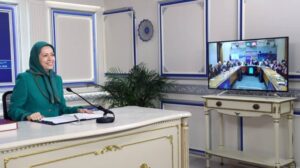
NCRI President-elect Mrs. Maryam Rajavi addresses UK parliamentarians and legal experts during a conference on March 4, 2026
NCRI President-elect Mrs. Maryam Rajavi addresses UK parliamentarians and legal experts during a conference on March 4, 2026
Baroness Rosalind Scott of Needham Market, co-chair of the British Committee for Iran Freedom, highlighted the “institutionalized female leadership” within the PMOI. Baroness Scott noted that the leadership of the movement is the result of “nearly five decades of sustained struggle against the regime.” She pledged to press for “formal diplomatic recognition of you, Mrs. Maryam Rajavi, and of your provisional government.” Baroness Scott stated that “women are leading the resistance, the protest, the Resistance Units,” and that a free Iran is “within reach because of your courage and sacrifice and that of all the women and men whom you lead.”
Mr. Jim Shannon MP, Member of Parliament for Strangford, described the NCRI as the “steadfast heartbeat” of the struggle. MP Jim Shannon warned against the “dangerous mirage” of the monarchy’s remnants, stating: “The Iranian people have suffered enough under two forms of dictatorship: the monarchical and religious. They are not looking to return to the past.” Mr. Shannon declared his “full and unwavering endorsement of this provisional government,” noting that the Ten-Point Plan guarantees “gender equality, abolition of the death penalty, and the essential separation of religion and state.” MP Shannon stressed that the people are “marching towards a future defined by the ballot box.”
Sir Roger Gale, a long-standing Member of Parliament, praised Mrs. Maryam Rajavi for being a “shining example.” Sir Roger Gale expressed concern about a potential power vacuum, stressing: “If they leave a vacuum that is not filled very swiftly by democracy, then you and I both know that it will be filled by others with evil intent as that that has gone before.” Sir Roger underscored that while the resolution lies in the hands of the Iranian people, international support is vital to ensure that “your Ten-Point Plan and your government and your democracy find a real foothold and a place in the future of Iran.”
Lord Archie Hamilton, a former Member of Parliament, reflected on the shifting geopolitical landscape. Lord Hamilton expressed his support for the “Ten-Point Plan for a free secular pluralistic democratic Republic in Iran” and highlighted the central role of Mrs. Maryam Rajavi. Lord Hamilton suggested that recent events, including the removal of key regime figures, represent an “enormous relief I’m sure for all Iranian people.” Lord Hamilton urged the international community to “do everything we can to influence the United States to come to a democratic conclusion for the future of Iran.”
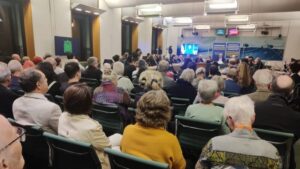
NCRI President-elect Mrs. Maryam Rajavi addresses UK parliamentarians and legal experts during a conference on March 4, 2026
NCRI President-elect Mrs. Maryam Rajavi addresses UK parliamentarians and legal experts during a conference on March 4, 2026
Massoud Zabeti, a lawyer and representative of the Anglo-Iranian community, congratulated the NCRI on the “formation of the provisional government.” Zabeti commended Mrs. Maryam Rajavi’s dedication “throughout all the difficult years that the Iranian people and your resistance have faced against the dictatorship of the Shah, followed by the tyranny and oppression of the Ayatollahs.” Zabeti described the Iranian embassy in London as a “den of spies and terrorists” that must be shut down. He emphasized that the “Resistance Units” and supporters of the PMOI are “all ready to pay whatever the price may be to bring about that final change.”
Professor Sarah Chandler, Secretary of the Federation of European Bar Associations Human Rights Commission, stated that the “international legal community stands by the Iranian people.” Prof. Chandler praised Mrs. Maryam Rajavi’s “consistent stand against war, appeasement, and your work over decades to build support for the Iranian people.” Prof. Chandler urged the UK government to “work for transition to a new government” and to implement the Ten-Point Plan to “bring justice to the people of Iran.” She concluded by calling for the release of political prisoners, including the “lawyers who represent protesters.”
Lord John Cryer compared the current regime to historical tyrannies, stating: “They’re the nearest thing we’ve got in the world today to the Nazis.” Lord Cryer advocated for the closure of the embassy and the expulsion of the ambassador, arguing that a democratic transition would create a “virtuous ripple out across the globe.” Lord Cryer reaffirmed his support for the NCRI’s Ten-Point Plan, asserting that “free election and the ballot box is the true criteria for any election.” Lord Cryer also called for the prosecution of those with “undisclosed financial links to Tehran” and its proxies.
Lord Malcolm Bruce expressed his long-standing support, stating: “My hope is that the Ten-Point Plan which articulates what anyone in the broadest sense of the word liberal would want to see in any country.” Lord Malcolm Bruce noted the extraordinary bravery of the “women in particular” who take risks to demand change. He remarked that “if there is strong support undercover in the country that can find its way through, then everything you’ve been doing for the last decades will be absolutely vindicated.” Lord Bruce emphasized that a “democratic liberal Iran” is essential for the “peace of the world.”
UK Parliament, online conference: Women’s leadership, an imperative for a free Iran, a democratic republic-
On the eve of International Women’s Day, I extend my sincere congratulations to you. This day is a time to renew our commitment to the ideals of freedom and equality. This… pic.twitter.com/OePiE47jRr— Maryam Rajavi (@Maryam_Rajavi) March 4, 2026
Dame Theresa Villiers, former cabinet minister, described the current moment as one filled with “hope.” Dame Theresa Villiers highlighted that “women are leading the campaign for democratic change and reform” and called for the creation of a “democratic, secular, non-nuclear republic where men and women enjoy equal rights.” Dame Villiers stated it is “time for the brutalization of women and girls by the regime to end” and for the “abhorrent prolific use of the death penalty” to be abolished. She expressed her desire to see Iran’s ancient civilization thrive again under the leadership of the resistance.
Dr. Leyla Hannbeck, who spent time in prison as a child in Iran, shared her firsthand witness of the “resilience of Iranian women under the brutal, murderous mullah regime.” Dr. Leyla Hannbeck stated that the courage of Iranian women is “one of a kind” and that they have “consistently spearheaded the protests and resistance.” Dr. Hannbeck called for the immediate proscription of the IRGC as terrorists. She concluded by stating: “It is encouraging to see the leader of the National Council of Resistance of Iran being a woman, Mrs. Maryam Rajavi, bringing hope to the oppressed women of Iran.”