
U.S. House Briefing Supports Mrs. Rajavi’s Roadmap for Democratic Change Led by Iranians
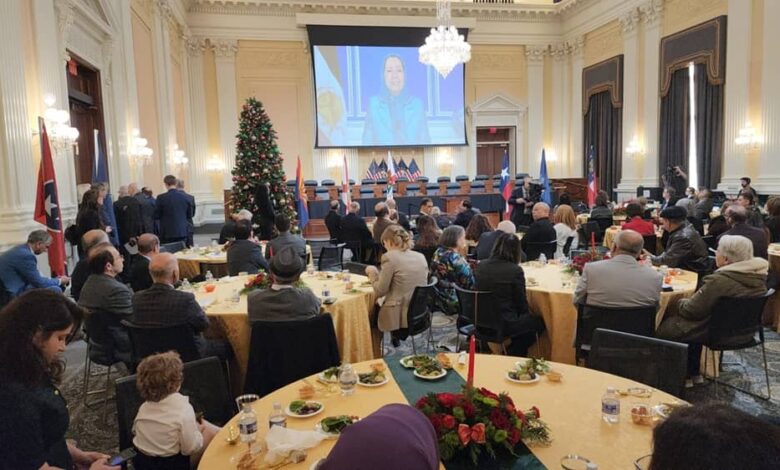
NCRI President-elect Mrs. Maryam Rajavi addresses US House Briefing on December 16, 2025
Written by
Shamsi Saadati
WASHINGTON — In a Dec. 16, 2025, briefing and reception in the U.S. House’s Cannon Caucus Room, Iranian American organizers and a bipartisan group of lawmakers promoted House Resolution 166 and amplified a shared message: Iran’s political future should be decided by Iranians, through a democratic, secular, non-nuclear republic. Speakers endorsed Mrs. Maryam Rajavi’s transition framework and Ten-Point Plan as a viable alternative, condemned Tehran’s repression and corruption, and—echoing warnings about “fake solutions”—argued against both clerical rule and a return to monarchy.
Moderating the event, Dr. Azadeh Sami, DO, a pediatrics specialist speaking for the Organization of Iranian American Communities, opened by thanking members of Congress, staff, advocates, and community leaders for gathering during “a time traditionally marked by reflection, hope, and a renewed commitment to peace.” Dr. Sami said the event and its accompanying resolution reflected “growing international recognition” of the Iranian people’s demands, honoring citizens who have “repeatedly made their voices heard” despite intimidation. Dr. Sami urged solidarity with those who “cannot speak safely for themselves,” particularly women, and framed the briefing as a values-driven appeal for “freedom, dignity, and democratic change.”
In her remarks, Mrs. Maryam Rajavi, President-elect of the National Council of Resistance of Iran, thanked lawmakers for sustained attention and highlighted H.Res. 166 as a political marker of support for “a democratic, secular, and nonnuclear Republic of Iran.” Mrs. Maryam Rajavi described the ruling clerical establishment as “a threat… to global peace and security,” citing executions and warning that repression at home and militarism abroad remain central to regime survival.
“This regime must be overthrown,” Mrs. Maryam Rajavi said, while underscoring a strict boundary: “Regime change is only the duty of the Iranian people and no one else.” She added, “We have never asked any country to intervene… We have never asked for money or weapons, and we will never do so.”
The NCRI President-elect laid out a transition blueprint: after the dictatorship falls, a six-month timeline leading to a nationwide election for a Constituent Assembly to draft a democratic constitution and appoint a transitional government. Mrs. Maryam Rajavi cast the organized resistance as capable and enduring—pointing to the NCRI’s coalition structure and the PMOI’s cadres, including the Ashraf-3 community in Albania—and argued that recent developments have “swept away fake ‘solutions’ and false alternatives” in favor of a democratic republic.
Briefing at the U.S. House of Representatives
I must also stress the importance of House Resolution 166, supported by 226 members, “expressing support for the Iranian people’s desire for a democratic, secular, and nonnuclear Republic of Iran,” and urging the free world to… pic.twitter.com/YNEd0NdvOZ— Maryam Rajavi (@Maryam_Rajavi) December 16, 2025
General Wesley Clark, the former NATO Supreme Allied Commander Europe, stressed agency inside Iran: “Only, only the people of Iran” can bring freedom, he said. General Wesley Clark urged lawmakers to consistently foreground Mrs. Rajavi’s Ten-Point Plan as the “right alternative,” emphasizing popular sovereignty; freedoms of speech, assembly, and political parties; separation of religion and state; gender equality; an independent judiciary; equal economic opportunity; and “a non-nuclear Iran devoid of weapons of mass destruction.” General Wesley Clark argued the plan should be repeated “here in the halls of Congress” and discussed broadly, describing it as a platform for peace and prosperity anchored in rights-based governance rather than force from abroad.
Representative Tom McClintock framed the moment as a season when “darkness begins to recede and light returns,” contending that Tehran’s system shows signs of terminal decay. Representative McClintock compared the ruling structure to “a rotting porch” that “still maintains its shape and form but is weak and hollowed out,” predicting it “only awaits a sudden shock” to collapse. Turning to congressional action, Representative McClintock credited advocates for winning overwhelming bipartisan support for H.Res. 166, describing it as a statement aligned with a “democratic, secular, and non-nuclear Iran.” He argued the future must be “liberated from the shackles of theocracy and monarchy,” restoring sovereignty to the people and guaranteeing rights “regardless of… gender or religion or race.”
I was pleased to deliver remarks in support of a democratic, secular, and non-nuclear Iran. The cause of a free Iran transcends party lines and history will remember who stood on the side of freedom. pic.twitter.com/IbHUGDuaIq
— Tom McClintock (@RepMcClintock) December 16, 2025
Congressman Brad Sherman, a senior member of the House Foreign Affairs Committee, paired holiday greetings with a grim accounting of repression. Congressman Sherman said the year had seen public executions numbering about a thousand, plus “sham trials,” citing cases he said lasted “only fifteen minutes.” He argued these conditions underscore the urgency of passing H.Res. 166 to formally support a “democratic secular non-nuclear Republic of Iran,” and said he stood with Representative Tom McClintock in pressing for passage. Congressman Sherman closed with a pointed wish for Iran’s capital: “Let us hope that when we go, there’s freedom there,” adding he hoped the end of clerical rule comes soon.
Congresswoman Val Hoyle anchored her remarks in women’s rights and secular governance, explicitly citing Mrs. Maryam Rajavi’s Ten-Point Plan. Congresswoman Hoyle said the plan makes clear “what we are fighting for,” including “the right to free speech, freedom of assembly, and the separation of religion and state,” plus freedom of belief. Congresswoman Hoyle emphasized “complete gender equality” and “equal participation of women in political leadership,” arguing that a society cannot be free if “almost half the population… need[s] to have representation.” She referenced conversations with women describing torture and the loss of family members for speaking out, then pledged continued advocacy in Washington: “We’re fighting for you, we’re supporting you, and this fight is worth having,” Congresswoman Hoyle said, looking ahead to implementation of the Ten-Point Plan.
A glance at a conference in the U.S. Senate on the eve of the New Year: Bipartisan support for the Iranian resistance, backing the Iranian people's demand for a free, secular, and democratic republic. Mrs. @Maryam_Rajavi was the keynote speaker. Some speakers included… pic.twitter.com/GmNaKZsAZE
— SIMAY AZADI TV (@en_simayazadi) December 18, 2025
Congressman Raul Ruiz delivered a short solidarity message tied to remembrance and perseverance. Congressman Ruiz said the gathering honored those “past and present, who have yearned for freedom in Iran,” and praised Aziz Rezai as emblematic of sacrifice and endurance. Congressman Ruiz described her legacy as reflecting “the greatness of a people” who have lived through “torture” and “struggle” sustained by hope for “a free secular democratic Republic of Iran.” He aligned that aspiration with Mrs. Maryam Rajavi’s Ten-Point Plan, urging supporters to “continue on with that dream” so future generations can live in a “free and prosperous” Iran with “equal rights for all.”
Congressman Lance Gooden centered his remarks on protecting opposition members at Ashraf 3 in Albania and keeping their cause visible in Washington. Congressman Gooden said safeguarding Ashraf 3 residents is “something that I’m very passionate about,” noting he has visited in person and hopes to return. His ultimate objective, he said, is that they “eventually… be able to return to a free Iran.” Congressman Gooden acknowledged “difficulties” with authorities in Albania and said supporters are “working to rectify that and working to protect you all,” while also thanking those inside Iran “continuing to stand up… for the rights of all.”
HAPPENING NOW | US House Briefing: Supporting The Iranian People's Struggle for A Democratic Free Republic, in the historic Cannon Caucus Room
Rep. Tom McClintock (R-CA) introducing Mrs Maryam Rajavi, stresses bipartisan support in the US Congress for her 10-Point plan.… pic.twitter.com/EBgzlAmiqr— NCRI-U.S. Rep Office (@NCRIUS) December 16, 2025
Chairman French Hill welcomed attendees to the Cannon Caucus Room and stressed that “energy and passion remains on both sides of the aisle” for a free, democratic, secular Iran. Chairman Hill highlighted an accountability measure he said became law last year, designed to expose alleged theft and corruption by senior leaders in Tehran, arguing that vast personal fortunes contradict claims of religious service. Chairman Hill said his committee would continue to “deliver sanctions” and press against Iran’s kleptocratic system, while also sustaining political and diplomatic pressure aimed at change led by Iranians themselves. Chairman Hill described the current period as unusually favorable for democratic momentum, portraying Tehran as weakened and facing growing constraints on its ability to project power.
Congresswoman Laura Friedman praised the Iranian American community for keeping democratic principles—peaceful assembly, self-determination, and the right to choose leaders—visible to the public and to Congress. She said their work is “keeping this issue in the news” and “putting a human face” on events affecting Iranians. Congresswoman Friedman said she was “proud to be a cosponsor” of H.Res. 166 in support of a “democratic, non-nuclear, and secular government,” and described her Los Angeles-area Iranian diaspora constituents as determined not to forget relatives facing repression. “I hope that you see me as your partner in that effort,” Congresswoman Friedman said.
Bipartisan House Briefing Affirms Support for the NCRI Alternative. Maryam Rajavi: "Only two real options remain: either the continuation of religious fascism… or real change by #Iran's people & Resistance, leading to a democratic, pluralistic republic." https://t.co/eJirIib1RL pic.twitter.com/UOpKrzlVo3
— Alireza Jafarzadeh (@A_Jafarzadeh) December 17, 2025
Representative Rob Menendez emphasized partnership with the Iranian American community and the goal of aligning U.S. policy with the interests of Iranians. Representative Menendez called it a “privilege” to join advocates who work to elevate “their voices, their stories,” and said he has supported legislation “important… to your community” to help “uplift the dignity of the Iranian people.” While acknowledging “the work is ahead of us,” Representative Menendez pledged continued engagement toward “a free Iran” with “a prosperous future,” describing the advocacy relationship as both persistent and personal.
Congressman Pete Sessions used his remarks to push an unambiguous political objective, repeatedly framing H.Res. 166 as an opportunity to “speak clearly” about Tehran’s brutality and Washington’s stance. Congressman Sessions said the resolution helps ensure “the truth is told,” but he placed greater emphasis on outcome: “our resolve… for regime change.” He argued the goal is not to anoint a successor but to insist the Iranian people deserve “a brighter future for themselves and their families,” built on Iran’s “greatest… asset… its people.” Congressman Sessions praised decades of diaspora advocacy for building bipartisan understanding, thanked supporters for public, peaceful mobilization, and urged sustained unity: “We want regime change… without really attempting to pick who might be next,” he said.
Congressman Glenn Grossman thanked attendees for coming to “educate the congressmen and the U.S. senators” about “the wonderful Iran that’s just beneath the surface.” Congressman Grossman offered a forward-looking note, saying he looked forward to continued discussions with advocates tracking developments and conveying on-the-ground realities. He described the aspiration as an Iran that can again be “the great wonderful country that it has been in the past and will again be in the future,” and he closed by welcoming further briefings from organizers.