
The University: Iran’s Bastion Against the Dictatorships of the Past, Present, and Future
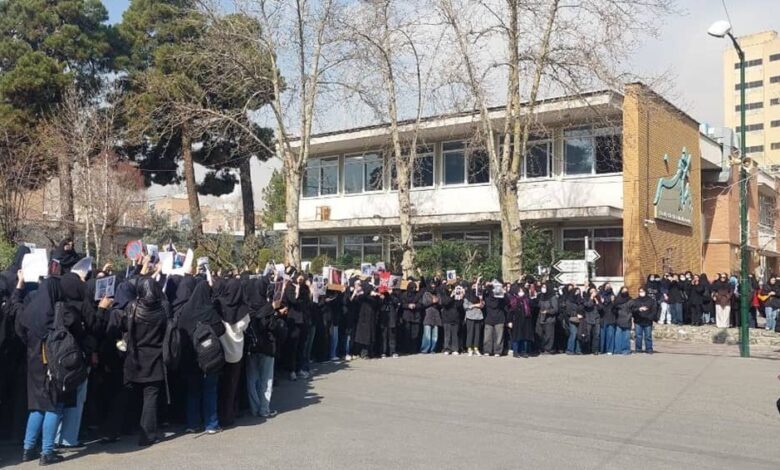
Tehran, February 23, 2026 — Alzahra University students gather in large numbers to commemorate the martyrs of the January uprising
Written by
Mehdi Oghbai
In the winter of 2026, as the new semester opened amid the lingering grief of January’s mass killings, Iran’s university campuses erupted once more. On February 22, students at the University of Tehran and Amirkabir University of Technology filled courtyards and streets with a single, resounding demand. They chanted: “Death to the oppressor, whether shah or leader.” And: “Neither monarchy nor leadership; democracy, equality.”
These are not mere slogans. They represent a hard-won clarity forged over nearly five decades of clerical despotism, punctuated by waves of uprising since 2017. The Iranian people—from young intellectuals and ethnic communities like the Kurds, Arabs, Baluchis, Lurs, and Azeris, to the older generations who remember the pre-1979 era without nostalgia—refuse to exchange one form of autocracy for another. They will not flee religious tyranny only to embrace a supposedly secular dictatorship propped up by exile figures and selective Western patronage.
February 22—Tehran, Iran
Students rallied to commemorate martyrs of the uprising. In their slogans, they rejected both the mullahs' and shah regimes:
"Down with the oppressor, be it the shah or the supreme leader"
"Neither monarchy, nor the mullahs' rule, yes to democracy and… pic.twitter.com/tHmiUW1gE8— People's Mojahedin Organization of Iran (PMOI/MEK) (@Mojahedineng) February 22, 2026
The Architecture of Influence
The current regime has ruled Iran for almost half a century, turning a geostrategically vital nation—rich in resources, population, and revolutionary potential—into a prison of fear and isolation. Yet every major upheaval in Iran reverberates far beyond its borders. A genuine revolution here would reshape the Middle East and beyond, for better or worse. The clerical rulers know this; that is why they crush dissent with such ferocity. But the students know it too, and they are acting accordingly.
The February protests build on a resilient, decentralized resistance that has radicalized over time. From the 2017–2018 demonstrations to the 2022 uprising and the deadly crackdowns of January 2026, each wave has grown more explicit in its call for regime overthrow, not reform. Universities remain the vanguard: spaces where relative autonomy allows organized defiance to flourish, where networks span cities and ethnic lines, and where 47 years of bitter experience have taught Iranians to distinguish propaganda from truth.
This experience breeds deep skepticism toward external narratives and imported saviors. State media long ago lost all credibility, leaving many vulnerable to slick exile broadcasts that mix genuine exposés with agenda-driven spin. Social media amplifies emotionally charged content, often funded by interests that have no stake in Iran’s sovereignty. Fake clips, paid influencers, and psychological operations exploit the population’s pain—economic collapse, mass poverty, endless repression—to steer public sentiment toward prefabricated outcomes.
#Breaking Iran Protests Update – Statement by a Group of Tehran University Students Regarding the Fake Videos Published:
“The monarchists seek to legitimize dictatorship and deprive this space — the voice of the people — of real freedom and democracy.”#No2ShahNo2MullahThe… pic.twitter.com/BFAIgC71IT
— SIMAY AZADI TV (@en_simayazadi) February 22, 2026
The Caricature of Leadership
The failed diaspora “alliance” at Georgetown University in early 2023 stands as a cautionary tale. In the wake of Mahsa Amini’s murder and the ensuing nationwide revolt, controversial exiles—including Reza Pahlavi—gathered to issue the Mahsa Charter and promise unity for a secular, democratic transition. The effort collapsed almost immediately, fractured by egos, strategic disagreements, and the unmistakable sense that one figure sought dominance over genuine coalition-building. It was symbolic theater, not serious politics—much like the broader exile opposition, which excels at media appearances but struggles to translate diaspora clout into domestic organization.
Reza Pahlavi, in particular, embodies this disconnect. Cast by some as a transitional figure or unifying symbol, he is better understood as a caricature of past autocrats: armed with media access, selective Western support, and little else. Unlike Ruhollah Khomeini in 1979—who exploited a vacuum left by the Shah’s brutal suppression of secular opposition while clerical networks operated freely—Pahlavi lacks even minimal legitimacy or infrastructure inside Iran. The Shah had eliminated rivals and tolerated the mullahs as a “safe” alternative; today’s resistance is far more organized, nationwide, and ideologically diverse. It draws on decades of trial and error, bridging ethnic groups, generations, and political tendencies in pursuit of real independence.
❓ Do you know why protesters across Iran chant “Down with the Oppressor, Be it the SHAH or the LEADER"?
▶️ Because ongoing #IranProtests embody over 120 yrs of struggle for freedom, against tyranny of monarchs & clerics.#مرگ_بر_ستمگر_چه_شاه_باشه_چه_رهبرpic.twitter.com/RlKWg0lt8p
— NCRI-U.S. Rep Office (@NCRIUS) February 17, 2023
A Sovereignty of the People
The contrast with 1979 could not be starker. Back then, revolution filled a void. Today, an organic, street-tested movement exists—one capable of mobilizing bazaars, factories, schools, and neighborhoods. It rejects both the decaying theocracy and any shadow dictatorship waiting in the wings. The students’ chants are a double rejection: no to the mullahs in power, and no to the monarchy lurking in exile, often amplified by powers eager to fragment opposition or extract concessions from the regime.
Iran’s future cannot be dictated from Los Angeles studios or Georgetown conference rooms. It will emerge from the campuses, streets, and resilient networks that have sustained defiance for years. The regime’s brutality—thousands dead in recent months alone—only accelerates the inevitable. As protests enter their third day amid clashes and fresh crackdowns, the message from Iran’s universities rings clear: The people demand democracy and equality on their own terms, free from tyrants of any stripe.
This is not nostalgia for a lost empire or faith in a clerical republic. It is the voice of a nation that has suffered enough experiments imposed from above—or from abroad. Iran’s students are not waiting for permission or a crowned intermediary. They are declaring that the era of stolen revolutions is over.