
The Sinking State: Iran’s Winter of Converging Crises
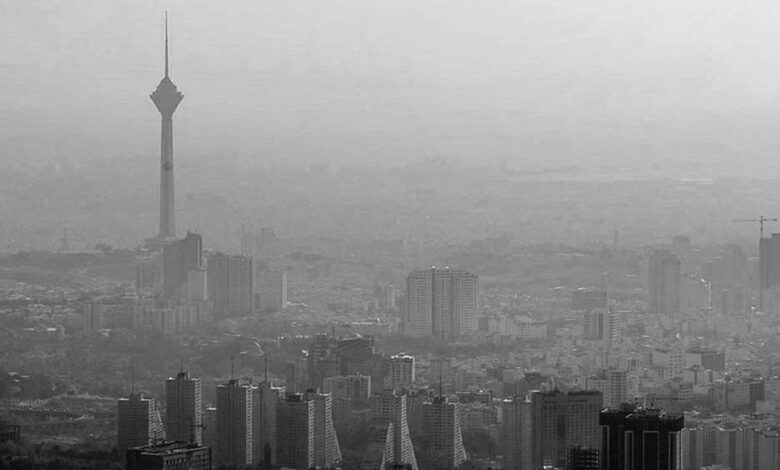
The Milad Tower rises above a smog-choked Tehran in December 2021
Written by
Dr. Masumeh Bolurchi
In the southern city of Ahvaz, the ground opened up on December 16 and swallowed a truck. It was not an isolated geological fluke, but a visceral metaphor for a nation where the literal and metaphorical foundations are giving way. As December 2025 draws to a close, Iran finds itself paralyzed by a “perfect storm” of state failure: a collapsing healthcare system, an environmental catastrophe of sinking lands, and an economy so hollowed by inflation that even the middle class has begun purchasing basic holiday goods on credit.
The crisis is no longer confined to the corridors of power or the fringes of society; it has moved into the lungs and wallets of every citizen. In mid-December, school gates across nine provinces—from the mountainous northwest to the humid southern coast—swung shut. The official reason was a “dual threat” of a virulent influenza wave and hazardous air pollution. Yet, beneath the smog, the shutdown signaled a deeper bankruptcy of public infrastructure.
Health officials have confirmed that influenza fatalities have climbed past 115 in the current wave, with infection rates in several provinces doubling the “warning threshold.” In Tehran and other major hubs, the air has become a toxic cocktail of industrial emissions and low-grade fuel, creating a respiratory trap that has forced millions into an involuntary lockdown.
#Iran’s Crises Converge as Inflation, Shortages and Safety Failures Deepen https://t.co/QDa3Cc0NCz
— NCRI-FAC (@iran_policy) December 17, 2025
The Earth Gives Way
While the air stifles the population, the ground beneath them is disappearing. Experts within the regime’s own environmental agencies are now warning of a “national disaster” regarding land subsidence. Khorasan Razavi province has emerged as the epicenter of this collapse, with sinking zones five times larger than those of its neighbors. This structural decay is the bitter harvest of decades of aggressive groundwater depletion and mismanagement.
In the south, nature has added a cruel irony. While much of the country thirsts, provinces like Fars and Hormozgan have been ravaged by flash floods. Streets have transformed into “roaring rivers,” washing away harbor piers in Bandar Abbas and severing the lifelines of dozens of villages. The state’s response has been criticized as sluggish and disorganized, leaving volunteers and local communities to search for the missing among the debris of destroyed homes.
#Iran’s Clerical Regime Besieged by Crisis on All Frontshttps://t.co/nZOV8dWMx6
— NCRI-FAC (@iran_policy) October 23, 2025
The Economics of Extortion
The economic indicators for the final quarter of 2025 suggest a country entering a terminal stage of stagflation. With economic growth hovering at zero and the official account of inflation projected to hit 50 percent by the Persian New Year, the government has resorted to what critics call “state-sponsored extortion.”
Toll fees for ten major national highways were recently hiked by as much as 120 percent. The move is widely seen as a desperate attempt to patch a massive budget deficit. For a population already reeling from a 320 percent cumulative inflation rate over the last eight years, the move is a gut punch. Reports from the bazaar indicate that the official account of poverty rate has expanded to 36 percent of the population. In a telling sign of the times, pastry shops and nut vendors—traditional staples of Iranian social life—report that demand has plummeted by half. Those who do buy are increasingly doing so through installment plans or post-dated checks.
Even the digital escape for Iran’s youth has been severed. For years, tech-savvy Iranians used “virtual private networks” (VPNs) to bypass state censorship and earn income on platforms like YouTube. However, a new phase of digital fingerprinting and behavioral tracking by global tech giants—intended to comply with international sanctions—has effectively identified Iranian users with pinpoint accuracy. This has triggered a “total collapse” in ad revenue for Iranian creators, shutting off one of the last remaining avenues for dollar-based income in a country where the local currency is in freefall.
#Iran’s Poverty Line Exposed as Deception, Leaving Millions Below Survivalhttps://t.co/tC7yv7lDgJ
— NCRI-FAC (@iran_policy) October 25, 2025
A Burnt Earth of Trust
Politically, the administration of Masoud Pezeshkian is drowning in a “burnt earth of trust.” Elected on empty promises of “consensus” and “reform,” Pezeshkian now stands accused of overseeing a government of “oscillation.” His promises to end internet filtering and stabilize the currency have withered, while the “merchants of filtering”—shadowy entities that profit from the sale of state-blocked software—continue to rake in an estimated 50 trillion tomans annually.
The internal discord has become public. Former President Hassan Rouhani recently made a rare, stinging intervention, admitting that the regime’s leadership committed a catastrophic “calculation error” by assuming that military strikes from the United States or Israel were an impossibility. This admission of strategic blindness comes as extremist factions and revisionists trade blame in the state media, with the former calling for a return to the “revolutionary” austerity of the past and the latter warning of a total social explosion.
#Iran's Regime Scrambles to Contain What It Now Calls a ‘War’ at Homehttps://t.co/G98dTRcceg
— NCRI-FAC (@iran_policy) October 25, 2025
The Lost Generation
Perhaps most damning is the toll on Iran’s human capital. The country’s educational and professional structures are no longer functioning as ladders for social mobility. Official data reveals that nearly 50 percent of the country’s unemployed are university graduates. For women, the figure is a staggering 70 percent.
This lack of future prospects has fueled a burgeoning addiction crisis. State health monitors now admit that five percent of the student population is struggling with drug addiction, with the age of onset dropping and the rate among young women rising sharply. Combined with a road safety crisis that claims 2,000 lives a month—a carnage that costs the country more than its entire education budget—the “future” of the clerical regime is being depleted before it can even begin.
As the winter of 2025 deepens, the narrative of a “stronghold” against foreign influence is being replaced by the reality of a state that cannot provide clean air, stable ground, or a living wage. The question looming over Tehran is no longer whether the system can reform, but how much longer it can survive by “bending the back” of a society that is rapidly reaching its breaking point.