
“The Flag Never Fell”: Veteran Political Prisoner Ali Moezzi Hails a New Era of Resistance from Ghezel Hesar
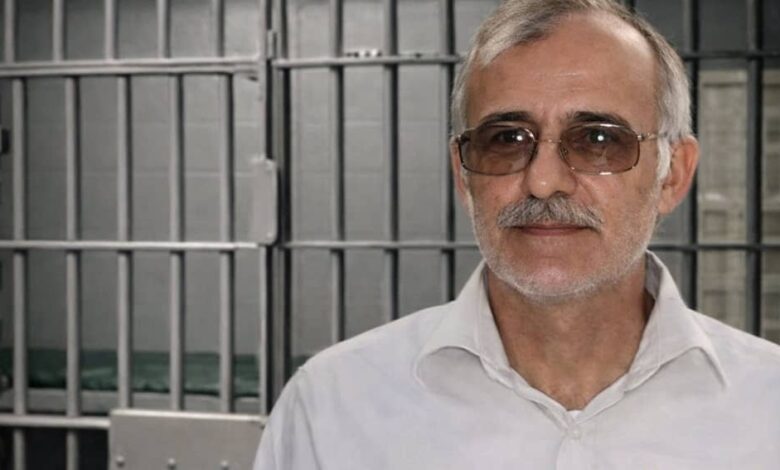
Iranian political prisoner and PMOI supporter Ali Moezzi
Written by
Dr. Masumeh Bolurchi
From the depths of Ghezel Hesar Prison, one of Iran’s most storied political detainees, Ali Moezzi, has issued a powerful message declaring that Iran has entered a “new stage of history.” Moezzi, a veteran activist whose experience spans four decades of incarceration, describes a fundamental shift in the Iranian resistance, characterized by a new generation of “iron-willed” youth who have rendered the regime’s machinery of execution obsolete.
Ending a Century of Dictatorship
Moezzi’s statement follows the National Council of Resistance of Iran’s (NCRI) announcement of a provisional government led by its president-elect Mrs. Maryam Rajavi. Moezzi views this as the definitive moment to “end a hundred years of the monarchist and clerical dictatorships once and for all.”
Reflecting on the recent uprisings, Moezzi writes with a sense of prophetic urgency: “The head of the snake has been struck, and the volcano of the people’s wrath is about to erupt. I bear witness to this through the brave children of the people with whom I have spent years of my life in these prisons.”
🚨 Political Prisoner Ali Moezzi in Danger 🚨
71-year-old Ali Moezzi, suffering from multiple illnesses, was beaten & forcibly moved from Evin to Qezel-Hesar Prison on Feb 15. His exact whereabouts remain unknown. https://t.co/R2F2zKUZe5
⚠️ With his health at grave risk, urgent…— IRAN HRM (@IranHrm) February 17, 2025
The “Iron Generation” of Resistance Units
A significant portion of Moezzi’s message is dedicated to the evolution of the resistance since 2022. He describes encountering a “new phenomenon of courage” in the form of Resistance Units within the prison walls. He honors recent martyrs like Mehdi Hassani and Behrouz Ehsani, noting that they held solitary confinement, torture, and the gallows “in total contempt.”
Moezzi provides a rare, vivid glimpse into the interrogations of this younger generation in the regime’s “show trials,” quoting their defiance directly:
Judge: “Are you not regretful?”
Prisoner: “No, not at all. I am proud!”
Judge: “Was this just youthful emotion?”
Prisoner: “No, it was intentional, conscious, and with firm resolve!”
Judge: “What will you do if you are released?”
Prisoner: “If I die and come back to life a hundred times, I will continue this same path!”
“It was here,” Moezzi reflects, “that I saw with my own eyes how the flag of the Mojahedin’s cause was passed from hand to hand; it turned and turned, but it never fell to the ground. Instead, it was raised each time on a higher peak by the next generation.”
Parliamentarians Call to Save Political Prisoner #AliMoezzi in #Iran. https://t.co/id0dbyLq5I pic.twitter.com/FWpFCZz3bO
— NCRI-FAC (@iran_policy) January 11, 2017
A Defiant Scene in a Public Hospital
Perhaps the most striking anecdote in Moezzi’s report involves a young Resistance Unit member recently sent from prison to a public hospital. When the surrounding patients, nurses, and staff realized he was a political prisoner under a death sentence, a crowd gathered in solidarity.
Moezzi recounts the dialogue that unfolded in the public ward:
Hospital Staff: “What sentence did you receive?”
Prisoner: “Execution!”
A Voice in the Crowd: “They are damn wrong to do so! What are you looking for?”
Prisoner: “Freedom for the people and a Democratic Republic. We want neither the Monarchy nor the Velayat-e Faqih (Clerical Rule)!”
According to the report, the young man then shouted three times in the middle of the hospital: “Death to the oppressor, whether it be the Shah or the Leader!”
Iran’s political prisoners champion the NCRI’s democratic transition https://t.co/7oSiWnpO3x
— People's Mojahedin Organization of Iran (PMOI/MEK) (@Mojahedineng) March 3, 2026
A Vision of Victory
Moezzi, who recalls the martyrs of the 1980s, 2000s, and 2010s—including Ali Saremi, Gholamreza Khosravi, and Zanyar Moradi—concludes that the continuity of this struggle has finally reached a breaking point for the regime. He describes the current generation as “unmatched gems” whose bravery has turned his long-held faith into “absolute certainty.”
“Victory is ours,” Moezzi declares from his cell in Ghezel Hesar. “Tomorrow is ours.”