
“The Fatal Blow Must Come from the People” – Inside the NCRI’s Vision for a Post-War Iran
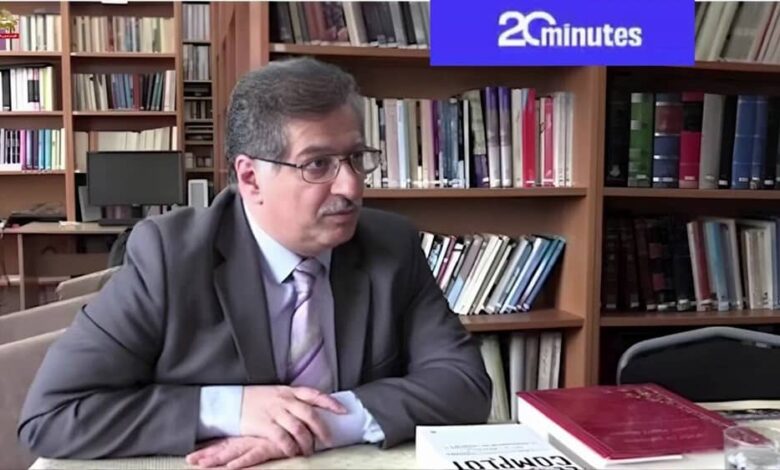
NCRI FAC member Afchin Alavin in an interview with 20 Minutes
Written by
Mahmoud Hakamian
In an exclusive interview with BFMTV, Afshine Alavi, a member of the Foreign Affairs Commission of the National Council of Resistance of Iran (NCRI), provided insights into the exiled opposition group’s perspective on the ongoing US and Israeli military operations against the Iranian regime, the death of Supreme Leader Ali Khamenei, and the future of the country. In his remarks, Alavi emphasized that true regime change must come from within Iran, rejecting both foreign-imposed solutions and media-prompted figures like Reza Pahlavi.
When asked how the NCRI views the military operation, Alavi responded that the council’s longstanding position is clear: “The solution is neither war nor complacency towards the regime, but the overthrow of the regime by the Iranian people and their resistance.”
He paraphrased the current situation by stating that Khamenei’s death at age 86 “marks the end of religious tyranny,” which could result from natural causes, internal resistance, or external pressures. However, Alavi stressed that the regime, while in “total destabilization,” will not collapse automatically, and “it is not foreign armies that will do it.”
"Le coup fatal ne peut être donné que par le peuple": en exil, comment le Conseil national de la résistance iranienne voit l'opération militaire américaine et l’avenirhttps://t.co/Oh0nQxlZrG
— BFM (@BFMTV) March 4, 2026
Looking forward, Alavi expressed hope for “the time has come to establish freedom and sovereignty for the Iranian people.” He called for international recognition of the Iranian people’s right to resist, particularly against the Revolutionary Guards, and for equipping them with the means to overthrow the weakened regime. Alavi warned against foreign interventions imposing leaders, as “such practices have never brought luck or good things.” He asserted, “The fatal blow can only be given from the inside by the Iranian people.”
Alavi highlighted NCRI President-elect Maryam Rajavi’s appeals during the conflict, noting she has urged belligerents “to take all measures to spare the population and potential damage to the country’s civil infrastructure” while encouraging Iranians to show solidarity and aid the vulnerable amid bombings.
Explaining the NCRI’s proposals, Alavi described the organization, founded in 1980 as a coalition of five political parties with nearly 456 members, as committed to overthrowing the theocratic regime and establishing a “democratic and secular republic.” He outlined Mrs. Rajavi’s Ten-Point Plan, which includes abolishing the death penalty, gender equality, separation of religion and state, regional autonomy (such as for Kurdistan), an independent judiciary, human rights protections, peaceful international relations, and a non-nuclear Iran. Alavi emphasized women’s central role, stating, “Without the leadership of women, the overthrow of the regime will not happen,” noting the NCRI’s majority-female membership. He added that the NCRI is independent, relying on no foreign state.
🔴 🗣️ Le fils de l'ancien Chah s'autoproclame figure de la transition.
"Sa seule représentation qui le met en avant, c'est d'être le fils d'un dictateur", estime @afchine_alavi, membre du Conseil national de la Résistance iranienne.
@loiccdelamornais #SurLeTerrain #Canal16 pic.twitter.com/unm5aMGNkY
— franceinfo (@franceinfo) January 12, 2026
In the event of the regime’s fall, Alavi detailed plans for a transitional government. He highlighted NCRI’s recently announced provisional government to oversee a maximum six-month period post-overthrow, preparing for free elections by universal suffrage to form a constituent assembly for a new constitution. The provisional government’s role ends once this assembly is established, he explained.
Addressing the NCRI’s exile status, Alavi explained that members are abroad due to severe persecution, including executions and family targeting by the regime. However, he highlighted their influence inside Iran through the People’s Mujahedin of Iran (PMOI), which operates “resistance units” in all cities. These units recently attacked Khamenei’s headquarters before the war, demonstrating ongoing internal challenges to the regime.
Alavi refuted labels of the NCRI as communist, describing it as a diverse coalition including liberals, Marxists, Muslims, atheists, and Christians, united without a single ideology. He called the PMOI “Muslim democrats” advocating for a secular state, led by women.
On support in Iran, Alavi noted the difficulty of polling under dictatorship but pointed to the regime’s repression—executing 100,000 members, including 30,000 in 1988—as evidence of the NCRI’s legitimacy, broad social base and threat to the authorities.
Ravi d’être l’invité de @franceinfo pour analyser la situation en #Iran. Le chaos au sommet suite à la disparition d'Ali Khamenei est manifeste. Pour briser définitivement l'emprise des Gardiens de la révolution (Pasdaran – #IRGC ), la réponse viendra de la résistance organisée… pic.twitter.com/AqnZaQW4Q8
— Afchine Alavi (@afchine_alavi) March 4, 2026
Finally, Alavi firmly opposed Reza Pahlavi, the son of the disposed Shah, reminding that the slogan “neither shah nor mullah” has been a principled and widespread chant among Iranians. He criticized Pahlavi for not condemning his father’s crimes and representing a “chauvinistic, autocratic, repressive system.”
Alavi warned that imposing Pahlavi externally could lead to “chaos and civil war,” as he lacks genuine support and pushes foreign powers to install him. Dismissing Pahlavi’s democratic claims, Alavi analyzed his program as autocratic, with appointed assemblies, extended transitions, and reinstatement of repressive institutions like the SAVAK under a new name, comparing it to the mistake made with Khomeini.