
Tehran Moved the Front Abroad. Its Survival Crisis Came Home
Protesters stand on a nighttime city street in Iran during the January 2026 uprising
Written by
Mehdi Oghbai
Iran’s crisis in September 2026 can be measured in missiles, oil tankers and inflation. Iranian crude loadings collapsed from roughly 2 million barrels a day in March to about 220,000–255,000 in August. The IMF expects inflation to approach 70 percent. A U.S. naval blockade has accomplished what years of sanctions could not: choking one of Tehran’s principal sources of foreign currency.
But the regime’s present crisis did not begin at sea, nor did it begin with the regional wars that eventually reached Iranian territory. Its origins lie in a far more fundamental threat to the ruling system: repeated nationwide revolt inside Iran.
The first warning came on December 28, 2017, less than two years after implementation of the JCPOA and the sanctions relief that accompanied it. Protests beginning over prices rapidly became political and spread nationwide. The National Council of Resistance of Iran reported at least 50 protesters killed and some 8,000 arrested.
November 2019 was more dangerous. A sudden gasoline-price increase ignited an uprising across roughly 190 cities. According to the NCRI, more than 1,500 protesters were killed, 4,000 wounded and 12,000 arrested. It estimated that more than 1,890 state and security-linked facilities were attacked, including more than 1,000 banks, dozens of security centers and scores of government institutions.
Then came September 2022. The uprising following Mahsa Amini’s death persisted for months. By December, the PMOI estimated that more than 750 protesters had been killed and more than 30,000 detained as demonstrations reached more than 280 cities.
2)
Iran: 2019 Uprising, Cities and Provinces in November 2019 #Iran Protests #WeStand4FreeIranhttps://t.co/wNYyIHTiII pic.twitter.com/WAxenPetAD— NCRI-FAC (@iran_policy) November 1, 2020
Three uprisings had established the strategic problem confronting Ali Khamenei: the gravest threat to the system was no longer merely foreign pressure. It was an increasingly rebellious society at home.
But the danger, from Tehran’s perspective, went beyond the existence of public anger. Iran was not simply witnessing isolated eruptions of discontent. During the same period, the MEK’s Resistance Units were expanding their activities across the country. The regime therefore faced two developments that were potentially far more dangerous in combination than separately: an explosive society repeatedly prepared to rise up, and an organized resistance seeking to give that anger continuity, direction and structure.
That combination changed the regime’s strategic calculation. Spontaneous unrest could be suppressed. Individual protests could be dispersed. But recurrent nationwide uprisings intersecting with an organized network presented a different problem: they pointed towards a potential mechanism for overthrow.
This domestic vulnerability is essential to understanding the deeper significance of Tehran’s doctrine of “strategic depth”. The policy was not merely about projecting power across the Middle East. It also served a regime whose overriding concern was survival at home. Keeping conflict beyond Iran’s borders, dominating regional battlefields and forcing international attention outward helped prevent domestic instability from becoming the central political question.
Khamenei repeatedly defended intervention abroad as a way of preventing war from reaching Iran. In 2017, explaining the Syrian intervention, he said that had Tehran not confronted its enemies there, it would have had to confront them in “Tehran, Fars, Khorasan and Isfahan.” Iranian military leaders similarly described Syria and Iraq as a security shield operating beyond Iran’s borders.
Tehran paid accordingly. Documents obtained after a breach of Iranian presidential servers indicated that the regime calculated more than $50 billion had been spent sustaining Bashar al-Assad’s government during the Syrian war. Other leaked correspondence showed billions in Syrian debts that Tehran was struggling to recover.
Leaked document exposes #Iranian regime's financial support for #Syria. What are the implications of Billions of dollars squandered to prop up #Assad's regime?https://t.co/z4Ol9DSoHd
— NCRI-FAC (@iran_policy) June 11, 2023
Syria was not simply an ally. It was the geographical hinge connecting Iran to Hezbollah and the Mediterranean—the “tent pole” of the regional axis, as Khamenei was quoted describing it.
Then came October 7, 2023. Whatever the immediate calculations behind the attack, the regional crisis that followed activated the architecture Tehran had spent decades constructing: armed proxies, allied militias and political influence extending from Tehran through Iraq and Syria to Lebanon and the Mediterranean. It also shifted international and regional attention dramatically away from Iran’s domestic crisis.
For a regime that had confronted three major uprisings in five years, that externalization of crisis had an obvious political advantage. The immediate center of gravity moved away from the streets of Iran and towards Gaza, Lebanon, Syria, Iraq and the wider confrontation with Israel and the United States.
The Iranian Resistance argued at the time that focusing only on Tehran’s proxies mistook the branches for the source of the problem: the “head of the snake”, it maintained, was in Tehran.
For a period, the regional confrontation gave the regime breathing space at home. But the price would prove enormous. A strategy designed to protect Tehran ultimately began destroying the very strategic depth on which Tehran had relied.
The regime’s proxy network was badly degraded. Hezbollah suffered severe military and leadership losses, while the collapse of the Syrian government in December 2024 broke a vital territorial and logistical link in Tehran’s regional network. The regional shield designed to keep confrontation away from Iran progressively disappeared.
War arrived directly in June 2025. After twelve days of Israeli and U.S. strikes, Khamenei rejected what he called an “imposed peace.” His logic was consistent: retreat under pressure threatened more than a military setback. It threatened the image of ideological invulnerability on which the regime’s remaining loyal constituency depended.
Khamenei’s Strategic Losses in 2024:
Apr 1 – Senior #IRGC commanders and Quds Force officials killed in Syria strike.
Jul 31 – Hamas leader Ismail Haniyeh assassinated in Tehran.
Sep 17-18 – Pager and walkie-talkie explosions injured 3,000 and killed 40 Hezbollah commanders in… pic.twitter.com/ICd74GVLsG— NCRI-FAC (@iran_policy) January 1, 2025
But even while the external shield was breaking apart, Tehran’s central fear remained at home. The regime had succeeded in postponing another nationwide confrontation; it had not removed the conditions that produced one.
By late 2025, officials were sufficiently worried about another gasoline-triggered explosion that price increases were introduced cautiously. The security forces were placed on maximum alert as the new pricing system was introduced.
It did not work.
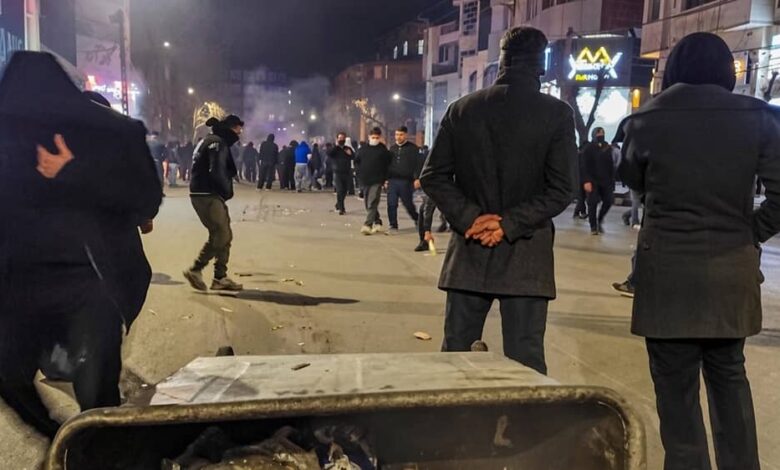
On December 28, Tehran’s bazaar merchants began closing their shops as the rial collapsed. The protests spread from the commercial heart of the capital into universities and cities nationwide.
The bloodshed dwarfed previous uprisings. The PMOI domestic network estimated by January 12 that more than 3,000 protesters had been killed. By February 24, the NCRI had published the identities of 2,572 of those killed. The regime subsequently announced an official toll of 3,117; other rights monitors produced still higher estimates.
The state had anticipated the revolt, mobilized against it and still failed to prevent it.
That point is crucial. After the uprisings of 2017–18, 2019 and 2022, after years of executions, arrests, surveillance and repression, and after a regional crisis that had temporarily diverted attention outward, the same threat returned. The underlying conflict between society and the state had not disappeared.
Then came February 28.
U.S. and Israeli strikes killed Ali Khamenei along with senior military leaders. After roughly forty days of intense fighting, a fragile ceasefire emerged in April, though hostilities later resumed and by September the conflict had become a six-month war.
Why #Iran's Regime Cannot Negotiate with the U.S.https://t.co/Saa010Slk8
— NCRI-FAC (@iran_policy) February 9, 2025
The regime answered Khamenei’s death not with reform but with continuity. On March 8, the Assembly of Experts selected his son Mojtaba as supreme leader. He subsequently kept his father’s appointees in place and ordered them to continue operating under existing policies.
That choice was not simply ideological continuity. It reflected the regime’s assessment of what would happen if a weakened leadership appeared to retreat while confronting an already rebellious society.
The regime’s loyalist base is narrower than it once was, but it remains armed, organized, and bound by shared interests rather than ideology. For a leadership facing an explosive society, visibly admitting that decades of suppression, proxy warfare, nuclear confrontation and economic deprivation ended in surrender risks demoralizing precisely the constituency it still needs to survive.
This is why seemingly separate actions by the regime must increasingly be viewed through the same lens. Its overriding question is no longer how to restore the regional order that existed before October 2023. It is how to prevent military defeat, economic crisis and public anger from converging into another uprising capable of threatening the system itself.
That is why foreign pressure and domestic repression now move together. Since March 19, at least 56 people have been executed on national-security charges, according to the UN human-rights chief, including 27 connected to the January protests. At the same time, the NCRI reports expanding activity by MEK-linked Resistance Units.
The mass killing of protesters during the January uprising, the security atmosphere imposed afterwards, the accelerated use of executions and the targeting of political prisoners must therefore be understood not as isolated acts of repression, but as elements of a broader survival strategy.
The Mistake That Defined #Iran’s Fate https://t.co/qFthScAww6
— Iran Freedom (@4FreedominIran) March 29, 2026
The regime is attempting to raise the cost of rebellion before another uprising begins.
At the same time, the NCRI reports expanding activity by MEK-linked Resistance Units.
And this is the central contradiction the regime has so far failed to resolve. Repression can kill protesters, but it has not removed the causes of revolt. Executions can spread fear, but they have not succeeded in creating lasting political passivity. The Resistance Units continue to operate, and public acts of defiance continue to challenge the image of a society that has been intimidated into submission.
For Tehran, therefore, suppressing dissent is only half of the problem. It must also prevent an explosive society from connecting politically and organizationally with the force it regards as its most serious organized enemy.
This helps explain the intensity of the regime’s campaign against the MEK. Physical repression and executions operate from one direction; demonization operates from another. The objective is not simply to attack an opposition organization. It is to create a political and psychological barrier between social discontent and an organized resistance capable of converting recurring revolt into a sustained challenge to the state.
Information control serves the same purpose. Censorship of MEK activities, restrictions on news concerning the Resistance Units and the amplification of political alternatives that present little organizational threat to the state can all have the practical effect of widening that barrier. Whatever the intentions of actors outside Iran, the regime benefits whenever the principal question, how domestic anger could acquire organization and direction, disappears from public discussion.
Must-Read enlightening analysis of the impact of the MEK @ResistanceUnits inside Iran: "The Illusion of the External Enemy: How Domestic Agency is Redefining Iran's Future"https://t.co/59ZIkRUIwn@realDonaldTrump @SecRubio @mattgaetz @jaketapper
— Ali Safavi (@amsafavi) July 13, 2026
The central question confronting Tehran in September 2026 is therefore the same question that emerged from the uprisings of 2017, 2019 and 2022, but under far more dangerous circumstances: can the regime prevent another explosion of popular revolt from connecting with an organized nationwide resistance?
Almost everything it is doing, from executions and internal repression to propaganda, censorship and its refusal to display weakness abroad, can be understood in relation to that fear.
Tehran moved the front abroad in an attempt to protect the regime at home. The regional front has now largely collapsed back towards Iran.
The decisive front is inside Iran.