
Senior Iranian Military Official’s Trip to Impoverished Sistan and Baluchestan Revealed Tehran’s True Priorities
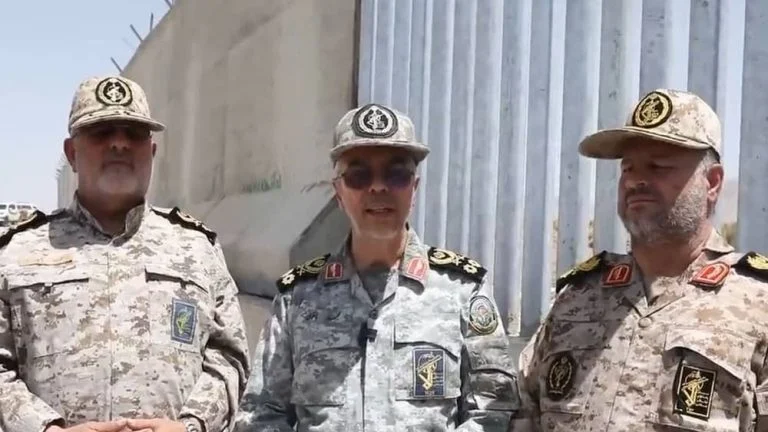
Major General Mohammad Bagheri (center) speaks to reporters during his visit to Sistan and Baluchistan — May 20, 2025
Written by
Farid Mahoutchi
On May 20, 2025, Major General Mohammad Bagheri, Chief of Staff of the regime’s Armed Forces, made a high-profile visit to Sistan and Baluchistan—one of Iran’s most impoverished and restive provinces. The purpose: overseeing the expansion of a massive border wall along Iran’s eastern frontiers with Pakistan and Afghanistan.
During the trip, Bagheri inspected military outposts in Mirjaveh and Saravan and visited a factory producing 4-meter-high concrete segments that form part of the wall. The structure, equipped with advanced surveillance systems such as drones, motion sensors, and panoramic cameras, is portrayed as a key tool for combating terrorism, smuggling, and illegal crossings. Bagheri stated that Iran could construct up to 600 kilometers of the wall per year.
This multi-year project—estimated to cost over $3.25 billion USD—is being led by the Revolutionary Guard’s engineering units. Though framed as a security imperative, it starkly illustrates the clerical regime’s priorities. In a province plagued by chronic underdevelopment, where many residents lack access to clean water, healthcare, and education, even a fraction of that budget could have significantly improved lives. Instead, the regime has chosen walls over welfare.
#Iran News: Regime Expands Security Apparatus in Sistan and Baluchestan Amid Resistance and Repressionhttps://t.co/xRGwChwFD0
— NCRI-FAC (@iran_policy) April 22, 2025
The timing of Bagheri’s visit further underscores the regime’s insecurity. It occurred just days before Pakistani Prime Minister Shehbaz Sharif arrived in Tehran for talks on what the state framed as “regional stability” and “cooperation.” While the regime staged warm diplomatic overtures in Tehran, it was simultaneously entrenching a physical and symbolic barrier along the shared border—revealing a profound distrust not just toward its neighbor, but toward the very population of Sistan and Baluchistan.
During a provincial strategy session held as part of the visit, Bagheri and top military, clerical, and administrative figures focused almost exclusively on security coordination. He lauded the readiness of deployed forces and praised their performance—language that pointedly ignored the deep socio-economic grievances that have fueled unrest in the region for years.
Protests in Iran’s Sistan and Baluchistan: Overview and Origins#Iran #Sistan_Baluchestan #Baluchestan #Saravan https://t.co/4CQLnxtwGc
— NCRI-FAC (@iran_policy) March 1, 2021
This is not merely about border control. The wall represents the clerical regime’s wider approach to governance: securitize, surveil, and suppress. For Tehran, Sistan and Baluchistan is not a region in need of investment and inclusion—it is a vulnerability to be fenced off and watched.
As concrete slabs rise along the eastern borders, they do so not as shields for the people, but as monuments to a regime that fears its margins more than it serves them.
https://www.ncr-iran.org/en/news/iran-protests/senior-iranian-military-officials-trip-to-impoverished-sistan-and-baluchestan-revealed-tehrans-true-priorities/