
Monarchist Harassment and Violence Target Iranian Dissidents
Monarchist Harassment and Violence Target Iranian Dissidents
Written by
Mohammad Sadat Khansari
Three-minute read
The Iranian nation stands at a historic crossroads. The regime has been critically weakened and brought nearer to collapse by the major January 2026 uprising and a foreign war that devastated its leadership and military. At the same time, a disturbing wave of radicalization within monarchist circles in the diaspora is drawing international concern. Reports of physical assaults, targeted killings, and systematic harassment of Reza Pahlavi’s critics have sparked a sharp debate over the democratic credentials of those claiming to oppose a brutal regime in Iran.
Harassment at the Iran Freedom Congress
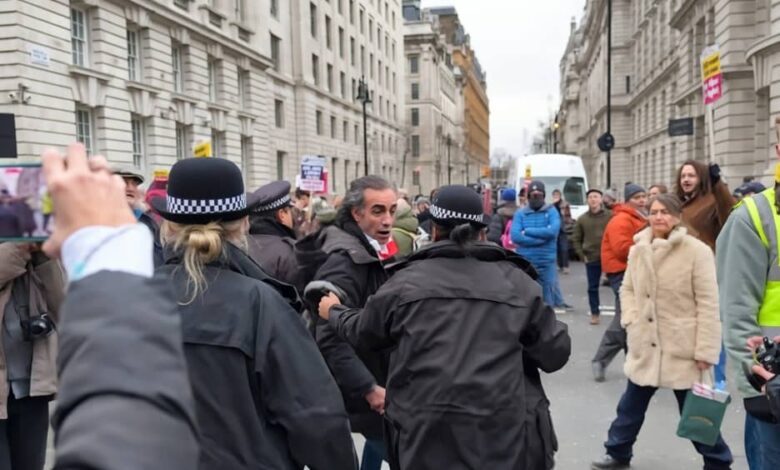
The latest flashpoint occurred this past weekend, March 28–29, during the Iran Freedom Congress held in London — a gathering of approximately 300 diverse anti-regime activists, political figures, and academics. As participants left the venue after the second day’s sessions, self-identified monarchist supporters launched a surprise attack involving verbal abuse, insults, and threats.
Participants were caught off guard by the usual vitriol and insults; they were targeted with slurs by the monarchists and pressured to chant “Javid Shah” (Long live the king). Only rapid police intervention—escorting some out via the parking exit—prevented further physical escalation.
The People’s Mojahedin Organization of Iran (PMOI/MEK) condemned these actions via a statement issued on March 29, 2026, calling out the attackers as “vile, despicable harassment and threats by Shah-worshipping lumpen thugs.”
Furthermore, video footage emerged over the weekend showing supporters of Reza Pahlavi physically harassing and attacking an Iranian woman dissident outside the Conservative Political Action Conference (CPAC) in Texas. The assailants, identifiable as monarchist hardliners, demanded she chant “long live the king” (Javid Shah), and threatened to “run her over with a truck” if she refused.
Earlier in March, Metropolitan Police investigated the severe beating of Kurdistan24 UK correspondent Dilovan Emadaldin by approximately 15 monarchist supporters while he reported on an attack against a Kurdish-owned restaurant.
Killing and harrasement
The violence has already turned deadly. In Canada, Iranian-Canadian dissident and activist Masoud Masjoudi, a vocal critic of Reza Pahlavi and monarchist networks, was murdered in February 2026. His remains were found in Mission, British Columbia, on March 6. On March 13, Canadian authorities charged Mehdi Ahmadzadeh Razavi, 48, of Maple Ridge, and Arezou Soltani, 45, of North Vancouver, with first-degree murder. Both are identified in police reports as associates of monarchist circles and founders of a pro-Reza Pahlavi foundation. The victim and suspects knew each other and had prior public disputes.
Beyond direct violence, monarchist groups have waged a campaign of economic and social coercion against Iranian-, Kurdish, and Afghan-owned restaurants and shops in diaspora centers including London, Toronto, and Los Angeles. Businesses have been pressured to display portraits of Reza Pahlavi or the pre-revolutionary Lion and Sun flag, with refusal reportedly met by aggression, vandalism threats, or online smear campaigns. Some monarchist-aligned shops and restaurants have displayed banners stating: “Entry forbidden to the ‘three corrupt’; dogs are allowed.” (The “three corrupt” refers to a derogatory phrase used in monarchist circles to denounce mullahs, leftists, and PMOI supporters).
The #Iranian Regime’s Calculated Use of Monarchists: A Political Decoyhttps://t.co/yBZ1QJSnHd
— NCRI-FAC (@iran_policy) February 2, 2025
The intimidation tactics displayed today by Pahlavi supporters on the streets of European cities have a deeper historical lineage. Under the dictatorship of Mohammad Reza Shah, SAVAK was not confined to arresting, torturing, and silencing opponents inside Iran; it also monitored and targeted dissidents abroad, including Iranian student activists in Europe and the United States. By the 1970s SAVAK was running European operations that gathered intelligence on Iranian students and even foreign citizens. One of the clearest historical examples came during the Shah’s June 2, 1967 visit to West Berlin, when protests by Iranian students and their German allies were violently attacked; official German historical sources record that SAVAK agents were beating demonstrators with wooden clubs. In other words, the use of intimidation and political violence against opponents in democratic countries was not an aberration, but part of a longer tradition associated with the Shah’s repressive apparatus and its supporters.
International Media Condemnation
Major Western outlets have published multiple reports on the issue.
The Guardian has documented the surge in UK intimidation and quoted long-term British-Iranians warning of a sudden atmosphere of fear created by pro-monarchist aggression, noting that communities once free of such tensions now face daily incidents and calls for official protection.
The Washington Examiner questions the behavior of Reza Pahlavi’s supporters by depicting them as intolerant and divisive “hardcore fans” whose personality-driven loyalty to Pahlavi fractures the Iranian diaspora. Rather than rallying around shared opposition to the Islamic Republic, the outlet argues, these supporters exhibit a troubling indifference to internal dissent—most notably showing “no tears” over the unexplained disappearance of regime critic Masood Masjoody since February 2—while elements of Pahlavi’s inner circle appear to encourage further division among exiles.
Politico questions the behavior of Reza Pahlavi’s supporters by painting them as aggressive operators who wield “slash-and-burn tactics” online and offline to dominate and intimidate the opposition. Instead of forging coalitions against the regime, they lash out at critics with misogynist threats, doxxing, and family harassment, leaving even seasoned U.S. officials to admit, “They scare me.”
Le Monde questions the behavior of Reza Pahlavi’s supporters by portraying them as zealous royalists backed by an “army of royalist cyber-soldiers” who harass any internet user daring to criticize him, leaving many Iranians wary. The outlet casts doubt on their claims that he seeks no crown and only a transitional role—rhetorically asking “Are they to be believed?”—while noting how this cult-like defense marginalizes non-monarchists and fractures opposition unity.
On Friday, December 26, 2025, #Iranian youth at Qazvin Stadium voiced their anger at the remnants of the ousted Shah’s regime, chanting: “Honorable Azerbaijan, dishonorable Pahlavi.” pic.twitter.com/knsJUV0mSQ
— NCRI-FAC (@iran_policy) December 28, 2025
A Gift to the Regime
While the ruling regime in Tehran continues to hijack the nation’s resources and enable foreign forces to further destroy Iran’s infrastructure and endanger the lives of millions of citizens, the thuggish actions of these monarchist hardliners are proving to be a strategic liability.
By prioritizing internal purges, harassment of fellow dissidents, and fascist-style intimidation over a unified democratic front, these circles are only causing deeper division abroad. Such behavior inadvertently serves the interests of the current leadership in Iran, handing them the “chaos” narrative they need to justify continued repression. Ultimately, these diaspora divisions do nothing but indirectly lengthen the pain and suffering of those most vulnerable at home.