
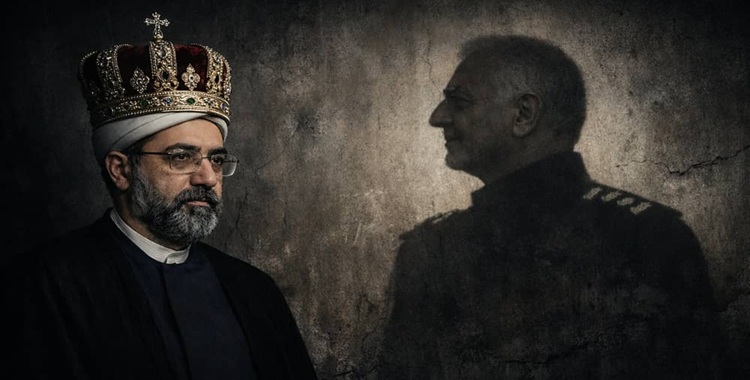
Mojtaba Khamenei’s Crowning Exposes the Clerical Regime’s Biggest Lie
Written by
Mohammad Sadat Khansari
power by hijacking the Iranian people’s uprising against monarchy has now arrived at hereditary rule. In 1979, Iranians rejected dynastic arrogance, unaccountable power, and the idea that a country could belong to a family. The clerical regime claimed it stood for the opposite. It wrapped itself in the language of justice, religion, sacrifice, and republican legitimacy. It denounced monarchy as corruption, decadence, and hereditary privilege.
Now the son takes the father’s place.
No clerical ritual can hide what that means. Mojtaba Khamenei did not rise through public trust, electoral legitimacy, merit, or a proven record in office. He rose because he was Ali Khamenei’s son, because he had been groomed for years inside the regime’s inner sanctum, and because the key levers of force, patronage, and security were already aligned behind him. This was not the triumph of a republic. It was the exposure of a dynasty.
NCRI Editorial: Iran and #Mojtaba_Khamenei: Succession Without Legitimacyhttps://t.co/NPnYW3WEPT
— NCRI-FAC (@iran_policy) March 9, 2026
Never a Republic
The truth is harsher than many admit: the Islamic Republic was never truly a republic. Now it has simply made that official.
A real republic rests on public sovereignty, accountability, rotation of power, and institutions stronger than any ruler or family. Iran never had that. Its elected offices always operated beneath an unelected core that monopolized the real decisions. Presidents came and went, parliaments changed factions, slogans shifted, and factions fought over access. But the structure of real power remained intact: the Supreme Leader, the security apparatus, the Guardian Council, the judiciary, and the closed circle of loyalists who governed from above and behind the scenes.
For decades, the word “republic” was packaging. It gave clerical absolutism a modern label. It allowed the regime to pretend it had reconciled divine authority with popular legitimacy. Mojtaba Khamenei’s succession tears away that packaging. It does not destroy a republic. It proves there was no republic to destroy.
Tonight, the absolute clerical rule (Velayat-e Faqih) has effectively turned itself into a hereditary monarchy by placing Mojtaba Khamenei on the throne.
But it cannot save the shipwrecked vessel of religious fascism.
Once again, this regime, just like the monarchical… pic.twitter.com/oXigoVaOJ7— Maryam Rajavi (@Maryam_Rajavi) March 9, 2026
Nepotism as a System
Mojtaba is not an exception. He is the purest expression of a regime already saturated with nepotism.
The clerical dictatorship has long functioned less as a public order than as a cartel of insiders. Senior officials repeatedly used office to distribute wealth, influence, protection, and opportunity to relatives and loyal networks. Ali Shamkhani became one of the clearest symbols of this culture, with his family’s business reach and privileged access drawing constant attention. Across different presidencies, the pattern barely changed. Whether under so-called moderates, pragmatists, or hardliners, the state remained a mechanism for placement. Children, sons-in-law, brothers, nephews, and extended networks were pushed into profitable or influential positions. Even members of parliament treated office as a pipeline for family advancement and patronage.
The labels changed. The method did not.
This system rewarded proximity more reliably than competence, loyalty more than merit, and kinship more than public service. Mojtaba Khamenei stands at the summit of that culture. He is what happens when nepotism reaches its logical conclusion: the state itself becomes inheritance.
Iran’s Kleptocracy and Systematic Nepotism#Iran #Kleptocracy #Nepotism #economy https://t.co/EUP4cLVyOH
— NCRI-FAC (@iran_policy) January 21, 2022
Why Monarchy Fails Iran
This is why monarchy in any form should be rejected for Iran in definite terms.
Hereditary politics is corrupt at its core because it declares that blood can outrank merit. It says ancestry can substitute for service, scrutiny, and achievement. It trains a nation to look toward households instead of institutions and toward heirs instead of citizens. It turns politics into inheritance and the public into spectators.
In some countries, monarchy survives only because democratic institutions have reduced it to ceremony. Iran has no such safeguards. It has no entrenched checks and balances capable of neutralizing hereditary power. It has a long culture of impunity at the top and a weak tradition of forcing rulers to answer before the public. In that setting, hereditary politics is not symbolic. It is destructive. It protects incompetence, rewards manipulation, and invites criminality.
Iran has already paid too much for rulers who stood above scrutiny and above consequence. It should not be asked to surrender once again to the logic of heirs.
Iran News: State-Run Newspaper Says Reza Pahlavi and Monarchists Have Served Clerical Regime https://t.co/EXfToXnGBe
— M. S. Khansari (@khansari_m) April 9, 2025
No Rival Heirs
That is why the answer to Mojtaba Khamenei cannot be another politics of surname.
Iran does not need one hereditary claimant replaced by another hereditary claimant in different packaging. It does not need more men treated as national options simply because they are someone’s son. A modern country cannot be rebuilt on dynastic nostalgia any more than it can survive under clerical inheritance.
The issue is not which family should rule Iran. The issue is whether Iran will remain trapped in the idea that families should rule at all.
Bury the Principle
Mojtaba Khamenei’s succession should be treated as a moment of clarity. The regime has finally made official what it always was: not a republic, not a government of citizens, but a hereditary order disguised in religious slogans and republican decoration. It denounced monarchy while reproducing its essence. It disbanded the notorious SAVAK, only to absorb many of its cadres into the brutal Ministry of Intelligence (MOIS).
Iran should draw the only serious conclusion.
No more sons of supreme leaders. No more sons of former rulers. No more politics of inheritance. No more mythology of bloodline. No more hereditary claims disguised as stability, continuity, or history.
The Islamic Republic has exposed itself. Iran should reject not only this dynasty, but the principle of dynasty itself.