
Khamenei’s Weak Position Exposed as Iran’s Rival Factions Escalate Infighting
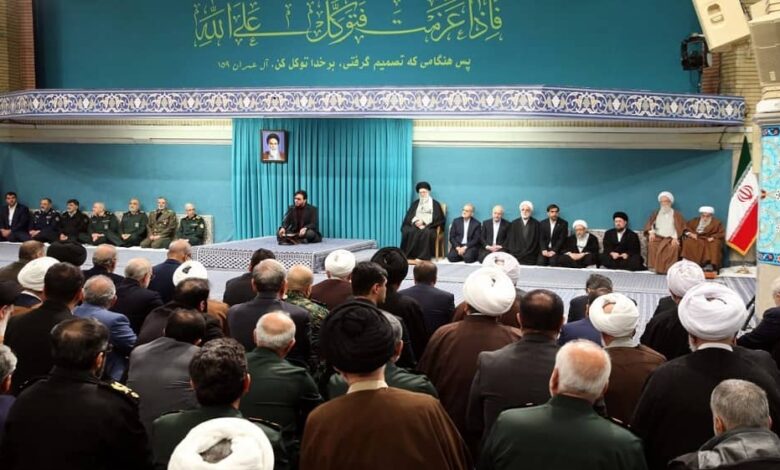
Iranian regime’s Supreme Leader Ali Khamenei conducted a speech for his followers on March 8, 2025
Written by
Dr. Masumeh Bolurchi
Iran’s clerical regime is facing one of its deepest political crises in years as the activation of the UN snapback mechanism triggers open clashes among rival factions. Hardline lawmakers are demanding that Tehran abandon the Nuclear Non-Proliferation Treaty and accelerate uranium enrichment to 90 percent, a level widely seen as crossing into weapons-grade production. While these calls are framed as defiance against Western pressure, they expose the regime’s growing weakness and inability to present a unified strategy as economic and political instability deepen.
On September 3, 2025, the regime’s parliament issued a statement urging full budgetary support for missile, drone, cyberwarfare, and air-defense programs under the direct supervision of Supreme Leader Ali Khamenei. At the same time, more than 60 lawmakers signed a letter to Deputy Foreign Minister and lead nuclear negotiator Abbas Araghchi rejecting talks with the United States and calling for Iran’s immediate withdrawal from the NPT. Yaghub Rezazadeh, a member of the parliamentary national security commission, declared, “The solution is to exit the NPT, cut ties with the International Atomic Energy Agency, and move directly toward 90 percent enrichment.”
Several other lawmakers adopted an equally belligerent tone. Rouhollah Najabat compared the UN’s snapback mechanism to “a mine designed to trap us” and warned that “leaning toward negotiations will not help our armed forces.” Morteza Mahmoudi was even more provocative, stating, “To change the enemy’s calculations, we must make them fear for the lives of 500 American soldiers.” Such rhetoric, while intended to project strength, highlights the growing anxiety among Iran’s political elites as the country faces renewed sanctions and rising internal pressure.
#Khamenei’s Grip on Power Slips Amid Intensifying Factional Warfarehttps://t.co/98hGe6rQfg
— NCRI-FAC (@iran_policy) September 2, 2025
The regime’s financial crisis is compounding these tensions. On September 3, Morteza Eslamzadeh, a senior member of the regime’s Chamber of Commerce, issued a rare public rebuke of the government’s handling of the economy. “If we don’t move fast, we’re finished. It’s over,” he warned. “People are living in misery. Workers beg for their wages and can’t get them. Producers have nothing, they’re ashamed in front of their employees. Do you know how many bounced checks we have?” His remarks reflect an unusual level of panic from business insiders typically aligned with the regime and underline the social and economic strain now eroding its support base.
Top officials have responded to the crisis with increasingly defiant rhetoric aimed at projecting strength. On September 1, Parliament Speaker Mohammad-Bagher Ghalibaf downplayed the impact of renewed UN sanctions, claiming they would have “little effect on Iran’s economy compared to existing U.S. measures.” He denounced the European activation of the snapback mechanism as “illegal” and called for “deterrent actions to make the Europeans pay a price.” Similarly, Abbas Araghchi, Deputy Foreign Minister and Tehran’s lead nuclear negotiator, condemned the move as “destructive and lacking any legal basis,” reflecting Tehran’s rejection of the process while offering no concrete alternative strategy.
#Iran Faces Deepening Power Struggles Amid @UN Sanctions “Snapback” https://t.co/7CqMVhSUWz
— NCRI-FAC (@iran_policy) September 1, 2025
Even within the regime, however, voices of caution are emerging. Mahmoud Vaezi, a senior figure associated with the so-called reformist bloc, warned on September 3 that threats to close the Strait of Hormuz would amount to “self-sanctioning,” cutting off Iran’s own oil exports and isolating the country further. His remarks reflect the growing divide between officials advocating aggressive confrontation and those urging limited restraint to avoid deepening Tehran’s international isolation.
Behind the fiery statements and symbolic threats, Iran’s power structure is fragmenting. The hardline push for 90 percent enrichment and NPT withdrawal is less a demonstration of strength than an acknowledgment of the regime’s weakening leverage in negotiations and its declining domestic legitimacy. Khamenei’s attempts to manage these rival camps by balancing hardliners, revisionists, and security forces are faltering, exposing his reduced authority over both parliament and the government.
#Iran’s Leadership Faces Growing Fears of Unrest Amid Snapback Sanctions and Internal Divisionshttps://t.co/vHMBfE7JON
— NCRI-FAC (@iran_policy) August 30, 2025
As sanctions tighten and economic pain intensifies, Tehran’s leadership is doubling down on militarized policymaking not only for factional survival but as a deliberate morale-management strategy for the Basij and the Islamic Revolutionary Guard Corps. Any visible retreat—on negotiations, the NPT, or enrichment levels—risks eroding the will of the security apparatus Khamenei relies on to police a volatile society. The push for missile and drone funding and the open talk of moving toward 90 percent enrichment function as internal cohesion signals and external bluffs, crafted to hold the regime together at home while encouraging foreign capitals to overestimate Iran’s capacity for escalation.
This is the paradox at the heart of the current posture: the louder the threats the clearer it becomes that the clerical dictatorship is acting from weakness, not strength. By staging deterrent theatrics to prevent a collapse of security-force morale, Tehran is buying time rather than solving problems, deepening policy incoherence even as it seeks to project resolve.
Khamenei’s Weak Position Exposed as Iran’s Rival Factions Escalate Infighting