
Khamenei Breaks Silence in Bid to Shore Up a Fractured Base After 12-Day War
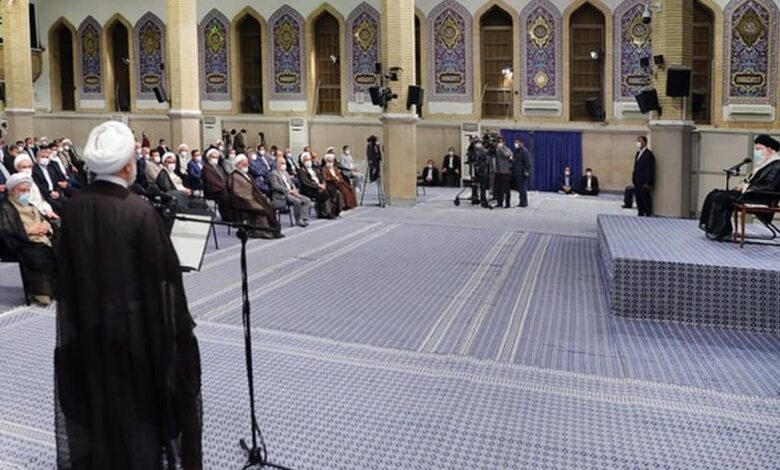
The Iranian regime’s Judiciary chief Gholam-Hossein Mohseni Ejei addresses the Supreme Leader Ali Khamenei during a high-level meeting with judicial officials on July 16, 2025
Written by
In his second public, non-televised appearance since the 12-day conflict, the clerical dictatorship’s Supreme Leader, Ali Khamenei, delivered a carefully choreographed speech on July 16, 2025, aimed squarely at addressing a deepening crisis of morale within his own ranks. Speaking before the judiciary leadership, Khamenei attempted to reassert authority and portray survival as victory—but the subtext of his remarks betrayed a regime rattled by fear of collapse. The judiciary, now explicitly tasked with executing a full-scale crackdown on dissent, has become a central tool in the regime’s strategy to suppress unrest before it resurfaces.
According to the transcript published on his official website, Khamenei declared, “The enemy’s calculation was that by attacking some figures and sensitive centers of Iran, the system would be weakened… then, by deploying sleeper cells—ranging from hypocrites [the regime’s pejorative to defame the People’s Mojahedin Organization] and monarchists to thugs—they would provoke people into the streets to finish the regime off.” He insisted this “plot” had failed and that “the exact opposite happened.” But this insistence on regime survival, repeated throughout his remarks, reveals not triumph but anxiety: Khamenei is acutely aware that the regime has once again come perilously close to being overthrown.
Behind the bombast lies a much more fragile reality. Khamenei’s unusual decision to appear in person—despite credible security risks—was not an act of strength but necessity. His core concern is the morale crisis within his own apparatus, particularly after a war that exposed vulnerabilities in the regime’s military, intelligence, and command structures. As his own words indicate, the regime feared a post-conflict uprising, activated by the PMOI-led Resistance Units, which Khamenei singled out by name.
Khamenei Orders Parliament to Fall in Line Amid Crises Facing #Iran’s Theocracyhttps://t.co/TzzdhXnSdc
— NCRI-FAC (@iran_policy) June 12, 2025
Throughout the speech, the regime leader repeated the theme of “national unity” and downplayed ideological rifts. He praised the alleged harmony of individuals with “different religious weight” who nonetheless came together to defend the “Islamic system.” This was a transparent call for regime loyalists—across the fractured spectrum of extremists, revisionists, and clerical factions—to close ranks. But the invocation of unity is itself a tell: the divisions are real, and growing, particularly after the clerical dictatorship’s failures during and after the conflict.
What Khamenei portrayed as a renewed “national spirit” was, in effect, a plea for discipline and obedience. His warnings against “irresponsible criticism” and “uninformed objections” were clearly aimed at intra-regime dissenters, particularly those skeptical of the regime’s handling of the war and the fragile ceasefire. He cautioned that protest—especially from within—could be “harmful,” and instructed all institutions, from journalists to Friday prayer leaders, to protect the so-called “national unity.”
Meanwhile, the Ministry of Intelligence (MOIS) is operating in lockstep with this approach. In a separate statement, MOIS chief Esmail Khatib boasted of multiple executions and vowed that remaining detainees accused of espionage or anti-regime activity would “pay the price.” This open celebration of repression, amid mass arrests following the war, reinforces the regime’s true post-war strategy: fear over persuasion.
#Khamenei’s Rejection of U.S. #Nuclear Offer Reveals Deeper Fear of Internal Unrest Than Foreign Threatshttps://t.co/ArNlEG5qDL
— NCRI-FAC (@iran_policy) June 4, 2025
Khamenei’s meeting with judiciary officials was no accident. The judiciary, already weaponized against dissent, has been given a renewed mandate to crush unrest before it surfaces. Khamenei emphasized that “anyone, anywhere in the country who is subjected to oppression or transgression, must know their problem can be solved by the judiciary.” But this statement is steeped in irony; hundreds have been detained without charge, and many face swift, politically motivated verdicts.
On the international front, Khamenei struck a more calculated tone. Despite years of vilifying negotiations with the West, he now tempers that rhetoric. “We are equipped with both logic and military power, and when we enter either the diplomatic or military arenas, we do so with full hands,” he said. This is not a policy shift, but a strategic hedging. With the EU warning of an August 29 deadline to trigger the snapback mechanism on UN sanctions, Khamenei is clearly concerned about the consequences.
This posture contrasts with aligned factions, many of whom have grown increasingly vocal in denouncing any return to talks. Khamenei’s remarks appear to be aimed at containing these voices, keeping open the possibility of tactical negotiations to avoid further economic and political deterioration.
Khamenei's Plea to "Listen to the People" Reveals Fear, Not Confidence, Amid Nationwide Protests in #Iranhttps://t.co/RKI98KbL8e
— NCRI-FAC (@iran_policy) May 28, 2025
Yet, even in trying to project control, the cracks are evident. The war may have ended in a ceasefire, but the battle for legitimacy continues—and Khamenei knows it. His repeated references to “plots” and “sleeper cells,” and his demands for internal cohesion, signal a regime still on the edge, terrified of a public uprising it narrowly avoided.
The message behind the speech is clear: this was not a celebration of victory—it was a survival address. Khamenei’s appearance, rhetoric, and directives all reflect a leadership scrambling to maintain control of a system showing unmistakable signs of decay. The threat is no longer just external. It’s the Iranian people—and the Resistance—they fear most.