
Iran’s Killing Machine Claims Ten Political Prisoners in 16 Days
Written by
Farid Mahoutchi
Four-minute read
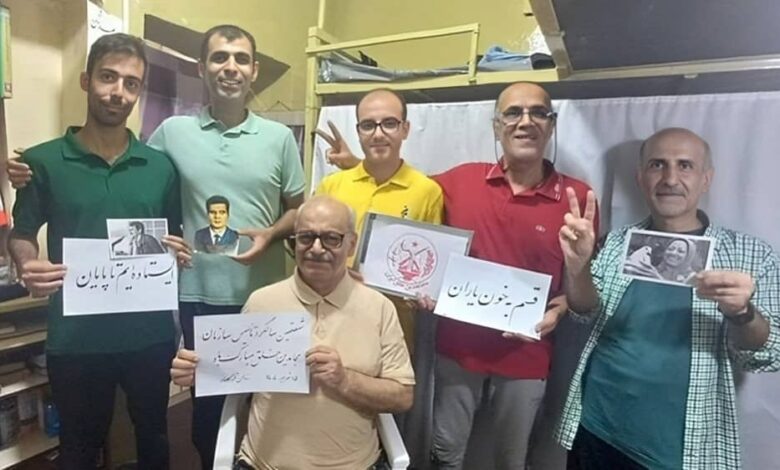
Between March 19 and April 4, 2026, Iran’s regime executed at least ten political prisoners; a wave of state killing that shows the clerical regime has once again turned the gallows into its main instrument for preserving power, instead of responding to the people’s demands. During this period, six political prisoners who were members of the People’s Mojahedin Organization of Iran (PMOI/MEK) and four political prisoners from among the protesters of the January 2026 uprising were executed; executions that are not a sign of strength, but rather reveal the regime’s terror in the face of a protesting society and a generation that no longer accepts the survival of this regime.
This wave of repression clearly reveals the regime’s objective: the physical elimination of the organized opposition. Mohammad Taghavi and Ali Akbar (Shahrokh) Daneshvarkar were executed on March 30; Babak Alipour and Pouya Ghobadi were hanged one day later, on March 31; and finally, Vahid Bani Amerian and Abolhassan Montazer were also executed on April 4. Amnesty International described these cases as stemming from “grossly unfair, torture-tainted trials” and warned that these executions were carried out secretly, without prior notice to the families or lawyers, after the prisoners had been transferred to an undisclosed location. Reuters also confirmed on April 4 that two more individuals connected to the same case had been executed that day, and that these executions were a continuation of the recent wave against individuals accused of links to the PMOI.
The six political prisoners who were PMOI members were not “terrorists,” contrary to the regime’s labels; they were political opponents of a regime that for years has responded to every organized voice for a free Iran with torture, forced confessions, and execution. The foundation of these cases follows the clerical regime’s familiar pattern: fabricating security-related cases, extracting confessions under torture, conducting trials that last only a few minutes, and then carrying out the sentence in silence and secrecy. For this reason, these executions must be called what they are: not justice, but premeditated political murder.
"I have sworn to overthrow the tyrant with my blood"
Six PMOI members after being sentenced to death by Iran's regime, singing songs of resistance and defiance against the mullahs' rule.
They were all executed this week:
Mohammad Taghavi (59)
Ali Akbar (Shahrokh) Daneshvarkar… pic.twitter.com/BnvzaRXYLr— People's Mojahedin Organization of Iran (PMOI/MEK) (@Mojahedineng) April 4, 2026
Alongside these six PMOI members, four other political prisoners from among the protesters of the January 2026 uprising were also executed; four rebellious young people who, contrary to the regime’s false claims branding them as “terrorists,” were freedom fighters who took to the streets for Iran’s freedom. Three of them—Saleh Mohammadi, Mehdi Ghasemi, and Saeed Davoudi—were publicly executed in Qom on March 19. According to the regime’s official narrative, their charges were “moharebeh” (waging war against God) through the use of cold weapons in “gatherings and riots,” “participation in the killing” of two State Security Force agents, and “inciting people to war and killing with the intent to disrupt the country’s security.”
The fourth prisoner, 18-year-old Amirhossein Hatami, was executed in Tehran on April 2; his charges were announced as “moharebeh” and “corruption on earth,” and the regime claimed that during the January uprising he had attacked a military center in Tehran, set it on fire, and entered it in search of weapons and ammunition. But behind these regime-fabricated labels lies another reality: these were rebellious young men who stood up to tyranny and paid the price for Iran’s freedom.
Through these executions, the regime seeks to intimidate society, but the very timing of these crimes shows that the ruling establishment is acting from a position of weakness and fear. Reuters had reported that on March 23, Iranian judicial authorities announced that the sentences in cases related to the January protests had been finalized and were being implemented, and that there would be “no leniency.” This means that the recent wave of executions is not a series of isolated events, but part of a political and security decision to crush dissent and prevent the return of uprising. At the same time, human rights reports speak of a rise in executions, the severing of prisoners’ contact with their families, and the use of war and crisis as cover to conceal repression.
#Iran News Alert, Simay Azadi Exclusive
Message in English by PMOI member Vahid Baniamerian (“Commander Vahid”), recorded in November 2025 from Ghezel Hesar Prison.
Supporting @Maryam_Rajavi’s Ten-Point Plan, he said: “It is time for the world to correct the failed and… https://t.co/9BFaFntZd6 pic.twitter.com/asbLik56oY
— SIMAY AZADI TV (@en_simayazadi) April 4, 2026
These crimes have been met with widespread condemnation. On April 3, Mai Sato, the UN Special Rapporteur on the situation of human rights in Iran, expressed concern over the imminent risk of execution facing Vahid Bani Amerian and Abolhassan Montazer, while noting that further reports of executions were continuing to reach her amid the ongoing war and internet shutdown. In addition, political figures in the United States and Britain have warned about these executions and the danger of further death sentences being carried out.
But in the face of this blatant bloodshed, the European Union’s silence is troubling and shameful. The European Union has made no clear and independent public statement regarding this recent wave of executions. Such silence, in the face of the execution of ten political prisoners within a short period, is nothing less than a moral and political failure. The European Union cannot use “human rights” as a diplomatic language while, at the same time, refusing even to issue a clear position when six members of the organized opposition and four young protesters are being hanged one by one.
#Iran News Alert – Simay Azadi Exclusive
Message by PMOI member Babak Alipour, following the confirmation of his death sentence by the regime's so-called Revolutionary Court in November 2025. "I vow to continue this path until the end." pic.twitter.com/AzSgQmTAwG— SIMAY AZADI TV (@en_simayazadi) March 31, 2026
The clerical regime uses executions to survive—to spread fear, silence dissent, and buy time. But killing political prisoners will not save a collapsing dictatorship or hide the truth. The ten executed prisoners stand as symbols of a people fighting for freedom and of a regime terrified of that demand. The international community, especially Europe, must go beyond words: break its silence, hold the perpetrators accountable, and raise the political and legal cost of these crimes. A first step is shutting down the regime’s embassies and expelling its terrorist diplomats from Europe.