
Iranian exiles in Stockholm demand accountability for regime officials
By
Matin Karim
mek supporters demonstration stockholm human rights
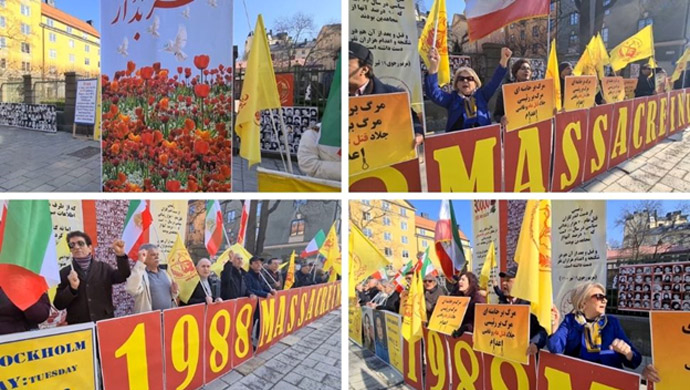
Freedom-loving Iranians and family members of the victims of Iran’s summer 1988 massacre rallying in Stockholm, Sweden – March 22, 2022
Freedom-loving Iranians and family members of the victims of Iran’s summer 1988 massacre rallied once again in Stockholm on Tuesday, March 22, calling on the international community to hold the mullahs’ regime in Tehran accountable for their ongoing human rights violations, crimes against humanity, and genocide.
The rallying Iranians on Tuesday were chanting:
“Four decades of crimes! Down with this regime!”
“Criminal Hamid Noury represents the mullahs’ deviousness!”
March 22 – Stockholm
Freedom-loving Iranians & supporters of the Iranian opposition MEK, rallying outside the court session of Iranian regime operative Hamid Noury for justice on #1988Massacre.#ProsecuteRaisiNOWpic.twitter.com/dl4ivjWwZh— People's Mojahedin Organization of Iran (PMOI/MEK) (@Mojahedineng) March 22, 2022
“Death to Khamenei and Raisi! Khomeini be damned!” referring to the regime’s Supreme Leader Ali Khamenei, President Ebrahim Raisi, and the regime’s first supreme leader Ruhollah Khomeini.
“1988 massacre saw 30,000 hangings! Raisi is the murderer of the 1988 massacre!”
“Iranian people want murderers to be held accountable!”
These individuals have long been traveling from across Europe, endured the bitter cold winter season of Sweden, to voice their demands as an Iranian regime functionary by the name of Hamid Noury is on trial for his role in the killings of 1988 across Iran that left over 30,000 political prisoners executed, mostly members and supporters of the Iranian opposition People’s Mojahedin Organization of Iran (PMOI/MEK).
March 17—Stockholm
Freedom-loving Iranians & family members of political prisoners killed by #Iran's regime during the #1988Massacre rallying outside the Swedish Parliament.#ProsecuteRaisiNOWpic.twitter.com/IkJWEz2SZ1— People's Mojahedin Organization of Iran (PMOI/MEK) (@Mojahedineng) March 17, 2022
More than 33 years ago, in the summer of 1988 the regime ruling Iran launched a massive killing spree in prisons across the country. Political prisoners from a variety of backgrounds were the target of a horrific campaign resulting in the mass killings that targeted minors, seniors, and even pregnant women.
Raisi was a member of the notorious “Death Commissions” in charge of holding minutes-long kangaroo “trials” determining the fates of thousands of political prisoners. None had been sentenced to death and many had already served their prison sentences and were held behind bars specifically to be eventually executed. Khamenei should also be held accountable for his direct role in leading the regime’s atrocities and horrific human rights dossier, the protesters chanted.
March 15 – Stockholm
Freedom-loving Iranians & supporters of the Iranian opposition MEK, rallying outside the court session of Iranian regime operative Hamid Noury for justice on #1988Massacre.#ProsecuteRaisiNOW pic.twitter.com/TQLXpoc4lb— People's Mojahedin Organization of Iran (PMOI/MEK) (@Mojahedineng) March 15, 2022
The protesting Iranians in Stockholm are calling for the referral of the Iranian regime’s abysmal human rights dossier to the United Nations Security Council and thus to the International Criminal Court. Proper tribunals are necessary to hold Iranian regime officials accountable for their crimes against humanity.
Iran’s 1988 massacre of over 30,000 political prisoners has been described as the worst crime against humanity since World War II.
A former Iranian Intelligence Ministry deputy recorded a video clip in 2008, in which he revealed that the mullahs’ regime had massacred some 33,700 political prisoners and buried them in mass graves. According to Reza Malek, there are between 170 to 190 mass graves across the country.
Geoffrey Robertson, QC, who has thoroughly investigated the 1988 massacre, underscored that this mass killing amounts to “genocide.”
“It has been a crime to kill prisoners for centuries. The difference is that if it amounts to a particular crime of genocide, there is an international convention that binds countries to take action and punish that genocide,” he said in an online conference held in August of last year.
“It seems to me that there is very strong evidence that this was a genocide. It applies to killing or torturing a certain group for their religious beliefs. A religious group that did not accept the backward ideology of the Iranian regime,” Robertson added referring to Khomeini’s fatwa as the basis of the massacre.
“There is no doubt that there is a case for prosecuting Raisi and others. There has been a crime committed that engages international responsibility. Something must be done about it as has been done against the perpetrators of the Srebrenica massacre,” he reiterated.