
Iranian Regime Issues Stark Warnings Against Internal Dissent Amid US-Israeli Airstrikes
iran-crackdown-fraja
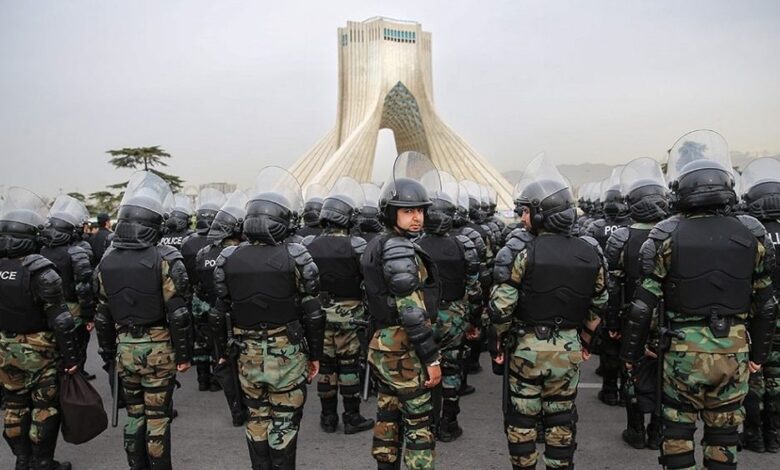
Anti-riot police in Tehran stands guard against the Azadi Tower
Written by
Dr. Masumeh Bolurchi
Facing an increasingly explosive society, the Iranian regime has ramped up its rhetoric to signal a “firm” crackdown on any signs of a popular revolt. Judicial and military officials are currently using the pretext of regional conflict to justify aggressive internal suppression, labeling domestic dissent as a “continuation of military aggression” by foreign powers.
This surge in “decisive action” directives is widely viewed as a desperate attempt to intimidate a restless public and preempt an imminent outburst of nationwide protests. By framing civilian frustration as enemy collaboration, the authorities are effectively “showing their teeth” to discourage further organized resistance.
The regime’s president Masoud Pezeshkian, addressing the situation in Kurdistan province, stated that “the provincial governor and armed forces of the country are duty bound to deal with any movements of separatists decisively.” He linked this to sympathy for victims of “US-Israeli aggression against Iran.”
On March 4, 2026, Judiciary Chief Gholamhossein Mohseni Ejei characterized the recent protests as foreign-instigated, linking the civil unrest to what he described as a “continuation of the 12-day military aggression.”
As Iran confronts mounting domestic unrest and growing international isolation, the regime’s supreme leader Ali #Khamenei has overseen an escalating crackdown that now reaches beyond street protesters and into the regime’s own political ranks.https://t.co/B22CZuVeMZ
— NCRI-FAC (@iran_policy) February 9, 2026
In previous statements, Ejei dismissed demonstrations as mere “vandalism,” arguing they do not qualify as legitimate protest. He further warned that the state would show no leniency toward individuals accused of “destabilizing” the economy or national security.
Ejei, in a March 2 speech reported across state outlets, reiterated a wartime posture: “Now it’s wartime; they’ve declared war officially and started it. If anyone utters any word or performs any action in line with the desires of this criminal enemy—namely America and the Zionist regime—they are in the enemy’s line and must be dealt with based on revolutionary and Islamic principles in wartime.”
Salar Abnoush, a member of the parliamentary security and foreign policy committee and former IRGC commander, appeared on state television’s news network on March 4, declaring: “Any person in Iranian soil who lets out a tune from their throat that harmonizes with the enemy is standing on Tel Aviv ground, their head is Netanyahu’s, and the shoot-to-kill order for them has been issued.”
Mohammad Javad Larijani, a senior regime figure, warned on March 4: “We must choke the smallest movement in the path of the enemy’s desires right on the spot… Fire at will to extinguish them right in their place.” State media echoes this sentiment, with reports noting enemies have “hijacked peaceful economic protests and turned them into violent riots.”
Iran’s ruling theocracy is facing a convergence of crises that repression cannot solve: collapsing purchasing power, widening social anger, and growing international penalties linked to the regime’s crackdown. In recent days, reports from inside the country describe coordinated…
— NCRI-FAC (@iran_policy) February 16, 2026
In a further measure amid the conflict, Police Chief Ahmadreza Radan announced on state television on March 5, 2026, that “shoot-to-kill” orders have been issued to police for confronting thieves within the framework of the “wartime situation.” Radan emphasized that forces are on full alert to preserve public security and will decisively counter any efforts to create insecurity, including actions in cyberspace that “disturb public minds.” This directive, ostensibly framed at “curbing crime during the crisis,” provides a broad pretext for lethal force against suspected dissidents, potentially conflating political opposition with criminal activity under the guise of maintaining order.
These declarations align with broader regime narratives in state media, portraying internal unrest as extensions of foreign threats. For instance, articles highlight Mossad’s alleged role in protests and assert no need to wait for enemy actions before responding.
Officials emphasize unity against attempts to turn economic issues into security crises, amid sanctions and military pressures.
In the aftermath of the #IranProtests and the ensuing crackdown, Iran’s clerical leadership is escalating a familiar two-track response: expanding arrests and judicial pressure at home while urging mass public displays of loyalty to project control.https://t.co/b05fLI15kX
— NCRI-FAC (@iran_policy) February 10, 2026
The airstrikes, ongoing since February 28, have targeted IRGC sites and nuclear facilities, resulting in Supreme Leader Ali Khamenei’s death and retaliatory Iranian actions, including missile strikes and closure of the Strait of Hormuz.
International observers report internet blackouts and heightened suppression, with the UN expressing concerns over lethal force against dissenters. Analysts note the regime’s focus on internal cohesion to prevent uprisings amid the conflict.