

Editorial: Iran’s Organized Resistance Enters a New Chapter
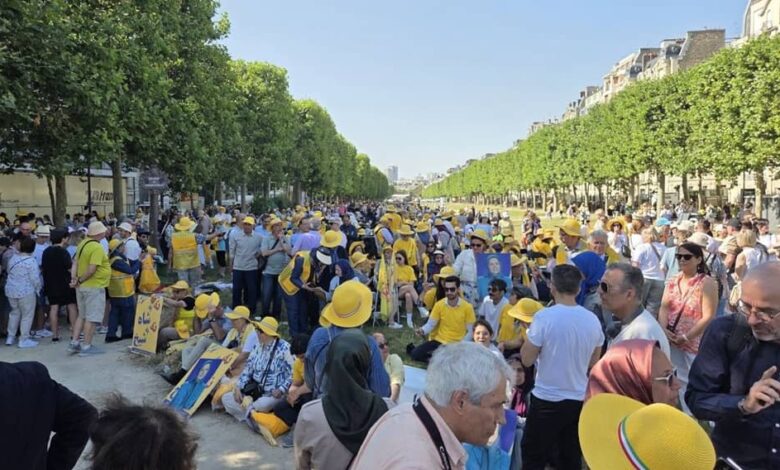
Thousands of Iranians gathered in Paris for the Free Iran 2026 Rally—June 20, 2026—June 20, 2026
Written by
The Editorial Board
Iran today stands at a decisive juncture. The ruling theocracy is weaker, more isolated and more dependent on repression than at any time in recent years. Yet precisely because it is weak, it has become more violent. Following the January 2026 uprising, the regime sought to impose silence through mass repression, executions and an atmosphere of fear. Its objective was clear: to convince Iranian society that resistance had been crushed and that the regime had emerged intact and victorious.
The reality has proved very different.
Neither the executions nor the regime’s intensified repression succeeded in creating the atmosphere of despair and resignation it sought to impose on Iranian society. A central reason has been the continued presence and expanding activities of the MEK’s Resistance Units across the country. Operating with remarkable courage under conditions of severe repression, these units have kept alive a spirit of resistance and defiance. Their persistent activities over the years, and particularly in the aftermath of the bloody suppression of the January 2026 uprising, have helped reinforce a climate of resistance rather than surrender, directly challenging the regime’s attempt to convince society that organized opposition had been crushed.
Perhaps nowhere is this more visible than inside Iran’s prisons. Political prisoners facing severe pressure and lengthy sentences, many of them under death sentences, have continued to send messages of defiance and support for resistance. In September, prisoners in Ghezel Hesar, Evin, Yazd, Mashhad and Karaj marked the 61st anniversary of the founding of the People’s Mojahedin Organization of Iran (PMOI/MEK), insisting that their messages reach the Iranian people. Their words convey a striking reality:
Weekly Report: #MEKResistanceUnits Escalate Nationwide Operations, Mark @Mojahedineng 61st Anniversaryhttps://t.co/o8lmaDMPLF
— NCRI-FAC (@iran_policy) September 14, 2026
This continuity is particularly significant after the executions carried out this year against MEK members and supporters. Nine MEK members were executed by the regime in 2026. Six were put to death between March 30 and April 4, followed by the executions of Hamed Validi and Mohammad (Nima) Massoum Shahi on April 20. On July 22, the regime executed 26-year-old law graduate Mehdi Khanaki. Rather than extinguishing resistance, these executions have reinforced its meaning for a new generation of political prisoners and activists.
This defiance is not an isolated response to the repression of 2026. It reflects the very logic on which the MEK was founded more than six decades ago.
On September 6, 1965, Mohammad Hanifnejad, Saeid Mohsen and Ali Asghar Badizadegan established the organization after concluding that decades of struggle against dictatorship had repeatedly faltered in the absence of a disciplined and organized force capable of sustaining the fight for freedom. The founders themselves paid the ultimate price. Hanifnejad, Mohsen and Badizadegan were executed by the Shah in 1972 after refusing to renounce their convictions.
"After nearly five decades, the regime is still trying to persuade Iranians that the @Mojahedineng does not represent a viable alternative. Yet its own #propaganda apparatus writes a different story," writes @khansari_m.https://t.co/3AcziS0L5v
— NCRI-FAC (@iran_policy) September 9, 2026
Yet the principle for which they gave their lives — that freedom requires organized resistance, sacrifice and an unwillingness to surrender before dictatorship — did not die with them. More than half a century later, that same principle is visible in successive generations who, from the streets to the prisons and even under the shadow of the gallows, continue to choose resistance over submission.
It is this continuity, from the principles established by the founders to the defiance of a new generation under the clerical regime, that gives particular significance to the MEK’s entry into its 62nd year. As the principal constituent organization of the National Council of Resistance of Iran (NCRI), the MEK’s endurance, renewal and capacity to organize have broader significance for the Iranian Resistance as a whole. The election of Mahnaz Maimanat as its new Secretary-General on September 6 must be viewed in that wider political context.
The importance of this transition goes beyond an internal organizational decision. In a country ruled by a profoundly misogynistic regime, the election of another woman to lead the MEK carries a powerful political message. For years, women have occupied leading positions throughout the Iranian Resistance. Their role represents a direct challenge to a system that has institutionalized discrimination against women and sought to exclude them from political and social leadership.
The regime’s own reaction demonstrates that it understands this significance. Its media have devoted extensive attention to the MEK’s leadership transition, reflecting the authorities’ continuing preoccupation with an organized movement they have spent decades attempting to destroy.
"The election of @Mojahedineng tenth female Secretary-General should be viewed in a broader perspective. It represents more than three decades of continuous #female leadership and constitutes a profound ideological and cultural challenge to Islamic fundamentalism," writes…
— NCRI-FAC (@iran_policy) September 9, 2026
The contrast could scarcely be clearer.
On one side stands a regime increasingly reliant on executions, prisons and coercion to preserve itself. On the other stands an organized resistance that has survived two dictatorships, enormous sacrifice and repeated campaigns of repression while continuing to renew itself across generations.
The broader significance of the MEK’s 61-year history as the NCRI’s principal constituent force, lies in its endurance, the spread of Resistance Units inside Iran, and the defiance of political prisoners—all of which point to the persistence of an organized alternative to the clerical dictatorship. At a time when the regime seeks to project strength through repression, the continued vitality of this organized resistance reveals a very different political reality.