The Mistake That Defined Iran’s Fate

Smoke rises from Supreme Leader Khamenei’s compound in Tehran on February 28, 2026, following coordinated military strikes
Written by
Farid Mahoutchi

On August 13, 2018, Ali Khamenei addressed a carefully selected audience and delivered a line that would come to define his strategic doctrine: “there would be no war, and there would be no negotiations.”

It was a statement of certainty—absolute, unambiguous, and, in retrospect, profoundly revealing.

Years later, on the morning of February 28, 2026, Khamenei convened his senior military and security leadership inside one of Tehran’s most fortified compounds. The question before him was no longer defiance in principle, but how to consolidate the results of indirect negotiations with Washington. By the end of that day, events had overtaken deliberation. A war had begun—and with his own death, the collapse of the certainty he once projected.

But this was not his first miscalculation.

Three years earlier, as Iran approached the anniversary of the 2022 nationwide uprising, Khamenei made a different gamble. On October 7, 2023, he helped ignite a wider regional confrontation—one that he likely believed would shift the balance of power abroad while relieving pressure at home. Instead, it weakened the very instruments he had spent decades constructing. His regional network—once the cornerstone of deterrence—was degraded across multiple fronts.

Yet even this was not the central error.

To understand that, one must look not outward, but inward.

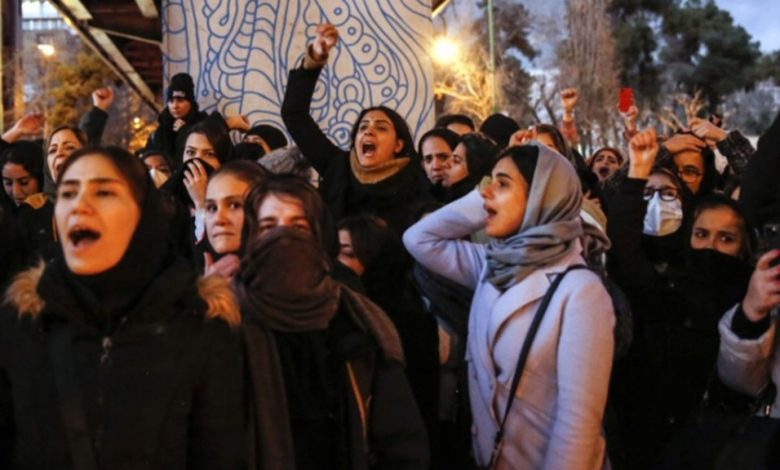
For years, a different force had been shaping Iran’s trajectory—one far more decisive than missiles, militias, or diplomacy. Across cities and provinces, in waves that rose and receded but never disappeared, ordinary Iranians repeatedly challenged the state. These were not isolated disturbances. They were nationwide expressions of rejection—persistent, decentralized, and increasingly explicit in their demands.

They revealed something that no intelligence assessment, no negotiation channel, and no military calculus could obscure: the regime lacked a durable social foundation.

Analysts had long noted that these protests reflected a deepening crisis of legitimacy within the system, one that could not be resolved through repression alone. Protesters openly called for the end of the political order, burned symbols of authority, and continued despite arrests, violence, and lethal force.

This mattered—not only domestically, but internationally.

Because it was these uprisings that stripped away the regime’s most valuable asset: the perception of stability. For years, the clerical dictatorship had leveraged its regional reach, its security apparatus, and its capacity for disruption to project strength. But once it became evident that it ruled over a society in open defiance, that image began to fracture.

Foreign pressure did not create that weakness. It responded to it.

And still, Khamenei did not—or could not—adjust.

The deeper irony is that the lesson had already been written into Iran’s modern history. Mohammad Reza Pahlavi, the ousted monarchial dictator, had once commanded one of the most formidable militaries in the region, backed by vast resources and powerful allies. Yet when confronted by a population that had withdrawn its consent, that machinery proved irrelevant.

Khamenei believed he had solved that problem.

Where the Shah relied on a conventional army, Khamenei built an entire ecosystem of control: the Islamic Revolutionary Guard Corps, the Basij, the Ministry of Intelligence, and a dense network of institutions designed to monitor, deter, and suppress dissent. It was a more sophisticated architecture of coercion—deeper, broader, and more resilient.

But it rested on the same flawed premise.

That premise was not simply that force could maintain order. It was that force could substitute for legitimacy.

Repeated uprisings proved otherwise. They demonstrated that even the most expansive security apparatus cannot fully contain a society that no longer recognizes the authority imposed upon it. They exposed elections as ritual, official mobilizations as performance, and reform as a closed path.

Khamenei understood the danger—but not the solution.

To retreat externally risked emboldening internal dissent. To compromise abroad threatened cohesion within the very forces tasked with maintaining control. And so, he chose escalation—regionally, militarily, and rhetorically—not because it ensured success, but because any alternative risked immediate erosion inside his own base.

This logic carried him from crisis to crisis: from the escalation of 2023, to the 12-day-war of 2025, to the refusal to yield in early 2026.

But it could not resolve the underlying contradiction.

Khamenei’s mistake was not made when he declared on August 13, 2018, that there would be no war and no negotiations. It was made in failing to recognize what the streets of Iran had already made unmistakably clear: that it is ultimately the Iranian people who will decide their own fate.

On the morning of February 28, as events moved toward their decisive rupture, he and his inner circle gathered not in retreat, but in confidence—reviewing what they regarded as a successful suppression of the January uprising and deliberating how best to confront the mounting pressure from the United States. It was, in their view, a moment of control.

Like the Shah before him, what ultimately undid Khamenei was his failure to grasp a simple, inescapable truth: that, in one way or another, the Iranian people have and will decide their own fate

The Mistake That Defined Iran’s Fate

Back to top button