
Iran Remains on the Brink as Explosive Unrest Defies State Crackdown
Iran Protests – January 2026
Written by
Mansoureh Galestan
Iran remains a powder keg of social and economic grievances as of February 10, 2026. Despite a brutal crackdown following the nationwide uprising that peaked in early January, the cycle of defiance continues across the country. Citizens from all walks of life—bazaar merchants, industrial workers, and students—remain in a state of high-intensity standoff with the regime. While mass street marches have been suppressed by lethal force in recent weeks, the underlying societal volatility has not dissipated, leaving the central government struggling to maintain a facade of control as it approaches the anniversary of the 1979 Revolution.
Flaming Defiance and Direct Action
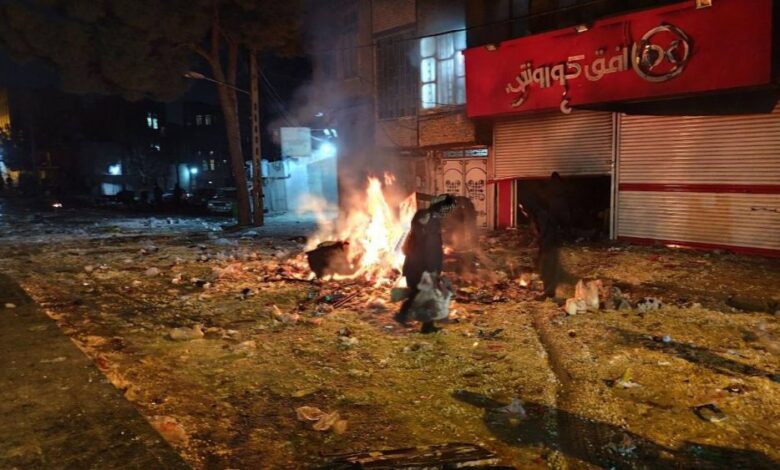
In the last 24 hours, coordinated operations across several provinces targeted symbols of the Islamic Revolutionary Guard Corps (IRGC) and the Basij paramilitary. Parcels of Iran’s rebellious youth reported at least 12 significant operations and the widespread use of incendiary devices against suppressive centers associated with the upcoming state anniversaries. In cities like Tehran, Shiraz, and Isfahan, state banners were set ablaze as youth rejected the regime’s narrative of stability, rebranding the official “Decade of Dawn” as a “Decade of Torment.”
The scale of state violence remains staggering, with judicial authorities maintaining a hardline stance against any form of dissent. On Tuesday, February 10, political prisoners in 56 detention facilities marked the 107th week of the “No to Executions Tuesdays” campaign with a nationwide hunger strike. This protest comes amid reports from campaign members that the government has executed over 207 people in the last three weeks alone. The crackdown has also expanded to the professional class; security forces have recently arrested numerous lawyers, doctors, and medical staff accused of treating injured protesters.
In a move widely seen as an attempt to manufacture legitimacy, Supreme Leader Ali Khamenei agreed on Tuesday to pardon or commute the sentences of 2,108 prisoners, but the judiciary explicitly stated that no one involved in the recent “riots” would benefit from the clemency. Meanwhile, families of detainees in Tehran report being pressured by IRGC intelligence to attend tomorrow’s February 11 state rallies, with some told their presence must be “verifiable” through photos and videos sent to security bodies.
January 8—Tehran, Iran
Newly obtained video from the January 2026 uprising shows the moment security forces opened fire on protesters in Tehran's Sadeghiyeh district.#IranProtests pic.twitter.com/cz0lmLchab— People's Mojahedin Organization of Iran (PMOI/MEK) (@Mojahedineng) February 9, 2026
State Paralysis and Factional Infighting
Inside the corridors of power, the regime is struggling to maintain a unified front as it attempts to manage both domestic revolt and international isolation. While the military has shifted to a “defensive-offensive” posture, the Ministry of Intelligence announced the arrest of 56 “instigators” in North Khorasan, accusing them of attacking government buildings and killing local officials. These sweeping arrests, including of the so-called “reformist” figures such as Azar Mansouri, indicate a narrowing of the political circle as the establishment attempts to purge all potential dissent.
While the regime believes it can intimidate, execute, and use diplomatic maneuvers on the nuclear front to convey the message that it has successfully moved beyond its existential threat—preparing to celebrate its survival for the umpteenth time—it is facing a more hostile society, deep regional isolation, and a global community that increasingly understands its days are numbered. Despite official efforts to project stability through backchannel talks in Oman and the orchestration of state anniversaries, the economic exhaustion of the Iranian people and the persistence of defiant actions across the country serve as a reminder that the system’s traditional tools of survival are no longer sufficient to contain an inevitable confrontation.