
Iran Protests Persist as Regime Admits Fear of Organized Resistance and Social Collapse
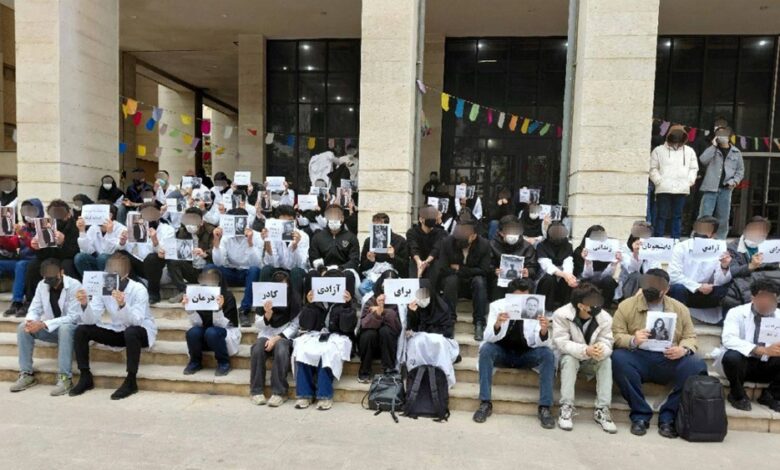
Protest gathering by students of Shiraz University of Medical Sciences – February 7, 2026
Written by
Mansoureh Galestan
Despite the brutal crackdown following the nationwide uprising in January 2026, the volatile state of Iranian society remains evident as protests flared across the country in the second week of February. While the regime attempts to project control, reports from the ground and admissions by state officials reveal a deepening crisis fueled by economic devastation and a palpable fear of the organized opposition.
Students, Retirees, and Shopkeepers Defy Suppression
On Saturday, February 7, students at the Shiraz University of Medical Sciences gathered to protest the continued detention of medical staff arrested during the January uprising. The rally highlighted the solidarity between university students and professionals, as protesters demanded the immediate release of their colleagues.
February 8—Shiraz, southern Iran
Students at Shiraz Medical Sciences University continue their protests, demanding the release of jailed doctors and medical staff who helped protesters during the nationwide uprising.#IranProtests pic.twitter.com/Bt8uu2yqTj— People's Mojahedin Organization of Iran (PMOI/MEK) (@Mojahedineng) February 8, 2026
Simultaneously, the economic crisis continues to drive Iran’s working class to the streets. On Sunday, February 8, retirees from Shush, Karkheh, and Haft Tappeh gathered outside the Social Security Administration in Shush. Their grievances were stark and desperate; protesters told labor news agencies that with current inflation, their pensions “do not even cover half a month’s living costs.” They demanded the full implementation of Article 96 regarding pension adjustments and the enforcement of free healthcare, stating that retirees should not have to pay “a single Rial” for medicine.
In Tehran, a tragedy at the Jannat Market sparked an emotional protest by shopkeepers who lost their livelihoods in a suspicious fire. Gathering in front of the outcome of the Municipality’s organizing company, the shopkeepers shouted, “Our capital of several years burned in 20 minutes.” With the Persian New Year approaching, the protesters highlighted the regime’s negligence. One shopkeeper cried out, “At least pay part of the damages; our children have no bread for tonight, and we cannot pay rent.”
February 8—Shush, southwest Iran
Retirees of the Social Security Organization resume their protest rallies, demanding higher pensions and access to basic services. Protesters held a minute of silence for the martyrs of the recent uprising.#IranProtestspic.twitter.com/9qcqh3Hh2P— People's Mojahedin Organization of Iran (PMOI/MEK) (@Mojahedineng) February 8, 2026
Regime Admits to Power of Organized Resistance
In a significant admission of the regime’s vulnerability, the Ministry of Intelligence (MOIS) in East Azerbaijan Province issued a statement on February 6 regarding the January uprising. The MOIS claimed to have identified and confronted a “seven-member cell” of the People’s Mojahedin Organization of Iran (PMOI/MEK) in Tabriz.
Contradicting earlier narratives that the January protests were scattered and minor, the intelligence statement acknowledged identifying “several hundred” field agents involved in the unrest across the province. Furthermore, the regime reported the seizure of 220 unauthorized weapons in the border city of Jolfa. These admissions underscore the regime’s growing alarm that the protests are not merely spontaneous outbursts but are increasingly organized and potentially armed.
February 8—Tehran, Iran
Merchants rally in front of the city council, demanding reimbursement for damages caused by the regime to their businesses. Regime authorities refuse to give them clear answers.#IranProtests pic.twitter.com/RUgtOPD1WJ— People's Mojahedin Organization of Iran (PMOI/MEK) (@Mojahedineng) February 8, 2026
“Fire Under the Ashes”
The persistence of these protests has triggered panic within the regime’s hierarchy. State-run media are now warning officials of a “fire under the ashes.” The newspaper Arman-e Emrooz warned on February 8 that the system stands at a “destiny crossroads.” The article criticized the government’s approach of “political palliation”—offering temporary painkillers instead of cures—warning that ignoring the root causes of the January uprising will lead to a re-emergence of crises with higher social and security costs.
This fear was echoed by Ahmad Khatami, a member of the Assembly of Experts. During the Friday Prayer sermon in Tehran on February 6, Khatami expressed terror regarding the regime’s isolation in cyberspace. Labeling the public’s rejection of the regime online as a “soft coup,” he desperately called on “Hezbollah youth” to enter the “Jihad of Explanation” to counter the flood of anti-regime sentiment. His plea reveals that the mullahs have lost the narrative war and view the internet—and the information it carries—as an existential threat.
As the regime continues to ignore the basic needs of the population while ramping up security measures, the events of early February suggest that the January uprising was not a conclusion, but a prelude to a larger confrontation.