
If Iran’s Future Is Uncertain, the Resistance’s Past Is Prologue
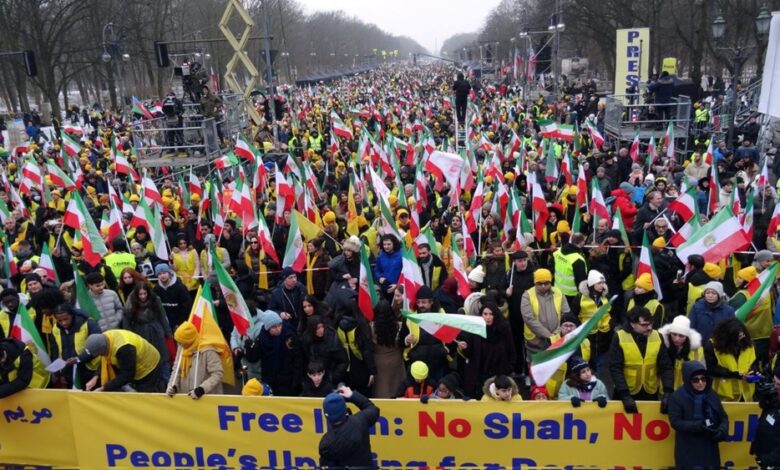
Tens of thousands rally in Berlin to support Iran’s democratic revolution and reject dictatorship
Written by
Mahmoud Hakamian
As war in Iran expands its consequences across the region and global economy, the question is no longer whether change will come, but who can manage what follows. In a country as complex and consequential as Iran, the risk is not only collapse, but mismanaged transition.
History offers no shortage of regime changes—some successful, many disastrous. In every revolution, actors present convincing plans. What distinguishes outcomes is not the clarity of those plans, but the record of those presenting them. The past remains the most reliable indicator of future conduct.
The National Council of Resistance of Iran (NCRI), which announced a provisional government on February 28, 2026, has stated that its role is to transfer sovereignty to the people, not to retain it. That claim can only be assessed through its historical behavior.
"Political support for the opposition is far more dangerous to the regime than any number of bombs" @iran_policy chair @Mohaddessin tells @20m: Europe must support NCRI's Provisional Government and recognise the right of the people of Iran to fight for regime change #FreeIran…
— NCRI-FAC (@iran_policy) March 25, 2026
Choosing Principles Over Power
A central component of the NCRI is the People’s Mojahedin Organization of Iran (PMOI/MEK), founded in 1965 and, by the late 1970s, one of the largest and most organized Muslim opposition force to the Shah. After the fall of the monarchy, Ruhollah Khomeini returned to Iran and despite all assurances, sought to consolidate authority over all political forces.
At that moment, the MEK faced a decisive choice. Khomeini required absolute ideological and political submission and, critically, the denunciation of all other political groups. For the MEK, this would have secured a share of power within the new state.
They refused.
In the months that followed, tensions escalated over compulsory veiling, minority rights, and fundamental civil liberties. They also opposed the new constitution on democratic grounds. This was not a symbolic disagreement—it was a structural rejection of authoritarian monopolization at a moment when aligning with Khomeini would have been the easiest path to influence, particularly for a Shia Muslim organization with broad popular support and substantial legitimacy earned through years of imprisonment and sacrifice under the Shah.
The cost was immediate and severe. Offices were closed, publications banned, and members killed. Yet the movement continued peaceful political activity until June 20, 1981, when regime forces opened fire on mass demonstrations, eliminating any remaining political space. Only then did armed resistance begin.
Debunking propaganda against People’s Mojahedin Organization of Iran (PMOI/MEK)
The Origins of “Peace and Freedom”
The same pattern reappeared during the Iran-Iraq war. In 1982, after Iraqi forces had withdrawn from Iranian territory, the MEK called for an end to the war. At the time, such a position was widely condemned as betrayal. Advocating peace was politically taboo, and those who now speak in the language of pacifism often held very different positions then.
Today, the NCRI’s central motto— “peace and freedom”—is rooted in that period. It reflects not a retrospective slogan, but a stance taken under extreme pressure, at significant cost. Once again, a position that was marginalized at the time was later vindicated by events, as the prolongation of the war is now broadly recognized as a national catastrophe.
Excellent thread on the #Iran – #Iraq war, that was fueled & continued by Khomeini to the detriment of the ppl of the two countries. It took tremendous courage by #MEK to destroy Mullahs' war machine, which forced them to accept the ceasefire. @Iran_Policy https://t.co/MowpoeIAfb
— Ali Safavi (@amsafavi) September 29, 2020
Organization, Cadres, and Operational Impact
For more than four decades, the Iranian regime has invested heavily in demonizing the MEK and the broader Resistance. Much of what circulates in Western discourse originates from that campaign. Yet despite this sustained effort, the movement has not only survived—it has built the most extensive and active network of dedicated cadres among Iranian opposition groups.
This distinction is critical. It is not about general popularity, but about organizational capacity. The NCRI and MEK possess a depth of committed, disciplined, and experienced members that is unparalleled among their peers. This is the infrastructure that determines whether a transition can be managed or will collapse into fragmentation.
Equally important is their operational record. The movement has repeatedly struck at the regime’s economic, intelligence, political, and military interests while simultaneously exposing key elements of its conduct, from systemic repression to its strategic programs. These actions demonstrated both the seriousness and effectiveness of the Resistance in confronting the regime at its peak, and to a significant extent, the international community’s understanding of this threat is rooted in the NCRI’s sustained efforts.
In light of @iaeaorg BoG resolution on the #Iranian regime's misconduct and failure to cooperate with the @UN watchdog, it's crucial to revisit over 3 decades of secretive activities and the NCRI's constant efforts to prevent a nuclear-armed pariah state.https://t.co/EiJenAsaiU https://t.co/lvD6qbumiY pic.twitter.com/qcXZLwOPO7
— NCRI-FAC (@iran_policy) June 5, 2024
Equality as Practice, Not Promise
The NCRI’s stated commitment to democracy, gender equality, and minority rights is often treated as a future-oriented program. However, its internal structure demonstrates these principles in practice.
For more than three decades, leadership within the MEK has been held by women. Women constitute over half of the NCRI’s membership, and its president-elect, Maryam Rajavi, reflects that institutional reality.
More broadly, members of the NCRI and MEK—who have lived and worked together for over four decades—come from diverse class, ethnic, and social backgrounds. Within this environment, equality is not theoretical. Discrimination, in practical terms, is absent. The organization functions as a lived model of the principles it advocates for Iran’s future.
This alignment between declared values and internal reality is rare, particularly among movements operating in exile.
Maryam Rajavi’s 1996 warning: Iran’s terror network, nuclear threat, and women leading the fight
The Meaning of the Provisional Government
The announcement of a provisional government in 2026 is not an isolated initiative, but the continuation of a framework built over decades of resistance.
What distinguishes it is not the existence of a plan, but the capacity behind it: organized leadership, a defined program, and trained cadres ready to manage a transition. It reflects accumulated experience, not abstract design.
If uncertainty defines the future, history provides the clearest standard for judgment. The question is not who offers the most appealing vision, but who has demonstrated—under pressure and at cost—the ability to act on their principles.
In that respect, the record is clear: a movement that chose democratic principles over immediate power, refused to legitimize authoritarian rule, paid the price for advocating peace when it was dangerous, and built the structure to sustain those choices.
For those assessing Iran’s future, that record is decisive.