
How Iran’s Clerical Rule Engineered Its Weakness
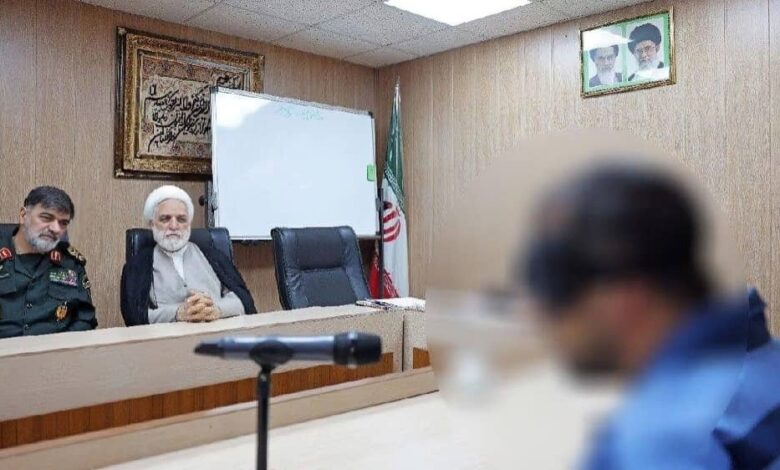
Ahmadreza Radan (left), commander of the regime’s SSF, and Judiciary Chief Gholam-Hosein Mohseni Ejei question an alleged spy during a televised interrogation aired by state media in June 2025
Written by
Farid Mahoutchi
For over four decades, Iran’s clerical regime has waged war—not only on foreign adversaries, but on its own people. It has drained the nation’s wealth into nuclear brinkmanship, proxy warfare, and ballistic escalation, claiming national dignity while denying citizens the most basic freedoms. The result is a hollow state: authoritarian, militarized, and catastrophically vulnerable.
That vulnerability is now fully exposed.
After a devastating 12-day war, Iran is left reeling. Its military deterrence has been battered, its command structure damaged, and its foreign leverage severely eroded. Yet instead of confronting these failures, the regime has doubled down on its oldest tactic—turning inward and labeling dissent as treason.
In the war’s aftermath, Judiciary Chief Gholam-Hossein Mohseni-Ejei ordered the creation of “special courts” to prosecute those accused of aiding “the enemy.” Judiciary spokesman Asghar Jahangir declared that these courts would handle cases involving “traitors, collaborators, and foreign agents,” particularly those active online. “Monitoring of cyberspace and confronting accounts working with the enemy,” he said on July 1, “has entered a new phase.”
#Iran's Regime Tightens Grip with Harsh New Espionage Law https://t.co/EPfTqGQrbS
— NCRI-FAC (@iran_policy) July 1, 2025
This is not a posture of strength. It is institutional panic.
The regime’s greatest fear now isn’t an external threat—it is its own citizens. For decades, it has held onto power through brutal repression: mass arrests of protesters, torture and execution of dissidents, long prison sentences for peaceful activists, and violent crackdowns on any form of opposition. This system of control is enforced not only through ideological mandates—like compulsory hijab, internet shutdowns, bans on basic freedoms—but through a widespread apparatus of surveillance, fear, and violence aimed at silencing every voice of dissent.
On June 30, former MP Heshmatollah Falahatpisheh publicly condemned the regime’s misplaced priorities: “One week before the war, the state was obsessed with banning dog-walking,” he told ILNA. “At the same time, Israel was manufacturing drones on Iranian soil. I warned them. No one listened.”
But its paranoia is no longer confined to the streets. It is turning inward at the highest levels. Following the war, Bulletin News, an outlet linked to the IRGC, published a blistering critique of former top security official Ali Shamkhani, whose home was leveled in an Israeli strike—while he and his son escaped unscathed. The outlet asked: “Mr. Shamkhani! People saw your house reduced to rubble, but you walked away without a scratch. Should this be called coincidence? Fate? Or something the people deserve answers about?”
#Iran Regime Shaken by Ceasefire Fallout, Fear of Unrest Mountshttps://t.co/iL8tM2lRNd
— NCRI-FAC (@iran_policy) June 30, 2025
The article went further, demanding: “Why did your son leave the house ten minutes before the blast? Why was he even there at that hour?” These aren’t rhetorical flourishes—they are accusations. In a regime where survival is suspect, proximity to disaster has become a test of loyalty.
This fracture is not surprising. A government that thrives on distrust and coercion inevitably consumes itself. For years, it has treated civil society as the enemy, criminalizing independent thought and labeling dissenters as foreign agents. It is no accident that political prisoners are tortured, whistleblowers are jailed, and even insiders are silenced.
The regime, weakened and humiliated, is now resorting to what it knows best: repression masquerading as strength. Mohseni-Ejei has urged vigilance “against internal infiltrators and deceivers,” warning that the enemy “may strike again.” But what he fears most is not an Israeli jet or American sanction—it’s a population no longer afraid.
After 46 years, the clerical dictatorship has lost every lever it once claimed: moral authority, economic control, military deterrence, and political unity. What remains is a machinery of fear. But that machine, like the war it just lost, is breaking down—and this time, no amount of censorship or courtrooms will rebuild it.