
Europe Must Back Iranian-Led Regime Change, NCRI FAC Chair Tells 20 Minutos
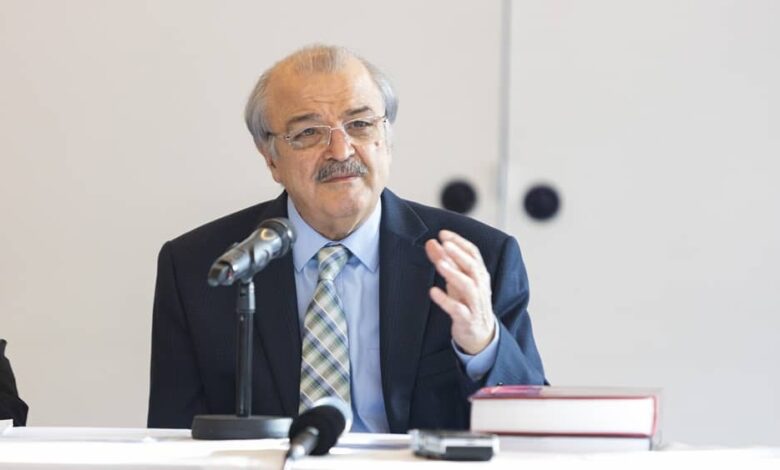
NCRI FAC Chair Mohammad Mohaddessin speaks at a news conference in Paris on March 12, 2026
Written by
Shamsi Saadati
Published by 20minutos on March 25, 2026, this interview with Mohammad Mohaddessin, Chairman of the Foreign Affairs Committee of the National Council of Resistance of Iran, presents the Iranian opposition’s case for regime change led by Iranians rather than foreign powers. Speaking in Brussels, Mohaddessin says the war could end within weeks, but argues that Western policy remains incomplete if it focuses only on military pressure, ceasefire slogans or diplomacy with Tehran.
Instead, he urges Europe, including Spain, to politically recognize the Iranian people’s right to overthrow the clerical dictatorship and to back the opposition and its proposed provisional government. He rejects the idea that outside armies, money or weapons are needed, insisting that Iranians themselves are ready to fight and finance the movement.
Mohaddessin argues that appeasement merely allowed Tehran to advance its nuclear ambitions, while a democratic Iran would also address the world’s concerns about nuclear weapons, military expansion and terrorism. He says the NCRI has spent 45 years building a political alternative, with plans for free elections within six months of the regime’s fall, a constituent assembly, a new constitution and protections for women, minorities and the separation of religion and state. He dismisses fears of an Iraq-style collapse.
A translated version of Mohammad Mohaddessin’s interview follows:
Interview: Mohammad Mohaddessin, Iranian opposition figure: “Saying ‘No to war’ is a good slogan, but Europe must support regime change.”
The chairman of the Foreign Affairs Committee of the National Council of Resistance of Iran (NCRI) sat down with 20minutos in Brussels to analyze the state of the war and the future of the ayatollahs’ regime: “We do not need money, weapons, or troops on the ground, only recognition of the Iranian people’s right to change the regime.”
Mohammad Mohaddessin (Tehran, 1955) is the chairman of the Foreign Affairs Committee of the National Council of Resistance of Iran (NCRI), and his activity right now is intense. He is working to gather support for the cause in the midst of the war by the United States and Israel against the ayatollahs, and he wants a country free from the autocratic yoke that has punished the population for decades: that is the message, the ayatollahs must fall. In that context, and while Donald Trump is giving Tehran room for negotiations that the Iranians are so far denying, Mohaddessin sits down in Brussels with 20minutos to talk not only about the conflict, but also about how a regime he sees as increasingly weakened can be defeated through resistance and from exile, and why, he insists, diplomacy is of no use with it.
Do you see the end of the war as near?
Yes, we pray for that, and we think it could be a matter of weeks. That is what people in Iran want. Our people right now are under two kinds of pressure. One comes from the Iranian regime, the repressive forces, the Revolutionary Guard, the Ministry of Intelligence; and on the other hand they are under the daily threat of bombings, because these bombings are not only against regime officials or the Revolutionary Guard. Ordinary people are also under the pressure of the bombings.
I told 🌍 media today: The overthrow of the mullahs’ regime requires a powerful, battle-tested, combat-ready force rooted within Iranian society. Today, that force exists within Iran in a disciplined and organized force: the PMOI Resistance Units, active across all 31 provinces. pic.twitter.com/BcPJdhzLgr
— Mohammad Mohaddessin (@Mohaddessin) March 19, 2026
Do you think Trump’s strategy is the right one?
In reality, I believe that Western countries in general, and the United States in this war, are leaving out a crucial link: the future of Iran must be in the hands of Iranians. The main element in thinking about policy toward Iran must include the Iranian people and the Iranian opposition movement, and that is what we have been arguing for decades.
At this point, do you think Europe should participate actively in the conflict?
I hope that will not be necessary. It is better for them to support change in Iran, now and after the war. Their slogan is “Ceasefire!” or “No to war!” It is a very good slogan, but it is not enough. Saying no to war is insufficient. The reality is that Europe must support regime change. The approach should be: end the war and change the regime. Our slogan is peace and freedom: peace means the end of the war, freedom means regime change. But that change must be carried out by the Iranian people, not by foreign powers.
What do you think, then, of the Spanish government’s position and its “no to war”?
I think the Spanish government’s position is similar to that of the European Union. Spain, with its recent experience of dictatorship, can lead a policy of support for the Iranian people. I remember that when Franco died, I was in prison under the Shah’s regime. It was great news because it symbolized the end of a dictatorship. Now Spain should offer political support: recognize the opposition, condemn the regime’s crimes, and support the struggle of the Iranian people.
Iran: Exclusive Interview with Mohammad Mohaddessin, Chair of NCRI’s Foreign Affairs Committee #IranRevolution2022 #IranProtests2022
#آزادی_آزادی_آزادیhttps://t.co/AAs719ZsxC— NCRI-FAC (@iran_policy) October 31, 2022
What, then, do you expect from both Spain and the EU?
We expect support for peace and freedom, support for regime change in Iran, support for the Iranian Resistance, and recognition of the provisional government based on the Ten-Point Plan. That would send a clear message. The regime will not change because of bombings, but it can be affected by support for the opposition. If the regime had to choose between bombings or political support for the opposition, it would choose the bombings, because support for the opposition is far more dangerous to it, since it strengthens the Iranian people’s internal struggle against the regime.
You have long warned that the policy of appeasement has achieved nothing.
No, and decades ago we said that this policy would lead to war. Western politicians thought that through this policy of appeasement, through concessions to the Iranian regime, they could reach some kind of conclusion, some kind of compromise with this regime. But the regime did not change. For example, in 2002, Europe, Germany, France, and the United Kingdom began negotiating with the regime, and later the United States joined in. That only gave the regime time to develop its nuclear weapon.
“Resistance Units” — Iran Society’s Response to Mullahs’ Rule of Terror#Iran #ResistanceUnits #IranProtestshttps://t.co/7XTmGHSFOD
— NCRI-FAC (@iran_policy) January 14, 2022
Precisely the main reason Trump gives for entering the war is Iran’s nuclear weapon. But do you think that is the only issue? Or are we talking about regime change? What is the full picture?
We have to distinguish what the United States sees in the regime, which is three things: that Iran should not have a nuclear weapon, that it should not further develop its military capacity, and that it should not export Hezbollah’s terrorism. But the Iranian people’s problem with this regime is different. The Iranian people’s problem with this regime is repression, the lack of democracy, the lack of popular sovereignty, and the lack of a democratic republic. These are the issues we want as the Iranian people. The key is that what the United States wants to achieve can only be achieved with a democratic Iran.
And how is that convergence achieved?
That is why we say that the main solution is regime change by the Iranian people and the Iranian Resistance. We are not saying that Western countries should send soldiers for us, give us money, or give us weapons. No, we do not need money, we do not need weapons, we do not need troops on the ground. We have our soldiers, the Iranian people; all of them are ready to fight against this regime. The Iranian people are financing the opposition and our movement, so what we need is for Western countries, the EU, Spain, France, the United States, the United Kingdom, and the others to recognize the Iranian people’s right to change the regime.
So, are you already prepared for the day after the regime falls?
We see that the end of the regime is attainable, we are fighting for regime change, and our movement, the NCRI, has already announced the formation of a provisional government for when that happens. We are prepared to deal with the situation after the regime falls.
.@Mohaddessin: European countries must disclose all information about #Iran regime's agents in EU countries. The regime's embassies in Europe must be shut down. This is necessary for peace and security in the EU and around the world.#DontFreeTerrorists https://t.co/2AOLhmuIls
— NCRI-FAC (@iran_policy) September 16, 2022
And what is the plan?
According to this provisional government plan, after the overthrow of the regime there will be a six-month period in which to hold free and fair elections that will lead to a constituent assembly. Once those six months have passed, the provisional government will hand over its mission to that assembly, whose representatives will assume responsibility for steering the country’s political transition.
What should that transition look like?
According to our vision, this assembly has four main tasks: first, to appoint a new provisional government to administer the country, whose legitimacy will no longer come from the Resistance but from parliament itself; second, to draft a new constitution for a new republic; third, to establish the temporary legislation needed while the constitution is being drafted and approved by referendum, a process that may last from one to eighteen months; and fourth, to supervise and oversee the actions of the provisional government. These functions would be exercised for a maximum of two years, after which the country would be governed in accordance with the new constitution, as an expression of the majority will of the Iranian people. At that point, the Resistance would cease to have authority, and its members, if they were part of the assembly, would have only their individual votes.
Is there any risk of a civil war, like what we saw in Iraq or Libya?
That is a very good question, and it is a very legitimate concern about Iran’s future. But there are some basic differences between Iran and Iraq or Libya and other countries. First, the existence of a real alternative to this regime. In Iraq, when the United States occupied the country, there was nothing; there was no alternative.
On March 18, 2026, NCRI FAC Chair @Mohaddessin urged #European leaders to abandon failed appeasement toward Tehran and instead support “regime change by the Iranian people and their organized resistance.”https://t.co/GaNr11KrtC
— NCRI-FAC (@iran_policy) March 18, 2026
You are that alternative.
We had and still have a political alternative for 45 years with all the necessary elements. We have a parliament in exile, we have detailed plans, we have plans on the separation of religion and state, on women’s rights, on minority rights, and a plan for autonomy in Iranian Kurdistan. We have a very progressive plan on minorities. So, the National Council of Resistance of Iran, as an alternative, has the ability to bring together all the different parts of society.
All of that despite differences, for example ethnic ones.
Yes, one of the main issues is that of ethnic minorities. We have good plans for them that are accepted by them. For example, the Kurdish people support our autonomy plan. Iran is a very old country, thousands of years old. Different ethnicities and religions have coexisted for thousands of years. There are no problems between Kurds and Persians, Arabs and Persians, Turks and Persians.
Do you not fear that this transition, when it comes, will be overseen by outside actors such as the United States?
No. In fact, it is true that the chaos in Iraq, Libya, or Yemen was caused in large part by external factors, especially the Iranian regime. If the regime falls, Iran will not be a new Iraq, and the regional situation could even improve.