
Economic Disaster Unfolds in Iran as MPs Slam Government’s Failures
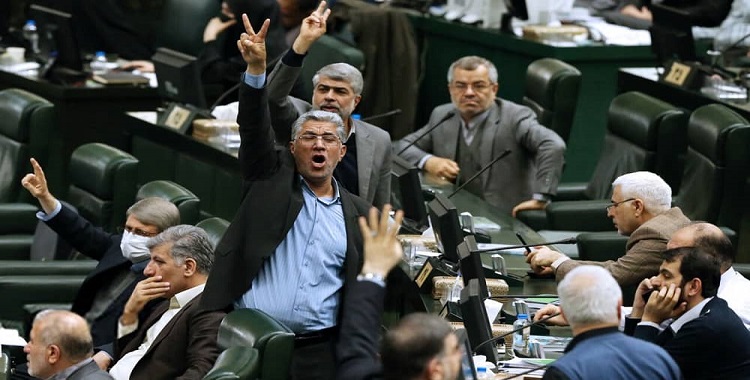
File photo: Iranian parliament (Majlis) descends into shouting and uproar
Written by
Mansoureh Galestan
Iran’s economy is collapsing at an alarming rate, with inflation, currency devaluation, and mass unemployment accelerating the country’s descent into chaos. Even within the regime, officials are no longer able to deny the disaster unfolding before them—not out of concern for the people, but out of fear for their own survival. The latest parliamentary sessions have exposed a government in total disarray, as MPs—sensing the ground shifting beneath them—lash out at the regime’s president Masoud Pezeshkian, not to address the suffering of millions, but to distance themselves from the regime’s inevitable downfall.
On a public session on February 25, MP Javad Nikbin didn’t hold back, delivering a searing rebuke of Pezeshkian’s government. “Have you been to a market?” he asked. “With this level of inflation, can you even afford a turnip? Can you serve potatoes to your guests?” His voice rising, he warned: “Your government’s direction is a disaster. If you don’t change course, impeachment is inevitable. If you don’t change, we will change you.”
Amid these fiery exchanges, the numbers paint an even bleaker picture. MP Habib Qasemi pointed out that in just the past six months, the rial has lost 50% of its value, meaning that Iranians’ purchasing power has been slashed in half. “How are people supposed to survive?” he asked. “Our industries are already on their knees, and now we have factories shutting down for three days a week due to power, gas, and water shortages. Is this your plan for economic growth?”
#Iran News: Regime Insiders Warn Pezeshkian Government of Economic Catastrophehttps://t.co/IGfYHvAx6m
— NCRI-FAC (@iran_policy) February 14, 2025
MP Samassami presented a grim economic picture: “Since 1989, the rial has lost 10,000 times its value, gold prices have increased 620-fold, and housing has surged 2,175 times.” He added, “This policy has not only failed to remove economic corruption but has increased it by more than 88%.” He warned that the refusal to enact structural reforms would only lead to further shocks, deepening economic crises, and worsening inequality.
With Iranians struggling to afford the basics, the government has chosen to prioritize its religious institutions over the people. The state-run Etemad newspaper revealed that while workers’ wages have stagnated, the regime has increased the budget for religious organizations by 900% between 2021 and 2025. “Why?” the newspaper asked. “Why, when government employees’ wages have been crushed by inflation, has the budget for institutions like the Supreme Council of Seminaries and Al-Mustafa International University grown even faster than the overall state budget?”
Meanwhile, the cost of daily life has become unbearable. According to Roozegar Khodro, metro fares in Tehran have tripled, now costing 14,000 tomans for a round trip, compared to just 6,000 tomans by car. For workers who rely on public transportation, this increase has only added to their financial burden.
#Iran's Economy Faces Unprecedented Decline Amid Global Isolation and #Financial Mismanagementhttps://t.co/5Jaf0w1gsp
— NCRI-FAC (@iran_policy) February 6, 2025
As economic hardship worsens, Pezeshkian is losing control of his own government. MP Ali Shirinzad directly confronted him, stating: “You held a meeting at the Ministry of Economy and said, ‘Changing people won’t change anything.’ Then why are you constantly reshuffling ministers? What is the point of these endless changes if they solve nothing?” She criticized the government’s focus on lobbying MPs to stop Economy Minister Abdolnaser Hemmati’s impeachment, rather than presenting solutions for the economic crisis.
The looming impeachment of Economy Minister Abdolnaser Hemmati has only made matters worse, exposing the regime’s internal fractures. While Pezeshkian fights to save him, the parliament is in open revolt, with MPs accusing each other of bribery and backroom deals. MP Mojtaba Zarei erupted in anger during a session, declaring, “They have turned this parliament into a marketplace! Some MPs are being taken to hotels and bought off with money and favors. Meanwhile, the rest of us are being smeared—people ask me how much I was paid! Damn this system!”
Speaker of Parliament Mohammad Bagher Ghalibaf tried to restore order, but his words only fueled further outrage. “We must not allow these accusations to damage the image of parliament,” he pleaded. But the damage had already been done—the session descended into shouting matches, with MPs exposing the sheer depth of corruption within the system.
#Iran’s #Economy Blocked by The Ruling Systemhttps://t.co/IIjPjPuveO
— NCRI-FAC (@iran_policy) June 17, 2022
In another public session on February 24, MP Ahmad Moradi delivered a chilling warning. “Inflation and the collapse of the rial have broken the backs of the people. People have lost hope. Youth unemployment is skyrocketing. Buying a home? It’s impossible. Even renting a home is becoming a dream.”
Meanwhile, in a recent meeting in Tehran, the regime’s Supreme Leader Ali Khamenei urged Qatari Emir Sheikh Tamim bin Hamad Al Thani to release $6 billion in Iranian oil revenues currently frozen in Doha. Khamenei emphasized that, despite U.S. pressures, Iran expects Qatar to return the funds, highlighting the regime’s economic desperation. Notably, Iranian state media coverage of the meeting lacked the usual emphasis on diplomatic successes, such as the Qatari Emir’s gestures of respect, indicating a weakened regional stance for the regime.
The answer is becoming clearer by the day. Across Iran, labor protests, street demonstrations, and economic strikes are growing. Retirees, factory workers, students, and shopkeepers are taking to the streets, demanding relief from an economy that no longer functions.
The Iranian Statistics Center recently confirmed what people already knew: the cost of imported goods has risen 53.8% in just one year, while domestic production continues to shrink due to blackouts and energy shortages. As crises deepen, MPs are not fighting to save the people—they are fighting to save themselves. But with public patience running out, the question is no longer whether the regime can fix the economy—it is whether they can hold on to power at all.