
Charlie Hebdo Unveils Reza Pahlavi as an Unwitting Digital Asset for Iran’s Clerical Regime
Written by
Mohammad Sadat Khansari
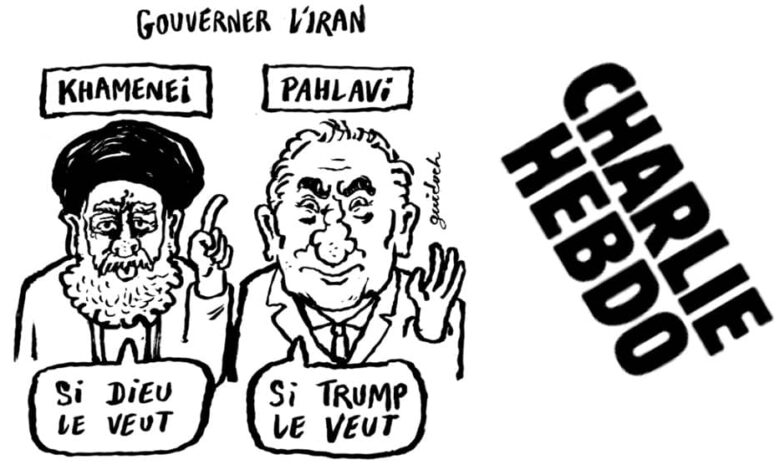
In its March 5, 2026, article titled “Reza Pahlavi, a digital tool at the service of the mullahs?” published on charliehebdo.fr, Charlie Hebdo delivers a stark examination of how social media manipulation has positioned Reza Pahlavi as a beneficiary—and inadvertent servant—of Iran’s theocratic rulers. Drawing on a detailed investigation by Treadstone 71, an American intelligence firm specializing in open-source intelligence (OSINT), the piece methodically dismantles the illusion of Pahlavi’s grassroots support, revealing it as a regime-orchestrated facade that ultimately bolsters the clerical dictatorship’s grip on power.
Charlie Hebdo highlights Treadstone 71’s findings, which expose a network of accounts ostensibly championing Pahlavi from the West but operating directly from within Iran. These profiles, far from representing genuine opposition, utilize “cartes SIM blanches”—special SIM cards reserved exclusively for regime officials. This access grants unrestricted internet connectivity in a country where authorities routinely impose blackouts to suppress dissent.
As Treadstone 71 analyst Dancho Danchev notes in the report cited by Charlie Hebdo, such privileges are typically extended by Iran’s intelligence and security services, often in exchange for written or verbal commitments to avoid crossing regime-defined “red lines.” This arrangement ensures that these accounts amplify Pahlavi’s visibility without posing any real threat to the mullahs, effectively channeling public frustration into a harmless outlet and diverting momentum from authentic democratic movements.
Accès libre | Le fils du chah d'Iran, Reza Pahlavi, se rêve en homme providentiel. Apparemment porté par une foule en délire sur ses réseaux sociaux, l'homme ne pourrait pourtant être qu'un pion au service… du régime des mollahs https://t.co/XGDA60wLXN
— Charlie Hebdo (@Charlie_Hebdo_) March 6, 2026
Further underscoring the regime’s calculated involvement, Charlie Hebdo details Treadstone 71’s discovery of an “army of bots” inflating Pahlavi’s online presence. Through mathematical analysis of account creation patterns—what Danchev terms “the heartbeat of the metronome”—the investigation identified thousands of profiles generated at the exact zero second of every minute, a precision unattainable by human users.
This bot-driven surge accounts for approximately 90% of Pahlavi’s Instagram followers, per the report. By fabricating an image of overwhelming popularity, these automated networks create a false narrative of inevitability around Pahlavi’s potential return, misleading both domestic Iranians and the global diaspora. Charlie Hebdo emphasizes how this deception attacks “situational awareness,” tricking policymakers, journalists, and the public into perceiving Pahlavi as a viable alternative when, in reality, it serves to undermine any genuine push for democratic reform.
The article in Charlie Hebdo also points to the broader strategic implications: this “blanchiment de légitimité” (legitimacy laundering) not only sustains the clerical regime by neutralizing opposition energy but also perpetuates division among Iranians. While Pahlavi publicly positions himself as the stabilizer Iran needs—especially following the December 2025 protests that claimed thousands of lives according to NGOs—the regime’s digital tactics ensure his prominence remains a controlled illusion.
Foreign AI Operations or Iran’s Cyber Forces Propping Up an Opportunist Campaign https://t.co/6Vd0p77kzG
— M. S. Khansari (@khansari_m) January 10, 2026
As Charlie Hebdo reports, this has allowed the mullahs to weather multiple uprisings over the years by redirecting attention toward a figure who, exiled since 1979, lacks on-the-ground influence yet absorbs the spotlight from more substantive challengers.
Ultimately, Charlie Hebdo’s piece, grounded in Treadstone 71’s data-driven revelations, illustrates a sophisticated disinformation campaign where Pahlavi functions as a digital pawn. By artificially elevating his profile, the clerical dictatorship maintains narrative control, stifles real alternatives, and prolongs its authoritarian rule—all without Pahlavi ever stepping foot in Iran. This fact-based exposé from Charlie Hebdo serves as a cautionary tale on the perils of social media in authoritarian contexts, where online fervor can mask regime-engineered manipulation.