
Blast in Bandar Abbas Exposes Iran’s Regime Panic and Incompetence Amid Fears of Uprising
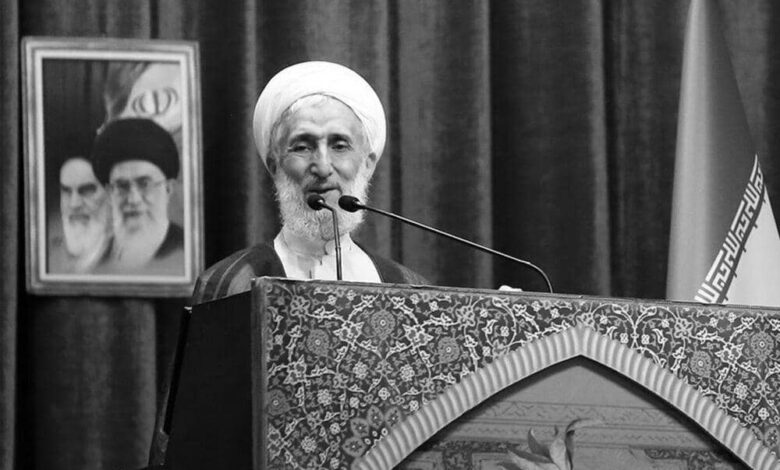
January 17, 2025 — Kazem Seddiqi, Tehran’s interim Friday Prayer leader, delivering a sermon during Friday prayers
Written by
Farid Mahoutchi
The horrific explosion that ripped through Bandar Abbas’s Rajaee port was more than just an industrial accident; it was a man-made catastrophe that peeled back the layers of the Iranian regime’s propaganda to reveal its core vulnerabilities: staggering incompetence and a deep-seated fear of its own populace.
While officials scramble to control the narrative and deflect blame onto external enemies, their own admissions and reactions betray a profound anxiety about the explosive potential simmering within Iranian society. The disaster serves as a grim testament to the deadly consequences of systemic mismanagement and the regime’s increasing fragility in the face of potential public outrage.
Acknowledging the incident, state media has refused to provide information on the casualties so far.
For more insight on #AbadanMetropol, read⬇️https://t.co/dRRiLuBilX pic.twitter.com/3Hg7JNqR2I— NCRI-FAC (@iran_policy) October 26, 2022
Unprecedented Devastation
The sheer scale of the devastation, acknowledged even in censored state media, underscores the gravity of the failure. Initial reports by the state-run ILNA news agency paint a nightmarish picture, suggesting the container explosion “caused over 90 percent of the maritime companies’ workers to go missing or be turned to ash.”
While the regime has been slow to release definitive figures, Mohammad Jamalian, a member of the Majlis (parliament), admitted that 1,375 injured individuals were initially admitted to hospitals following the blast. He further conceded the regime’s inability to provide an accurate death toll, stating, “Regarding the deceased, we do not have definitive statistics yet… It’s possible the bodies were scattered.”
He also admitted that the grim reality is that identification relies on DNA testing, highlighting the horrific nature of the explosion and the regime’s initial struggle to grasp, or perhaps its reluctance to reveal, the true human cost.
🚨 Exclusive #Thread : Catastrophic explosions at #Iran’s Bandar Abbas Rajaei Port (#BandarAbbasExplosion) on April 26–27 devastated the area.
Eyewitnesses told #en_simayazadi: "the regime censors the truth; the port has turned into a graveyard."pic.twitter.com/OPlphebcUd— SIMAY AZADI TV (@en_simayazadi) April 28, 2025
Lack of Transparency
Predictably, the regime’s first instinct was not transparency or accountability, but deflection and the invocation of shadowy enemies. The Friday prayer leader in Ilam, Allah Nour Karimitabar, exemplified this tactic, praising state media’s supposed “momentary and precise reporting” while simultaneously accusing “enemy media, America, Israel, and Britain” of spreading “speculations and rumors to target our national security.” He explicitly stated, “They tried to turn the people against the system.”
Mohammad Mokhtari, the Friday prayer leader in Birjand, echoed this, claiming the “enemy greatly tried to ride the wave… to create sedition.” He specifically refuted rumors of military involvement in moving missile fuel or an Israeli attack, declaring such notions were “strangled in the cradle,” showcasing the regime’s frantic efforts to suppress any narrative that doesn’t involve foreign culprits.
Despite the outward bluster blaming foreign powers, cracks appeared in the official façade, revealing internal acknowledgments of negligence that point to the regime’s incompetence. The same Ilam prayer leader who blamed enemies also questioned the systemic failures that allowed the disaster, asking, “Why should goods accumulate for a long time in a port where we have the most commercial interactions? It needs planning. Why should hazardous cargoes with explosion potential be stored in such a way that if, God forbid, something happens, it creates such a cost for our country?”
Everything the Collapse of the Metropol Building In Abadan Brought to Lighthttps://t.co/dRRiLuBilX pic.twitter.com/XySFQDQ79o
— NCRI-FAC (@iran_policy) June 3, 2022
Similarly, the Birjand prayer leader urged authorities to “pay attention to the causes of this incident and the negligence and faults,” demanding accountability if “unfit officials were in charge.” This hints at the systemic rot the regime usually denies, further evidenced by past incidents where managers escaped punishment despite safety breaches, compensating losses through insurance while continuing business as usual due to special relationships.
This obsession with controlling the “first narrative” was further highlighted by Hosseini Hamedani, the Friday prayer leader in Karaj. While urging an investigation into potential negligence or mismanagement, he stressed the need to quickly “inform the public so that others cannot orchestrate these events and disturb the people’s minds,” explicitly referencing the recent public reaction: “Did you see how much uproar there was this week?” This reveals the regime’s palpable fear that uncontrolled information could galvanize public anger.
Fear of Public Outrage
Perhaps most revealing of the regime’s underlying fear is its reaction to signs of popular solidarity and its perpetual anxiety about organized dissent, particularly from the working class. Following the Bandar Abbas tragedy, expressions of solidarity emerged from heavy vehicle drivers in several cities, including Isfahan, Kermanshah, Ardabil, and Sirjan, who gathered to mourn their lost colleagues.
🚨 Exclusive #Thread : Catastrophic explosions at #Iran’s Bandar Abbas Rajaei Port (#BandarAbbasExplosion) on April 26–27 devastated the area.
Eyewitnesses told #en_simayazadi: "the regime censors the truth; the port has turned into a graveyard."pic.twitter.com/OPlphebcUd— SIMAY AZADI TV (@en_simayazadi) April 28, 2025
While framed as sympathy, such collective action invariably rattles the regime, which is constantly trying to play down public resentment in fear of larger protests. For example, on May 2, 2025, Tehran’s Friday prayer leader, Kazem Sedighi, discussing workers, said: “Forty-six years have passed since the revolution, all these infiltrators, all these hypocrites [regime term for PMOI/MEK], all this poisonous propaganda atmosphere, yet not a single instance of our workers coming to the streets because of salaries or perhaps resentment from somewhere.”
This blatant denial of decades of labor protests underscores the regime’s deep-seated terror of worker mobilization, seeing the specter of the organized opposition, the NCRI and MEK, behind every expression of discontent. And now, in the aftermath of the Bandar Abbas disaster, the regime is more fearful than ever of disgruntled workers gravitating toward the organized resistance movement.
May 1—Qom, central Iran
Truck drivers hold rally in solidarity with the victims of the Bandar Abbas explosion.pic.twitter.com/qlMvUBci2e— People's Mojahedin Organization of Iran (PMOI/MEK) (@Mojahedineng) May 1, 2025
The Regime’s Weakness Laid Bare
The Bandar Abbas explosion, therefore, is far more than a localized tragedy. It is a stark symptom of a regime plagued by incompetence and paralyzed by fear. The chaotic response, oscillating between blaming external enemies and admitting internal failures, exposes a leadership terrified of accountability and deeply anxious about the potential for public anger to ignite in Iran’s volatile social landscape.
The disaster lays bare the regime’s fundamental weaknesses, highlighting how its corruption and mismanagement not only endanger the lives of ordinary Iranians but also fuel the very discontent it fears most, further ripening conditions for fundamental change.