

Baluch Women Stand Tall Against Regime Brutality in Southeastern Gunich Village
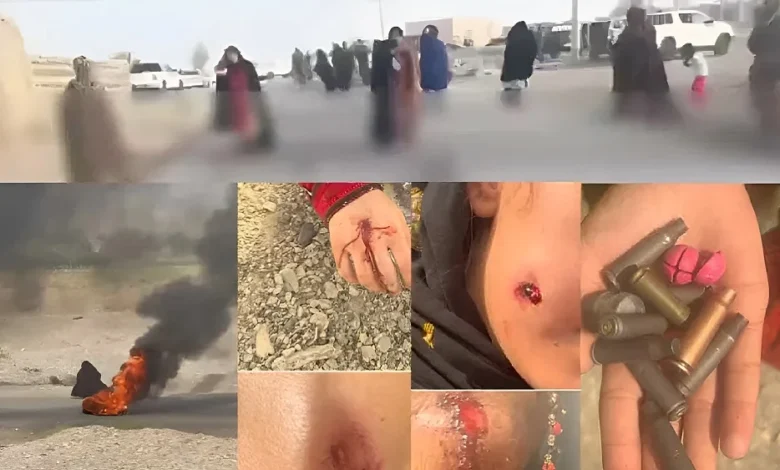
IRGC attack on the village of Gunich leaves one dead and 11 injured
Written by
Mansoureh Galestan
In the early hours of Tuesday, July 1, the village of Gunich in Khash County, located in Iran’s Sistan and Baluchestan province, became the latest site of state-sponsored violence. A coordinated military raid, launched by the Islamic Revolutionary Guard Corps (IRGC) and regime law enforcement, left at least one woman dead, eleven injured—many critically—and more than 50 arrested, according to both human rights organizations and regime-affiliated media.
The attack began around 5:00 AM and continued for nearly five hours. With the village’s men absent at the time, Baluch women took it upon themselves to resist. In a bold act of self-defense, they blocked the entrances to their village and burned tires to prevent the armed forces from advancing further. Videos circulating on social media show women hurling stones, erecting makeshift barriers, and crying out in protest as live ammunition was fired in their direction.
This resistance was not just spontaneous—it was an act of generational defiance rooted in years of systemic repression and marginalization of the Baluch minority in Iran. The attack on Gunich is widely seen as a continuation of the regime’s brutal policies against ethnic groups, reminiscent of the 2022 “Bloody Friday” massacre in Zahedan, when security forces killed scores of Baluch protesters.
The brutal attack by the Revolutionary Guards and the State Security forces on the defenseless women of Gonich village in Khash County, in southeastern Iran, once again reveals the ugly face of the misogynistic clerical regime.
At the same time, the brave resistance of Baluchi…— Maryam Rajavi (@Maryam_Rajavi) July 1, 2025
Deadly Raid Without Justification
According to human rights reports, the regime’s forces entered Gunich without a court order, falsely claiming that residents were armed. They stormed homes and indiscriminately opened fire. The primary target appeared to be members of the Bameri family, several of whom were protesting the regime’s recent military conduct in the region.
One woman, 40-year-old Khan Bibi Bameri, was killed during the raid. Eleven others, including four girls under the age of 18, were seriously wounded.
At least two of the injured remain in critical condition in the intensive care unit at Khash Hospital. The young age of many of the victims highlights the indiscriminate nature of the violence and the regime’s willingness to target even children and pregnant women.
More footage of the attack by regime security forces against the village of Hossein Abad near Zahedan.pic.twitter.com/DYIzyFHwXF
— People's Mojahedin Organization of Iran (PMOI/MEK) (@Mojahedineng) June 1, 2025
Maryam Rajavi: A Salute to the Brave Baluchi Women
Following the attack, Mrs. Maryam Rajavi, President-elect of the National Council of Resistance of Iran (NCRI), condemned the assault and honored the bravery of the women in Gunich. In a post on X (formerly Twitter), she wrote: “The brutal attack by the Revolutionary Guards and the State Security forces on the defenseless women of Gonich village in Khash County, in southeastern Iran, once again reveals the ugly face of the misogynistic clerical regime.
“At the same time, the brave resistance of Baluchi women against the aggressors reflects the determination and strength of Iranian women in the fight against religious fascism.
In this brutal assault, one Baluchi woman lost her life, and several others were injured, some critically. The women of the village resisted by throwing stones and burning tires, successfully preventing the assailants from re-entering.
“Salute to the brave Baluchi women. My heartfelt condolences go out to the people of Khash and to the family of Khan-Bibi Bameri, who was murdered by Khamenei’s agents. I wish the wounded a swift recovery, and call on the youth to stand in solidarity with the people of Gonich.”
A Symbol of Defiance
The women of Gunich, unarmed and unprotected, took extraordinary steps to protect their community. In the face of gunfire and intimidation, they raised their voices, blocked roads, and physically resisted with nothing but stones and determination. Their resistance has become a powerful symbol of courage in the face of tyranny.
Local sources describe the village atmosphere as “warlike,” with children traumatized and families shattered. The regime’s raid has sparked renewed outrage among civil society and human rights advocates, who say the attack reflects a broader pattern of targeted repression and ethnic cleansing under the mullahs’ regime.
PMOI Resistance Units in Zahedan defy regime, lead Iran’s true battle for freedom https://t.co/LTTt1l6MJD
— People's Mojahedin Organization of Iran (PMOI/MEK) (@Mojahedineng) June 28, 2025
A Pattern of Oppression
The Baluch minority in Iran has long suffered from state neglect, poverty, discrimination, and periodic crackdowns. Tuesday’s attack was not an isolated incident but part of a larger strategy of domination through fear, especially in regions home to ethnic and religious minorities.
This assault, occurring in the silence of Iran’s judiciary and political institutions, once again highlights the lack of accountability in the regime’s security apparatus. While Tasnim News, affiliated with the IRGC, confirmed two deaths and dozens of arrests, it provided no justification for the deadly raid—underscoring the regime’s impunity.
The World Must Not Remain Silent
The tragedy in Gunich is a stark reminder of the regime’s unrelenting brutality, particularly against women and marginalized communities. As the regime tightens its grip in the wake of its war with Israel and amid mounting internal unrest, these acts of violence are likely to escalate.
But the women of Gunich have shown the world that even in the darkest moments, resistance persists. Their stand is a call to action—for justice, for accountability, and for international attention to the plight of Iran’s oppressed minorities.