
Britain’s Express: Iran’s 1988 Massacre Must Be Recognized by UK as Crime Against Humanity
Written by Mahmoud Hakamian
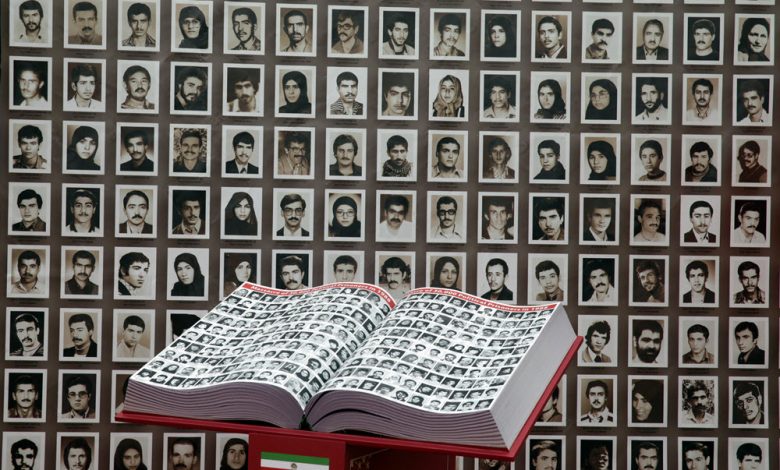
Britain’s Express has published harrowing personal accounts from relatives of Iranian political prisoners who perished in Iran’s 1988 massacre.
The Express wrote that thousands of political prisoners, affiliated to the main opposition People’s Mojahedin Organization of Iran (PMOI, Mujahedin-e Khalq or MEK), were executed in 1988 following a ‘fatwa’ handed down by the regime’s then-supreme leader Ruhollah Khomeini ordering the purge.
The Express interviewed Ehsan Qaraee, an Iranian civil engineer and human rights activist who now lives in Europe and whose father was executed during the 1988 massacre.
Now Mr Qaraee has spoken out to condemn what Amnesty International and Human Rights Watch have branded “crimes against humanity,” The Express wrote on Friday, August 16, 2019.
Speaking of his experience, Mr Qaraee told Express.co.uk his father was murdered by the regime and claimed his mother was savagely tortured in front of her one-year-old daughter’s eyes.
He said: “My parents were both teachers—my father was a historian and my mother was a maths teacher.
“After Khomeini took power they started to arrest people and at the start, they went for academic people. They arrested both of my parents separately in 1981. My sister was just one year old.
“For a period of three months, they tortured my mother in front of my sister’s eyes.”
The Express pointed out that many of the perpetrators still enjoy high-level governments role today, and Mr Qaraee called for those responsible to be “brought to justice.”
He said: “For me, I would like some recognition from especially the UK Government that this crime was a crime against humanity. And I would like that the UN establish a committee—a truce committee—and that they investigate this crime.
“Because all of those who committed these crimes—all of those who were in ‘death committees’ all around the country—they are still in power.
“We are talking about Ebrahim Raisi who is the head of the judiciary system in Iran—or Mostafa Pourmohammadi who is Justice Minister.”
Thousands of opponents of Iran’s regime—mainly supporters of the MEK or PMOI anti-government faction—were targeted by the hardline mullahs during the 1988 killings, which were highlighted in an Amnesty International paper last year, the Express wrote.
The damning document, entitled ‘Iran: Blood-Soaked Secrets’, exposes what it describes as “ongoing crimes against humanity” due to the inability of victims to be reunited with the bodies of their lost ones.
Speaking to Express.co.uk, Amnesty International’s lead researcher on Iran, Raha Bahreini, said: “For three decades, families and survivors and former prisoners have been struggling for truth and justice and they have documented this horrific crime in order to counter the narratives of denial and distortion the Iranian authorities have been perpetuating.
“We have relied on this legacy of documentation and tried to use the new evidence that has emerged in order to further the struggle of the families and survivors for truth and justice.”
Hossein Fathi, 68, and his wife Fatima Abdi, 53, were also targeted by the 1988 massacre.
They told Express.co.uk of their harrowing plight as they gave lucid accounts on what they claimed were barbaric acts of torture.
Mr Fathi, who lost 14 members of his family, said: “I witnessed torture and they tortured me by lashing. They hung me from the roof and tried to kill me.”
Meanwhile, Ahmad Ebrahimi—who was detained in Gohardashst prison—said of his “shocking” experience: “They kept us in the dark—we didn’t know what was going on or what was going to happen. And we were taken blindfolded where all of us, 150 of us, were taken to an interrogation room and asked about our views towards the regime. If we did not say we supported the regime, they would kill us straight away.”
Mostafa Pourmohammadi, one of Iran’s so-called “Judges of Death”, accused of being complicit in the massacre, was appointed the Minister of Justice under current Iranian President, Hassan Rouhani.
His controversial appointment came shortly after Amnesty International asked the government of Iran to bring to light what happened to the political detainees in the country on December 4, 2018. Amnesty also asked the United Nations to set up an investigation group to find the facts of “crimes against humanity” in Iran.