
Weekly Report: Global Diaspora Demonstrations and Diplomatic Pressure Campaign (August 16–22, 2026)
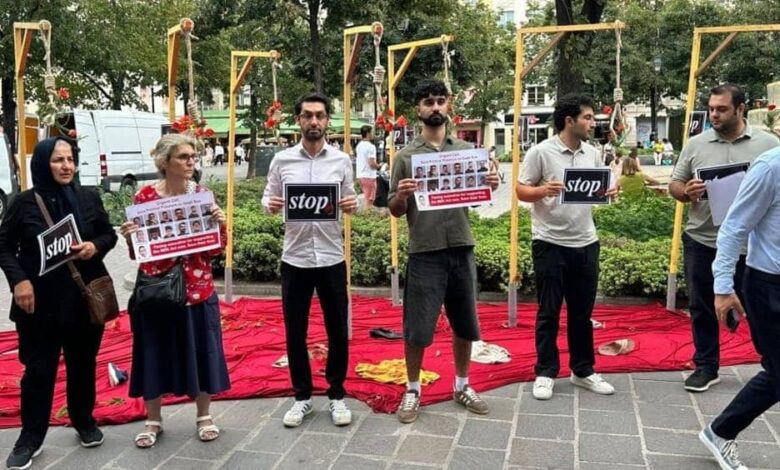
On August 15, 2026, supporters of the National Council of Resistance of Iran held an exhibition at Place Joachim-du-Bellay in Paris, France, calling for the global abolition of the death penalty in Iran
Written by
Shamsi Saadati
Against the backdrop of a plunging economy, systemic corruption, and severe fuel shortages that have pushed the Iranian population to unprecedented levels of outrage and exhaustion, the Iranian democratic resistance has mobilized a vast international front to mirror the defiance on the streets inside Iran. From August 16 to August 22, 2026, supporters of the National Council of Resistance of Iran (NCRI) and the People’s Mojahedin Organization of Iran (PMOI/MEK) held coordinated demonstrations, sit-ins, and public exhibitions across major cities in Europe and North America. Amplifying the voice of an exhausted public undergoing severe socio-economic hardship and brutal state violence under the newly installed supreme leader Mojtaba Khamenei, these global actions demanded an immediate end to executions, called for the closure of Iranian diplomatic missions functioning as espionage hubs, and pressed the international community to recognize the Iranian people’s demand for a secular, democratic republic.
August 21, 2026
In Berlin, supporters of the NCRI continued their ongoing sit-in outside the Iranian regime’s embassy, marking nearly half a year of continuous demonstration against state violence, systemic executions, and diplomatic appeasement. Demonstrators reiterated demands for the complete closure of the embassy, characterizing it as a center for espionage and state-sponsored terrorism, while advocating for a democratic republic based on NCRI President-elect Maryam Rajavi’s Ten-Point Plan. In Paris, activists organized a book stand and photo exhibition highlighting the continuing detention of protesters arrested during the January 2026 uprising and the surge in death sentences under the clerical dictatorship. A similar educational initiative was launched in Winchester, United Kingdom, where the Academics in Exile Association held a photo exhibition that drew strong public engagement, collecting signatures on petitions calling for United Nations intervention against state repression. Simultaneously, broad rallies and solidarity demonstrations under the global “No to Executions” campaign were conducted across Stockholm, Oslo, Copenhagen, and The Hague, with NCRI Nordic representative Parviz Khazaei calling for decisive international action against Tehran’s apparatus of terror. In tandem, coordinated commemorations honoring the martyrs of the 1988 massacre and fallen dissidents took place in Berlin, Bern, Aarhus, Paris, Rome, Munich, Toronto, and Ottawa, where crowds chanted slogans rejecting both monarchical autocracy and theocratic rule.
Irvine, California: Iranian-Americans Rally in Support of the “No to Execution Tuesdays” Campaign
August 20, 2026
Marking its 173rd consecutive day, the embassy sit-in in Berlin maintained its persistent presence, with protesters emphasizing that Western governments must halt policies of appeasement toward Tehran and support the Iranian people’s drive for a secular democracy. In Paris, NCRI supporters convened another photo exhibition and outreach drive, presenting the platform of the Iranian Resistance as the definitive path toward justice, peace, and fundamental civil liberties while condemning ongoing human rights abuses against political prisoners inside Iran.
August 19, 2026
Gathering at Dam Square in Amsterdam, Iranian expatriates and resistance supporters organized a public demonstration aligned with the “No to Executions Tuesdays” movement, demanding the immediate abolition of capital punishment and the release of all political detainees. Demonstrators emphasized that neither the return of the monarchy nor the continuation of the ruling theocracy reflects the will of the Iranian public. Meanwhile, in Paris, activists maintained public outreach through photo displays and book stands, exposing the regime’s escalating execution rates designed to quell internal discontent following the January 2026 nationwide uprising.
Paris Exhibition Calls for End to Executions and Death Penalty in Iran – August 15, 2026
August 18, 2026
In Gothenburg, NCRI supporters rallied in solidarity with the 134th week of the “No to Executions Tuesdays” campaign, warning of the grave, immediate danger facing political prisoners across Iran’s security dungeons and voicing explicit support for the MEK Resistance Units active inside the country. Across the Atlantic in Toronto, Canadian Member of Parliament and former minister Judy Sgro joined members of the Iranian-Canadian community at Queen’s Park for a solemn gathering and exhibition marking the 38th anniversary of the 1988 massacre of over 30,000 political prisoners, while demanding an end to the current wave of executions. In Irvine, California, Iranian-American activists hosted a rally and memorial photo display, honoring executed protesters and reaffirming their commitment to establishing a democratic, secular republic in Iran.
Winchester Exhibition Raises Awareness of Iran’s Escalating Executions and Human Rights Violations
August 16, 2026
Immediate protests erupted outside Iranian diplomatic facilities in response to the hanging earlier that day of protester Shahram Sadeghi, who had been detained during the January 2026 uprising. Outside the Iranian embassy in Oslo, demonstrators joined by NCRI Nordic representative Parviz Khazaei condemned Sadeghi’s execution, called for the immediate release of all political prisoners, and demanded the closure of the embassy as a hub of state intelligence operations. Outside Sweden’s Foreign Ministry in Stockholm, demonstrators similarly gathered with photographs of executed dissidents, urging the Swedish government to adopt a firm policy against Tehran’s state-sanctioned violence. In Berlin, where supporters marked the 164th day of their ongoing embassy sit-in, protesters held an emergency rally condemning Sadeghi’s execution and reiterating calls for an end to Western appeasement.
Oslo Protesters Condemn Execution, Call for Closure of Iran Regime’s Embassy – Video 1
August 15, 2026
Reports received during the current reporting cycle detailed multiple major rallies and exhibitions held earlier in August. In Paris, an exhibition at Place Joachim-du-Bellay focused on the dramatic surge in state executions since early 2026, framed within the broader destabilization following the conflict between Iran and the United States that began on February 28. In Bern, supporters gathered to honor the victims of the 1988 massacre and pay tribute to Hossein Shariati, a longtime PMOI member who recently passed away after decades of opposition activity. In Munich, a photo exhibition drew attention to the thousands of casualties reported during the crackdown on the January 2026 uprising alongside the victims of 1988. In Bucharest, Romanian citizens joined Iranian expatriates at a public exhibition urging an international tribunal to prosecute senior Iranian officials for crimes against humanity.
Oslo Protesters Condemn Execution, Call for Closure of Iran Regime’s Embassy – Video 3
The widespread international mobilization across European capitals and North American cities demonstrates that the Iranian democratic opposition has successfully established a synchronized global counterweight to Tehran’s authoritarian apparatus. As the clerical regime faces insurmountable domestic pressure—driven by severe economic collapse, public exhaustion, and escalating internal strikes—its attempt to project authority through capital punishment and overseas intelligence networks has only deepened its international isolation.
The persistence of long-term sit-ins and coordinated diaspora actions underscores that the struggle inside Iran is inextricably linked to a global diplomatic push that rejects both theocratic tyranny and monarchical restoration. Despite the regime’s efforts to silence internal dissent through state terror, the global campaign highlights an undeniable reality: Tehran’s strategy of coercion has failed to suppress the demand for a free, secular, and democratic republic.