
French Dignitaries and NCRI Denounce Paris Rally Ban as Capitulation to Tehran
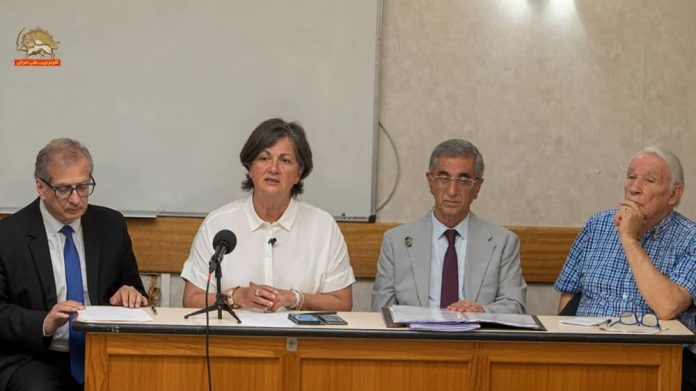
From left to right: NCRI member Afchine Alavi, French MP Christine Arrighi, NCRI member Behzad Naziri, and Gilbert Mitterrand, President of France Libertés, speak at a press conference in Paris on June 19, 2026, to challenge the ban on the June 20 rally
Written by
Mohammad Sadat Khansari
PARIS — Following a last-minute decision by the Paris Police Prefecture to prohibit a massive rally scheduled for Saturday, June 20, organizers and prominent political figures held an emergency press conference in Paris on Friday afternoon, June 19, 2026. The briefing aimed to expose the political motivations behind the restriction and lay out the legal counter-offensive launched by the movement.
The sudden prohibition on the human rights rally coincided with the cancellation of several other local events for various reasons, including the French Music Festival and a demonstration by the La France Insoumise party led by Jean-Luc Mélenchon.
Meticulous Preparation Upended in Seven Minutes
During the press conference, representatives detailed a compliance timeline that indicates the ban was sudden and arbitrary. Registration for the event, which was organized to protest the alarming surge of political executions in Iran, began on April 20. Organizers had spent two months coordinating technical requirements, march routes, and safety protocols with local law enforcement. As recently as June 15, an eight-member delegation met directly with police officials, who formally approved Place Vauban as the gathering site and signed off on the designated march route.
La députée 🇫🇷 @ChArrighi, présidente du Comité parlementaire pour un Iran démocratique, dénonce la décision du gouvernement français d’interdire le rassemblement prévu demain à Paris contre les exécutions en Iran. Les organisateurs ont déposé un recours juridique.
CC : @jnbarrot pic.twitter.com/7DvfBUKJvv
— M. Hanif Jazayeri (@HanifJazayeri) June 19, 2026
The legal process was disrupted on Thursday evening. At 7:27 p.m., the organizing committee received a message from the police commissioner stating that he was waiting for final approval from higher authorities. Merely seven minutes later, at 7:34 p.m., an official decree from the Prefect’s office arrived, enforcing a total ban on the gathering. Representatives emphasized that while the rule of law had governed the process for nearly two months, it was abruptly abandoned in favor of external political deals.
Baseless Security Arguments Challenged
Spokespersons for the Iranian Resistance dismantled the security pretexts cited by the Paris Prefecture, which included fears of counter-protester clashes, proximity to sensitive diplomatic sites in the 7th arrondissement, and a highly tense international landscape.
Media coordinators for the Iranian Resistance described these justifications as entirely groundless and illogical, pointing out that previous rallies organized by the National Council of Resistance of Iran (NCRI) and its allies have maintained an unblemished record of safety and peace.
NCRI Statement: Remnants of the Shah’s Regime Are Accomplices and Instruments of the Religious Dictatorship
Administrative Court: #100KFreeIranRally Faces the Risk of a Major Attack by the Iranian Regime or Monarchists; #SAVAK Threatened to Bomb the Rallyhttps://t.co/gfdo9IiC42— NCRI-FAC (@iran_policy) June 20, 2026
The coalition characterized the ban as a familiar pattern of diplomatic blackmail used by the clerical regime to pressure Western democracies into silencing organized democratic opposition.
Speakers noted that Tehran is acting out of systemic fragility and a deep fear of the Iranian Resistance, especially as the regime escalates executions against PMOI members and dissidents involved in the January 2026 uprisings.
Organizers recalled a similar scenario in 2023, when the administrative court successfully overturned a matching ban issued by the Prefecture, expressing confidence that justice would prevail again in their newly filed emergency appeal.
French Officials and Human Rights Leaders Object
French lawmakers expressed sharp criticism over the ruling, calling it a blow to freedom of speech and an affront to the struggle of the Iranian population. Christine Arrighi, a member of the French National Assembly and head of the Parliamentary Committee for a Democratic Iran, stated that implementing a prohibition just 24 hours prior to the event was unacceptable, particularly with an estimated 100,000 travelers already en route from Europe, Canada, and the United States. She noted that the ban would not deter participants from arriving in the capital, thereby creating unnecessary administrative and security complications.
Paris birthplace of a revolution that helped inspire modern ideals of liberty, free expression, and the right of citizens to assemble has banned a peaceful demonstration against the wave of executions in Iran.
When those protesting state executions and a free Iran are silenced,… pic.twitter.com/3EhIE2Tw6I
— Dean Baxendale (@DMCBaxendale) June 20, 2026
Arrighi also pointed to media reports highlighting a phone call between French Foreign Minister Jean-Noël Barrot and Iranian Foreign Minister Abbas Araghchi just prior to the ban, suggesting that the public would eventually learn the true nature of the diplomatic bargain struck with Tehran.
Gilbert Mitterrand, President of France Libertés (the Danielle Mitterrand Foundation), echoed these concerns by questioning what could have shifted so drastically on June 18 to reverse months of official cooperation. He suggested a direct correlation with a diplomatic memorandum of understanding signed at Versailles that same day. Mitterrand reminded attendees that historical security threats to these annual gatherings have originated solely from the Iranian regime itself, referencing a past foiled terror plot traced directly to Tehran’s agents.
Un rassemblement « contre les exécutions politiques en Iran », prévu samedi à Paris, interdit https://t.co/bfL9savo8X
— Le Parisien (@le_Parisien) June 19, 2026
International Reactions and Diplomatic Denials
The unfolding situation quickly drew global press coverage and prompted various diplomatic responses:
International Media: Outlets like Reuters, Le Monde, and Le Figaro highlighted the legal standoff. Reports noted that June 20 was specifically selected to commemorate the historic 1981 protests in Tehran against religious dictatorship. Media coverage also linked the diplomatic timeline to a separate memorandum signed between Washington and Tehran aimed at resolving a conflict that began on February 28.
French Foreign Ministry: In a daily briefing on June 19, the ministry explicitly denied acting on Tehran’s behalf, claiming that Minister Barrot never discussed the PMOI or requested a cancellation during his call with Araghchi. The spokesperson redirected all operational accountability to the Ministry of the Interior.
Tehran’s State Media: Outlets linked to the Islamic Revolutionary Guard Corps (IRGC) reported the prohibition with satisfaction, utilizing the French ministry’s denials to distance the regime from the decision.
Following the conclusion of the press conference, legal teams representing the Iranian Resistance and the New French Human Rights Association officially presented their case before the Paris Administrative Court during an emergency session. Organizers maintain that democratic nations must use concrete actions to condemn state-sponsored executions rather than yielding to external pressures.