
Seventy-eight Nobel Laureates Demand Urgent UN Intervention Over Escalating Executions in Iran
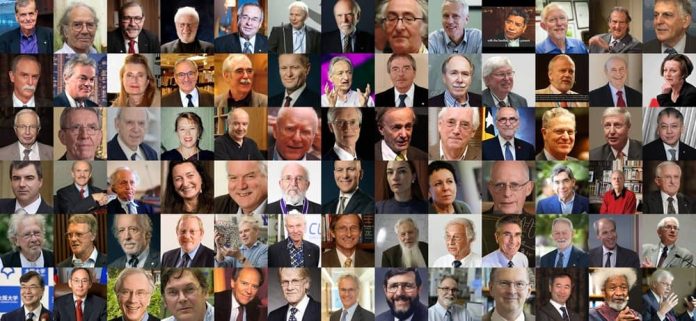
Images of 78 Nobel Laureates who signed the joint statement calling for an end to executions in Iran and expressing support for the NCRI — June 2026
Written by
Amir Taghati
In a powerful show of global solidarity, a coalition of 78 Nobel Laureates has issued a joint statement to United Nations Secretary-General António Guterres, sounding the alarm over “widespread, systematic, and ongoing” human rights violations in Iran.
The laureates, representing fields spanning Peace, Medicine, Physics, Chemistry, Literature, and Economics, are calling for immediate international intervention to halt a devastating new wave of political executions.
A “Devastating” Wave of Repression
According to the joint statement, the ruling theocracy in Iran has intensified its crackdown on dissent following widespread protests in January 2026. Citing reports from the United Nations High Commissioner for Human Rights, the signatories highlight that dozens of political prisoners have already been executed.
Those targeted include demonstrators from the January protests, political activists, and individuals alleged to be affiliated with the opposition group, the People’s Mojahedin Organization of Iran (PMOI/MEK). Furthermore, more than 4,000 individuals have reportedly been arrested on security-related charges, with some internal sources hinting at “several thousand” casualties during the initial suppression of the protests.
The laureates issued a stark warning to the international community regarding the cost of inaction: “International silence serves as a green light for repression; and with every passing day that this silence endures, another noose is tightened around another human life.”
Fifty-seven #Nobel laureates have issued a joint statement backing a democratic transition in Iran and endorsing a political roadmap advanced by the #NCRIAlternative.https://t.co/vBWcoT0Bo5
— NCRI-FAC (@iran_policy) March 22, 2026
Key Demands Issued to the United Nations
The co-signatories have outlined four critical demands to address the escalating crisis:
An absolute freeze on the death penalty, particularly for cases of a political nature.
The immediate release of all political prisoners and detained protesters.
Granting unrestricted access for international monitoring mechanisms to Iranian detention centers and establishing independent oversight of detainee conditions.
Urging democratic governments worldwide to re-evaluate their diplomatic and economic relations with Iran, establishing the abolition of the death penalty as a non-negotiable benchmark.
More than 100 Nobel Laureates Urge @UN Action on Human Rights Crisis in #Iranhttps://t.co/njTk4CwiYJ pic.twitter.com/s7TGjZCFJG
— NCRI-FAC (@iran_policy) September 4, 2025
A Vision for Democratic Transition
Looking forward, the statement explicitly rejects both foreign military intervention and any return to past authoritarian models. The laureates emphasize that Iran’s future must be determined solely by its citizens through free and sovereign will, “without war, without foreign military intervention, and without any return to dictatorship—whether under the guise of monarchy or religious absolutism.”
The coalition threw its weight behind the democratic roadmap proposed by the National Council of Resistance of Iran (NCRI). They noted that the Ten-Point Plan articulated by NCRI President-elect Mrs. Maryam Rajavi offers a “clear and democratic vision” for a peaceful transition toward popular sovereignty via a temporary transitional government.
The release of the statement comes just ahead of June 20, 2026—commemorated as the Day of Martyrs and Political Prisoners. More than 100,000 Iranians and international supporters are expected to gather at a massive rally in Paris to amplify these demands to the global community.
In Joint Letter to World Leaders, 80 Nobel Laureates Support Free and Democratic Iranhttps://t.co/3GcLtf6Kdc
— NCRI-FAC (@iran_policy) July 7, 2024
Global Elite Stand in Solidarity
The 78 signatories hail from over two dozen countries—including the United States, France, Germany, the United Kingdom, Japan, Canada, and Ukraine—and comprise some of the world’s most influential minds. This prominent coalition spans across all major academic and humanitarian disciplines, demonstrating a rare consensus among the world’s scientific and cultural elite.
Among the 78 co-signatories are 22 Chemistry laureates, 21 Physics laureates, 18 Medicine laureates, seven Literature laureates, six Peace laureates, and four Economics laureates.
The roster includes globally recognized figures such as President José Ramos-Horta, the current President of Timor-Leste and 1996 Peace laureate; Professor Geoffrey Hinton, widely recognized as the “godfather of artificial intelligence” and 2024 Physics laureate; and Professor John Mather, the senior project scientist for NASA’s James Webb Space Telescope. Other notable signatories include Peace laureates Oscar Arias of Costa Rica and Oleksandra Matvichuk of Ukraine, alongside acclaimed literary figures such as Sir Kazuo Ishiguro, Wole Soyinka, and Herta Müller. The medical and scientific fields are further represented by pioneering minds like Victor Ambros, Harvey J. Alter, and Sir Peter Ratcliffe.
The sheer scale and diversity of the academic and political weight behind this appeal underscores a growing global consensus: the international community can no longer afford to remain silent on Iran.
On March 15, in a joint letter to the President of the Council of Europe, 24 Nobel Prize winners expressed their support of #IranRevoIution and the 10-point plan of NCRI President-elect @Maryam_Rajavi. pic.twitter.com/W9ERcz8PE1
— NCRI-FAC (@iran_policy) March 19, 2023
Signatories:
President Jose Ramos-Horta, Nobel Prize, Peace 1996, Timor-Leste. President of Timor-Leste Since 2022
Professor Pierre Agostini, Nobel Prize, Physics 2023, France
Professor Harvey J Alter, Nobel Prize, Medicine 2020, USA
Professor Victor Ambros, Nobel Prize, Medicine 2024, USA
Honorable Oscar Arias, Nobel Prize, peace, 1987, President of Costa Rica 2006-2010, Costa Rica
Professor Alain Aspect, Nobel Prize, Physics 2022, France
Professor Robert Aumann, Nobel Prize, Economics 2005, USA-Israel
Professor Barry C Barish, Nobel prize, Physics 2017, USA
Professor Moungi Bawendi, Nobel prize, Chemistry 2023, USA-Tunisia-France
Professor Georg Bednorz, Noble prize, Physics 1987, Germany
Carlos Filipe Ximenes Belo, Nobel Prize, Peace 1996, East Timor
Professor Mario Capecchi, Nobel Prize, Medicine 2007, Italy-USA
Professor Thomas Cech, Nobel Prize, Chemistry 1989, USA
Professor Aaron Ciechanover, Nobel prize, Chemistry 2004, Israel
Professor Steven Chu, Nobel prize, Physics 1997, USA
Professor Elias Corey, Nobel prize, Chemistry 1990, USA
Professor Johann Deisenhofer, Nobel prize, Chemistry 1988, USA
Professor Gerhard Ertl, Nobel prize, Chemistry 2007, Germany
Adolfo Perez Esquivel, Nobel prize, Peace 1980, Argentine
Professor Jerome Friedman, Nobel prize, Physics 1990, USA
Professor Reinhard Genzel, Nobel prize, Physics 2020, Germany
Professor Sheldon Glashow, Nobel prize, Physics 1979, USA
Professor John Lewis Hall, Nobel prize, Physics 2005, USA
Professor Peter Handke, Nobel prize, Literature 2019, Austria
Professor Oliver Hart, Nobel prize, Economics 2016, USA
Professor Alan Heeger, Nobel prize, Chemistry 2000, USA
Professor Richard Henderson, Nobel prize, Chemistry, 2017, UK
Professor Avram Hershko, Nobel prize, Chemistry 2004, Israel-Hungary
Professor Geoffrey Hinton, Nobel prize, Physics 2024, Canada
Professor Jules Hoffmann, Nobel prize, Medicine 2011, France
Professor Bengt Holmstrom, Nobel Prize, Economics 2016, Finland
Professor Gerardus ‘t Hooft, Nobel prize, Physics 1999, the Netherlands
Professor Sir Michael Houghton, Nobel prize, Medicine 2020, UK
Professor Robert Huber, Nobel prize, Chemistry 1988, Germany
Tim Hunt, Nobel Prize, Medicine 2001, UK
Professor Louis Ignarro, Nobel prize, Medicine 1998, USA
Sir Kazuo Ishiguro, Nobel Prize, Literature 2017, UK
Elfriede Jelinek, Noble prize, Literature 2004, Austria
Professor Brian Josephson, Nobel prize, Physics 1973, UK
Professor Takaaki Kajita, Nobel Prize, Physics 2015, Japan
Professor Brian Kobilka, Nobel Prize, Chemistry 2012, USA
Professor Roger D. Kornberg, Nobel prize, Chemistry 2006, USA
Professor Ference Krausz, Nobel prize, Physics 2023, Austria-Hungary
Professor Robert Lefkowitz, Nobel prize, Chemistry 2012, USA
Professor Jean-Marie Lehn, Nobel prize, Chemistry, 1988, France
Professor John Mather, Nobel Prize, Physics 2006, USA
Oleksandra Matvichuk, Nobel prize, Peace 2022, Ukraine
Professor Michel Mayor, Nobel prize, Physics 2019, Switzerland
Professor Craig Mello, Nobel Prize, Medicine 2006, USA
Professor Hartmut Michel, Nobel prize, Chemistry 1988, Germany
Professor Patrick Modiano, Nobel prize, Literature 2014, France
Professor Paul Modrich, Nobel prize, Chemistry 2015, USA
Professor Edvard Moser, Nobel Prize, Medicine 2014, Norway
Professor May-Britt Moser, Nobel Prize, Medicine 2014, Norway
Herta Muller, Nobel Prize, Literature 2009, Germany
Professor Konstantin Novoselov, Nobel prize, Physics 2010, Russia-UK
Professor William Phillips, Nobel prize, Physics 1997, USA
Professor John Polanyi, Nobel Prize, Chemistry 1986, Canada
Professor Sir Peter Ratcliffe, Nobel Prize, Medicine 2019, UK
Professor Charles M. Rice, Nobel prize, Medicine 2020, USA
Professor Sir Richard J. Roberts, Nobel prize, Medicine 1993, UK-USA
Professor Shimon Sakaguchi, Nobel prize, Medicine 2025, Japan
Professor Jean-Pierre Sauvage, Nobel prize, Chemistry 2016, France
Professor Richard Schrock, Nobel prize, Chemistry 2005, USA
Professor Gregg Semenza, Nobel prize, Medicine 2019, USA
Professor Danny Shechtman, Nobel prize, Chemistry 2011, Israel
Professor Vernon Smith, Nobel prize, Economics, 2002, USA
Professor Wole Soyinka, Nobel prize, Literature 1986, Nigeria
Professor Jack Szostak, Nobel prize, Medicine 2009, USA
Professor Joseph H. Taylor, Nobel prize, Physics 1993, US
Professor Olga Tokarczuk, Nobel Prize, Literature 2018, Poland
Professor Sir John Walker, Nobel prize, Chemistry 1998, UK
Professor Arieh Warshel, Nobel prize, Chemistry 2013, USA-Israel
Professor Eric Wieschaus, Nobel prize, Medicine, 1995, USA
Professor Torsten Wiesel, Nobel prize, Medicine 1981, Sweden
Jody Williams, Nobel prize, Peace 1996, USA
Professor Robert Wilson, Nobel prize, Physics 1978, USA
Professor David J. Wineland, Nobel prize, Physics 2012, USA