

Italian Parliament Hosts Conference with Maryam Rajavi to Condemn Executions in Iran, Back NCRI
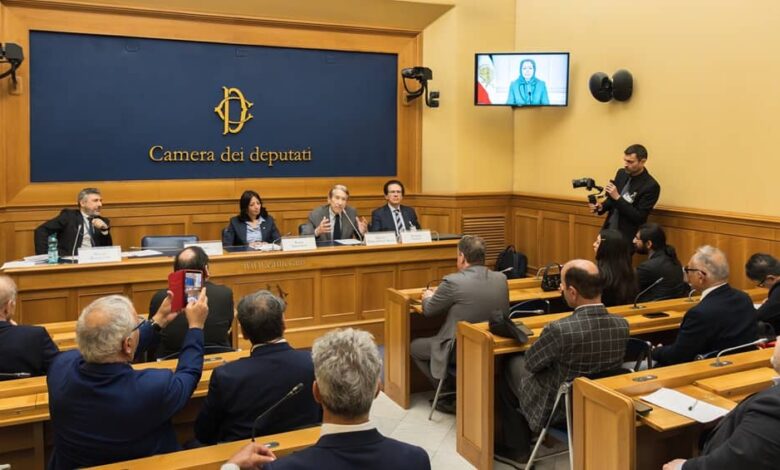
Senator Giulio Terzi speaks at a conference at the Italian parliament on May 21, 2026, with NCRI President-elect Mrs. Maryam Rajavi attending
Written by
Shamsi Saadati
ROME, Italy (May 21, 2026) — At a conference held at the Italian Parliament, prominent lawmakers and human rights defenders united with Mrs. Maryam Rajavi, President-elect of the National Council of Resistance of Iran (NCRI), to strongly condemn the Iranian regime’s surge in political executions and demand an end to Western appeasement. The strategic briefing addressed the structural crisis within the theocracy, emphasizing that the primary conflict is the organized internal war waged by PMOI-led Resistance Units against the ruling dictatorship.
Panelists explicitly endorsed Mrs. Rajavi’s Ten-Point Plan as the definitive blueprint for a democratic, non-nuclear republic, while systematically rejecting both the current religious autocracy and the “pseudo-alternative” of the deposed monarchy. Lawmakers called for the proscription of the Islamic Revolutionary Guard Corps (IRGC) and urged the European Union to officially recognize the right of the Iranian people to resist oppression and achieve a free society.
Opening the session, the event’s moderator established a sobering baseline for the discussion, warning that a dangerous veil of silence and indifference routinely blankets the atrocities committed by the clerical regime. The moderator pointed out that despite brief spikes in media attention during regional street protests or external conflicts, the international community often ignores the reality that “Iran is the country that carries out half of the capital executions in the world, of the whole world”. This systemic internal terror—marked by summary trials, torture, and widespread abuse—remains a continuous, daily apparatus designed to maintain total societal control. To counter this silence, the conference brought together a panel of authoritative speakers to keep the spotlight burning brightly on the regime’s ongoing abuses.
Conference at the Italian Parliament: Support human rights and condemn executions in Iran
The Iranian people are moving toward establishing a society free from all forms of tyranny.#StopExecutionsInIranhttps://t.co/OeYM4c6hnk pic.twitter.com/O6a1sGaQuB— Maryam Rajavi (@Maryam_Rajavi) May 21, 2026
In her keynote address, Mrs. Maryam Rajavi expressed her profound gratitude to the distinguished Senators and Deputies of Italy for their solidarity, stating, “As a nation that has experienced defining and pivotal moments over the past century, you are uniquely positioned to understand the reality of our country today.” She emphasized that the conflict of recent months has obscured the real war, declaring, “the fundamental conflict is between the ruling regime and the Iranian people. This is a battle that began forty-five years ago, and today it persists through the ongoing popular uprisings and the activities of the Resistance Units.”
Mrs. Rajavi exposed the domestic crisis prompting the regime’s brutality, noting that “these daily executions are driven by the regime’s sheer fear of the Iranian people and their uprisings.” She underscored that the path to overthrowing the theocracy relies on “popular uprisings and the organized resistance of the Iranian people, spearheaded by the Resistance Units.” She firmly rejected those who “have manufactured a pseudo-alternative out of the remnants of the monarchical dictatorship,” condemning remnants of the monarchy who staged European marches “waving the banners of the Shah’s torturous secret police, SAVAK.”
Highlighting that the National Council of Resistance of Iran (NCRI) offers a structured alternative, she concluded by urging Western nations to abandon their complacency: “If the European Union is truly serious in its calls for peace, it must simultaneously recognize the right of the Iranian people and their resistance to overthrow this regime and stand firmly by their side.”
Why does the regime conduct daily executions in Iran?
The daily executions are driven by the regime's sheer fear of the Iranian people and their uprisings. Yet, it has utterly failed, and will always fail, to intimidate an outraged public.On the contrary, the defiance of the… pic.twitter.com/THtFR4KoxZ
— Maryam Rajavi (@Maryam_Rajavi) May 21, 2026
The floor was then passed to the event’s primary organizer, MP Naike Gruppioni, who delivered an impassioned critique of Western complacency regarding fundamental human rights. Gruppioni argued that Western democracies possess a dangerous tendency to treat human liberty as an inherent, natural condition rather than a constantly threatened right that must be fiercely defended. She pointed out that true liberty is only fully understood when it is systematically choked, stating, “its importance is truly understood only when it is denied, repressed, and suffocated”.
Highlighting the tragic case of Vahid Bani-American, a young engineer and Resistance Units commander executed after a sham trial, she echoed his final, defiant words to the regime: “Even if you kill us, we multiply”. Gruppioni noted that this exact sentiment underpins the unyielding spirit of the organized resistance. She strongly endorsed Mrs. Rajavi’s Ten-Point Plan, describing it not as mere propaganda, but as “a concrete political project for a future of a free Iran, a democratic, non-nuclear Republic”.
Crucially, Gruppioni clarified that the Iranian public has definitively rejected all forms of totalitarianism, asserting that “the Iranian people have already rejected every form of authoritarianism, they have rejected the religious dictatorship of the ayatollahs, just as they have rejected the return to monarchical models belonging to the past”. Pledging her continued personal participation in the upcoming June 20 pan-Iranian mobilization in Paris, she called on Italy to stand on the right side of history by recognizing the right of citizens to resist oppression.
This morning, I attended the press conference hosted by Hon. Naike Gruppioni at the Chamber of Deputies, titled "Iran: The Right to Life in Danger," which was attended by the Vice President of the Chamber, Hon. Fabio Rampelli, Senator Marco Scurria, and the President of FIDU,… pic.twitter.com/Du6wvwvL7B
— Giulio Terzi (@GiulioTerzi) May 21, 2026
This strategic perspective was strongly reinforced by Senator Giulio Terzi di Sant’Agata, President of the European Affairs Committee and former Minister of Foreign Affairs, who drew upon decades of diplomatic experience to expose what he termed “the great deception” perpetrated by Tehran and facilitated by international complicity. Senator Terzi lambasted international actors who have historically engaged in a policy of appeasement with a regime he described as a “nazi-fundamentalist horror that wanted to have the atomic bomb to dominate more and more, torment its people, but torment humanity”.
He reminded the audience that it was the unyielding intelligence networks of the PMOI that originally exposed Tehran’s clandestine nuclear weapons program to the United Nations. Terzi sharply contrasted the immense sacrifices of the internal heroes of the resistance with the “false alternatives” operating abroad. Specifically referencing the Shah’s son, Reza Pahlavi, Senator Terzi criticized those who “pretend to be wanted by the Iranian people and live in comfortable, luxurious residences”.
He condemned Pahlavi’s explicit willingness to compromise with core elements of the current state-terror apparatus, stating that Pahlavi openly claims “a new Iran can be had because there is support in a solution that also includes a part of a terrorist organization that forms the backbone of the terrorist state of Iran, which are the Islamic Revolutionary Guard Corps, the MOIS, the Basiji, and other criminals of this type”. Senator Terzi asserted that the NCRI remains the only credible alternative capable of establishing a stable democracy based on the Ten-Point Plan.
Iran. Gruppioni (FdI): Difendere libertà e dignità del popolo iraniano, garantendo la pace https://t.co/KB9wSxwZRs via @vocedelpatriota
— 🇮🇹 La Voce del Patriota (@vocedelpatriota) May 21, 2026
Expanding on the systemic security threat posed by the theocracy, Professor Antonio Stango, President of the Italian Federation for Human Rights, offered a strict linguistic and political critique of contemporary diplomacy. Prof. Stango argued that the English term appeasement should not be translated into Italian as pacification, but rather as “condescension—an action of condescension, in that case, with the bloody regime of the ayatollahs”.
He noted that the regime’s internal disregard for human life is mirrored by its flagrant violations of international law, directly correcting superficial political commentators who attempt to position Iran as a victim of regional dynamics. “The regime of the Iranian ayatollahs is an aggressor regime,” Prof. Stango stated unequivocally.
He asserted that major regional atrocities are orchestrated directly by Tehran, noting that “the massacre of October 7, 2023, carried out by Hamas, was directed by the regime of Tehran,” while the attacks by Hezbollah in Lebanon and the Houthi missiles from Yemen are all “coordinated, armed, [and] financed by the regime of the Iranian ayatollahs”. For Prof. Stango, regional stability dictates a policy of “ayatollah regime zero,” as no compromise can ever be brokered with a state that has dealt in systematic execution for nearly five decades.
Iran, Terzi (FdI): regime nazi-fondamentalista prospera https://t.co/X7oQ11t4Sq via @vocedelpatriota
— 🇮🇹 La Voce del Patriota (@vocedelpatriota) May 21, 2026
Though unable to attend in person due to state business in Belgrade, Senator Marco Scurria transmitted an official written statement to the panel, aligning his voice with the call for an uncompromising defense of human dignity. Senator Scurria wrote that the ongoing slaughter of men, women, and children in Iran places a profound moral obligation upon the international community, stating, “One cannot witness in silence the repressions and killings that strike men and women, and even children. It is a reality that challenges the conscience of the international community”.
He maintained that no strategic, geopolitical, or economic interest could ever justify maintaining diplomatic or trade relations with a state actively engaged in the systematic repression of its own citizens, emphasizing that “no political or strategic interest can ever justify the systematic repression of a people”. Echoing the broader panel, Senator Scurria expressed his absolute conviction that the fundamental desire for self-determination cannot be permanently suppressed by autocratic violence, concluding that the preservation of human life must serve as the non-negotiable bedrock of international relations.