
Defying Terror and Death, PMOI Resistance Unit Strikes at the Core of Iran’s Regime
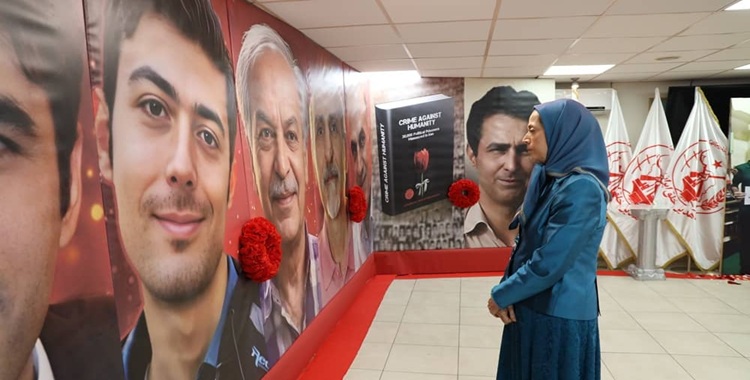
NCRI President-elect Mrs. Maryam Rajavi stands in front of the image of Vahid Bani-Amerian and his fellow PMOI brethren who were executed by the clerical regime in April 2026
Written by
Shahriar Kia
There are moments when a single testimony does more than describe reality—it dismantles it. The final words of Vahid Bani-Amerian constitute such a moment: not merely a personal declaration under sentence of death, but a rupture in a narrative carefully constructed over nearly half a century.
For decades, the ruling system has pursued a deliberate and sustained strategy to dehumanize and demonize the PMOI—deploying state media, educational channels, cultural productions, and political messaging to sever any connection between this organized Resistance and successive generations of Iranians. The objective was clear: to isolate, to stigmatize, and ultimately to erase the movement from the social and moral imagination of the country. Yet what emerges from Vahid’s message is not the intended outcome of that effort, but its unmistakable failure. In place of alienation, there is identification; in place of rejection, there is conscious alignment.
This is precisely why his words carry such weight. They do not simply defy a sentence—they invalidate a strategy. They reveal that, despite decades of systematic distortion, a new generation has not only rediscovered this Resistance but has chosen to embrace it knowingly and at great personal cost. His voice, therefore, extends far beyond the confines of a prison cell. It speaks simultaneously to the authorities, to an increasingly volatile society, and to young people who, rather than inheriting the regime’s narrative, are actively dismantling it.
The Final Defense of Political Prisoner Vahid Bani Amerian
A Message That Signals the Failure of Fear
At its core, the statement reflects a form of courage that authoritarian systems struggle to contain: composure in the face of execution. Where fear is intended to silence, it instead produces clarity. Where repression aims to deter, it inadvertently reveals its own limits.
A system that governs through intimidation depends on the psychological submission of those it seeks to control. Yet when individuals demonstrate that they no longer respond predictably to fear—when execution itself loses its deterrent effect—the very mechanism of control begins to erode. In such moments, even a heavily armed state finds itself strategically weakened, not by external force, but by an internal shift it cannot easily reverse.
What replaces fear in this equation is not chaos, but replication. The idea that courage can multiply—spreading from one individual to many—represents a form of pressure that no conventional instrument of power, whether military or economic, is designed to counter.
🚨 Simay Azadi Exclusive | #Iran Message by PMOI member Vahid Baniamerian (“Commander Vahid”) from exile in Hormozgan Province (southern Iran), recorded in July 2023. Coinciding with Ashura — a Shiite day of mourning for Hussain-ibn-Ali, symbolizing sacrifice and resistance… https://t.co/9BFaFntZd6 pic.twitter.com/a4aO4LbSFR
— SIMAY AZADI TV (@en_simayazadi) April 4, 2026
Continuity of Resistance Across Generations
A central element of the message is its deliberate connection to the past. By invoking those executed in the 1980s, he establishes a continuum rather than an isolated act. The implication is clear: repression has not erased memory; it has preserved and transmitted it.
This continuity reframes history as an active force. The narrative of tens of thousands PMOI members who refused to yield under torture or execution is not presented as distant remembrance, but as a living reference point—one that informs present choices and shapes future ones. In this sense, the past is not closed; it is operational.
Equally significant is the effort to translate that legacy for a new generation. The message functions not only as defiance, but as instruction—an attempt to ensure that the meaning of that earlier resistance is neither diluted nor forgotten.
🚨 #Iran News Alert –
On April 4, 2026, the Iranian regime hanged two PMOI members, Vahid Baniamerian (“Commander Vahid”) and Abolhassan Montazer.
This video shows them alongside four other PMOI members—Babak Alipour, Pouya Ghobadi, Mohammad Taghavi, and Akbar (Shahrokh)… https://t.co/9BFaFntZd6 pic.twitter.com/G6mluFM8lm
— SIMAY AZADI TV (@en_simayazadi) April 4, 2026
Rejecting Legitimacy, Reclaiming Moral Ground
One of the most consequential aspects of the statement is the outright rejection of the judicial process. There is no attempt to negotiate, justify, or seek leniency. Instead, the court itself is dismissed as illegitimate.
This is not simply a political stance; it is a strategic repositioning. By refusing to recognize the authority of the system judging him, he removes himself from its framework entirely. The dynamic shifts: it is no longer the individual seeking justice from the system, but the system being judged against a higher moral standard.
That moral standard is articulated with unusual clarity. A life secured at the cost of conscience is not considered life at all. In this formulation, survival is not the highest value—integrity is. The result is a reversal of power: those who wield coercion appear diminished, while the individual facing execution occupies what can only be described as moral elevation.
Simay Azadi Exclusive | #Iran News Alert
PMOI member Vahid Baniamerian takes an oath as part of the MEK Resistance Units in 2018, vowing to fight the regime until the end—something he ultimately carried out.Baniamerian, 33, was executed on April 4, 2026, in Ghezel Hesar Prison… pic.twitter.com/Idrgr9wSuy
— SIMAY AZADI TV (@en_simayazadi) April 4, 2026
A Message That Outlives Its Messenger
What ultimately emerges from this message is not only a personal stance, but a broader indicator of change. It suggests that the balance between fear and defiance is not static—that under certain conditions, it can shift rapidly and with far-reaching consequences.
The significance, therefore, is not confined to one individual or one event. It lies in what that individual represents: a point at which the mechanisms of control encounter diminishing returns, and where the narratives that sustained them begin to fracture.
Some messages are meant to conclude a story. Others, intentionally or not, begin a new chapter. This is unmistakably the latter. And that is what the tyrannical regime in Iran fears most.