
London Rally Urges UK Recognition of NCRI Provisional Government Amid Calls for Democratic Shift
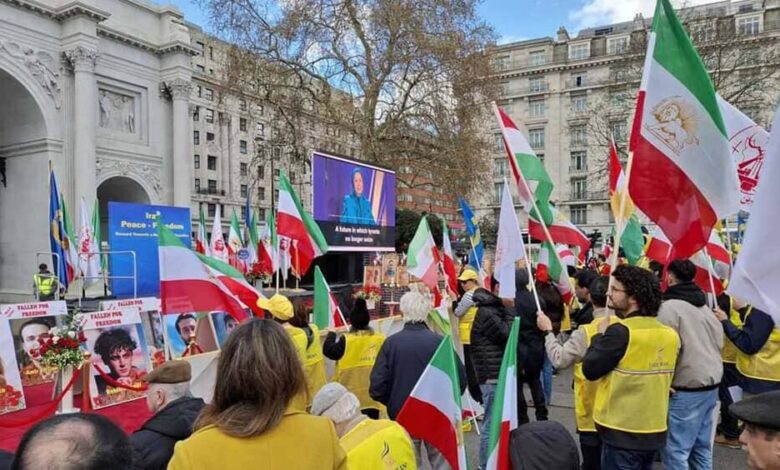
NCRI supporters together with other Iranian opposition groups held a rally in London on March 28, 2026
Written by
Shamsi Saadati
The heart of London became a focal point for the Iranian pro-democracy movement on March 28, 2026, as a massive gathering at Marble Arch called for a fundamental shift in how the West engages with Tehran. Iranian expatriates, joined by British lawmakers and human rights advocates, voiced a powerful endorsement for the National Council of Resistance of Iran (NCRI) as a viable provisional government. The atmosphere was charged with a sense of historical urgency, with participants arguing that the current Iranian regime has lost all internal legitimacy and that a structured transition toward a secular republic is the only path forward.
Speaker after speaker took to the podium to convey a message of resilience and political readiness. Naghmeh Rajabi opened the remarks by describing how the spirit of the Iranian uprising persists despite heavy-handed repression, emphasizing that the “Resistance Units” within the country remain a beacon for those seeking to overthrow the current theocracy.
This sentiment was echoed by Hossein Abedini, the NCRI’s Deputy Representative in the UK, who illustrated a nationwide map of resistance that stretches from the streets of Tehran to the furthest corners of Khuzestan and Kurdistan. He suggested that the sheer persistence of the Iranian people has now brought the regime to a tipping point.
Message to the freedom-loving Iranians demonstrating in London-
Recognize the Provisional Government announced by the National Council of Resistance of Iran
We call on the UK to:
– Recognize the provisional government announced by the National Council of Resistance of Iran;
–… pic.twitter.com/UL7E6G6IzJ— Maryam Rajavi (@Maryam_Rajavi) March 28, 2026
The political weight of the event was bolstered by British figures such as Member of Parliament Bob Blackman, who delivered a sharp critique of the UK’s diplomatic caution. Blackman asserted that international political support must now translate into concrete action, specifically the blacklisting of the Islamic Revolutionary Guard Corps (IRGC) and the closure of regime-linked embassies in London. He was joined in this call for structural change by Robert Ward, a Conservative Councillor, who made it clear that the Iranian people are not interested in trading one form of authoritarianism for another. Ward noted a strong collective rejection of both the current clerical rule and any potential return to monarchy, positioning the NCRI’s democratic vision as the true “third option.”
Legal and academic voices added a layer of institutional credibility to the proceedings. Professor Sarah Chandler, a prominent legal figure, argued that the NCRI’s framework is not merely a protest movement but a credible government-in-waiting that prioritizes the rule of law and human rights. This was further detailed by Dr. Leyla Hannbeck, who spoke of a future Iran defined by gender equality and secular governance. Meanwhile, Dr. Reza Pourabrisham linked the internal change in Iran to broader global security, suggesting that the regime’s destructive regional policies make its removal a prerequisite for lasting international peace.
New video#London — March 28, 2026: Freedom-loving Iranians rally, urging the UK to recognize the NCRI’s provisional government, blacklist the IRGC, shut regime embassies, expel MOIS/IRGC agents. #NCRIAlternative #FreeIran10PointPlan #BlacklistIRGC pic.twitter.com/UX8X1Sww6Q
— Iran Freedom (@4FreedominIran) March 28, 2026
The grassroots nature of the movement was underscored by Laila Jazayeri and Dr. Omid Ebrahimi. Jazayeri offered a blunt reminder that freedom is rarely granted by foreign powers or “backroom deals” but must be seized through the organized struggle of those on the ground. Ebrahimi highlighted the strategic operations of the Resistance Units, arguing that change is being driven by a disciplined internal force rather than spontaneous collapse. Azadeh Hosseini closed the speakers’ session by outlining the core tenets of Mrs. Maryam Rajavi’s Ten-Point Plan, emphasizing its focus on a non-nuclear Iran and the total abolition of the death penalty.
The rhetoric from the London rally signals a significant maturation of the Iranian opposition’s strategy. There is a deliberate move away from the language of “protest” toward the language of “statecraft.” By focusing on the concept of a provisional government, the Iranian Resistance is demonstrating what follows a potential regime change. It is presenting a well-prepared and time-tested democratic structure, complete with a legal roadmap and international endorsements, to argue that the transition would be managed rather than chaotic.
More pics#London — March 28, 2026: Freedom-loving Iranians rally, urging the UK to recognize the NCRI’s provisional government, blacklist the IRGC, shut regime embassies, expel MOIS/IRGC agents. #NCRIAlternative #FreeIran10PointPlan #BlacklistIRGC pic.twitter.com/cfSD89Rgaf
— Iran Freedom (@4FreedominIran) March 28, 2026
The speakers also demonstrated a sophisticated understanding of Western security concerns. By framing the IRGC not just as an internal oppressor but as a global security threat, they are aligning their cause with the strategic interests of the global community. Ultimately, the rally suggests that the Iranian Resistance is no longer just asking for solidarity; it is demanding formal recognition as a legitimate political alternative on the world stage.