
Amb. Carla Sands: Iran’s Future Lies in Democratic Change, Not Appeasement or War
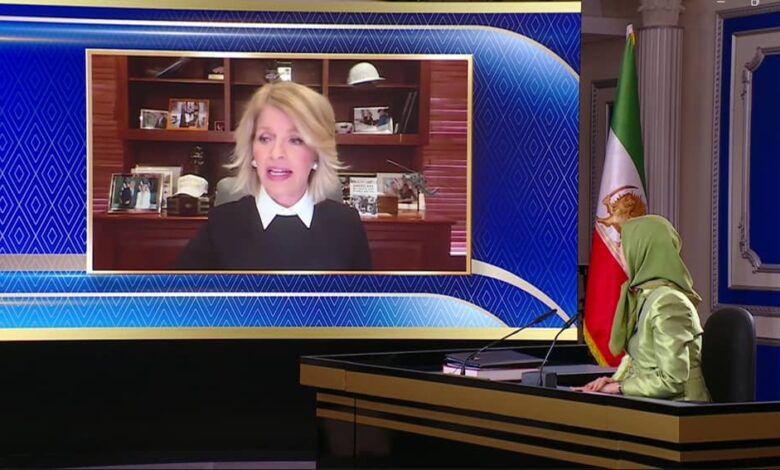
Carla Sands, former US Ambassador to Denmark, addresses an online conference held by the NCRI on March 15, 2026
Written by
Amir Taghati
At an online conference held by the National Council of Resistance of Iran (NCRI) on March 15, 2026, former U.S. Ambassador to Denmark Carla Sands argued that Iran has reached a historic turning point and that the international community must abandon two failed approaches: appeasement of the ruling regime and foreign-led war. She said that decades of concessions and dialogue did not moderate Tehran’s conduct, curb domestic repression, or stop the export of terrorism and instability. She also contended that military confrontation cannot produce legitimacy or a democratic alternative, even if it weakens the regime.
Amb. Sands framed Mrs. Maryam Rajavi’s “third option” as the only durable path forward: democratic change led by the Iranian people and their organized resistance. She said the regime cannot reform itself because repression at home and crisis abroad are central to its survival. In her account, Iran is already facing deep internal strain, marked by economic decline, social unrest, and a growing loss of legitimacy, while millions of Iranians increasingly demand freedom, justice, and democratic change.
She concluded by urging democratic governments to reassess their policies, engage with the National Council of Resistance of Iran, and support the Iranian people’s right to determine their own future. The solution, she insisted, is neither appeasement nor war, but democratic change from within.
The full text of Amb. Carla Sands’ speech follows:
Ambassador Carla Sands: True change in Iran must come from within— March 15, 2026.
Thank you for your welcome. Thank you to Madam Rajavi for your comments. And ladies and gentlemen, Iran today stands at a historic crossroads. For more than four decades, the international community has struggled to find an effective response to the crisis created by the ruling regime in Tehran.
Experience has now shown clearly that neither appeasement nor war can bring about the ultimate solution. The only lasting solution is democratic regime change in Iran. For years, many governments have pursued a policy of appeasement, and they’ve hoped that concessions and dialogue would moderate the regime’s behavior. But that policy has failed.
It did not curb repression inside Iran, and nor did it stop the export of terrorism and instability across the region and throughout the world. At the same time, military confrontation has also proven incapable of producing a real and sustainable political solution. War may weaken the regime, but it cannot create legitimacy or establish a democratic alternative.
More than two decades ago, Madam Rajavi warned the world about this dangerous illusion. In 2004, speaking to the European Parliament, she invoked Winston Churchill’s famous warning after the Munich Agreement, when he said: ‘You were given the choice between war and dishonor. You chose dishonor, and you will have war.’ Her message was clear: appeasement will only embolden the clerical regime and ultimately make the conflict inevitable.
Mrs. Rajavi has consistently offered what she calls the third option: neither appeasement nor war, but democratic change by the Iranian people and their organized resistance. She’s repeated this message time and again, including on May 2025, when she stressed that foreign war cannot solve the Iranian crisis, and that the real solution lies in the Iranian people themselves rising up to bring about change.
I support @Maryam_Rajavi and The Ten Point Plan for Democracy in Iran. https://t.co/u44aB3eyXw
— Carla Sands (@CarlaHSands) March 16, 2026
Iran today stands at a decisive moment. The regime cannot reform itself. Its survival depends on repression at home and the export of crisis abroad. And these policies are not temporary tactics; they’re central to the regime’s survival. As long as this system remains in power, the Iranian people will continue to face oppression and the regime will remain vulnerable to instability.
At the same time, experience shows that regime change cannot be imposed from outside. No country is prepared to deploy forces on the ground to determine Iran’s future. And even if such an attempt were made, it would likely lead to chaos and civil conflict. Lasting political change must come from within the Iranian society and be driven by the will of the people.
Inside Iran today, the regime faces a deep and growing crisis. Economic decline, social unrest, and the loss of legitimacy have weakened the foundations of the ruling system. The gap between the regime and the Iranian people has never been wider. Across the country, millions of Iranians are demanding freedom, justice and democratic change.
History shows that authoritarian regimes, however powerful their security forces may appear, cannot ultimately withstand the determination of their people. Iran itself offers a powerful example. In 1978, the Shah dictatorship commanded one of the largest armies in the Middle East. Yet when the Iranian people rose up, that army could not prevent the collapse of the regime.
A free Iran starts with women in leadership!
https://t.co/5SrsmWAH3W— Carla Sands (@CarlaHSands) March 4, 2026
For this reason, the international community must reassess its policies. For too long, the democratic opposition to the clerical regime was marginalized as a result of the misinformation and that policy of appeasement. Yet an organized resistance exists that seeks to mobilize the Iranian people for democratic change.
This movement does not seek foreign troops, weapons or military intervention. What it seeks is political recognition and an end to the misconceptions that surround have surrounded it for decades. Today, therefore, it’s time to open a new chapter. Democratic governments should begin dialogue with the National Council of Resistance of Iran and consider political recognition of the provisional government that it has announced.
Such engagement would send a powerful message to the Iranian people that the world supports their right to self-determination, the right to determine their future. The path forward is clear: the solution to the Iranian crisis is neither appeasement nor war. The solution lies in democratic change led by the Iranian people and their organized resistance. And it’s time for the world to stand with them.
Thank you.